 EN
EN TR
TR DE
DE FR
FR ES
ES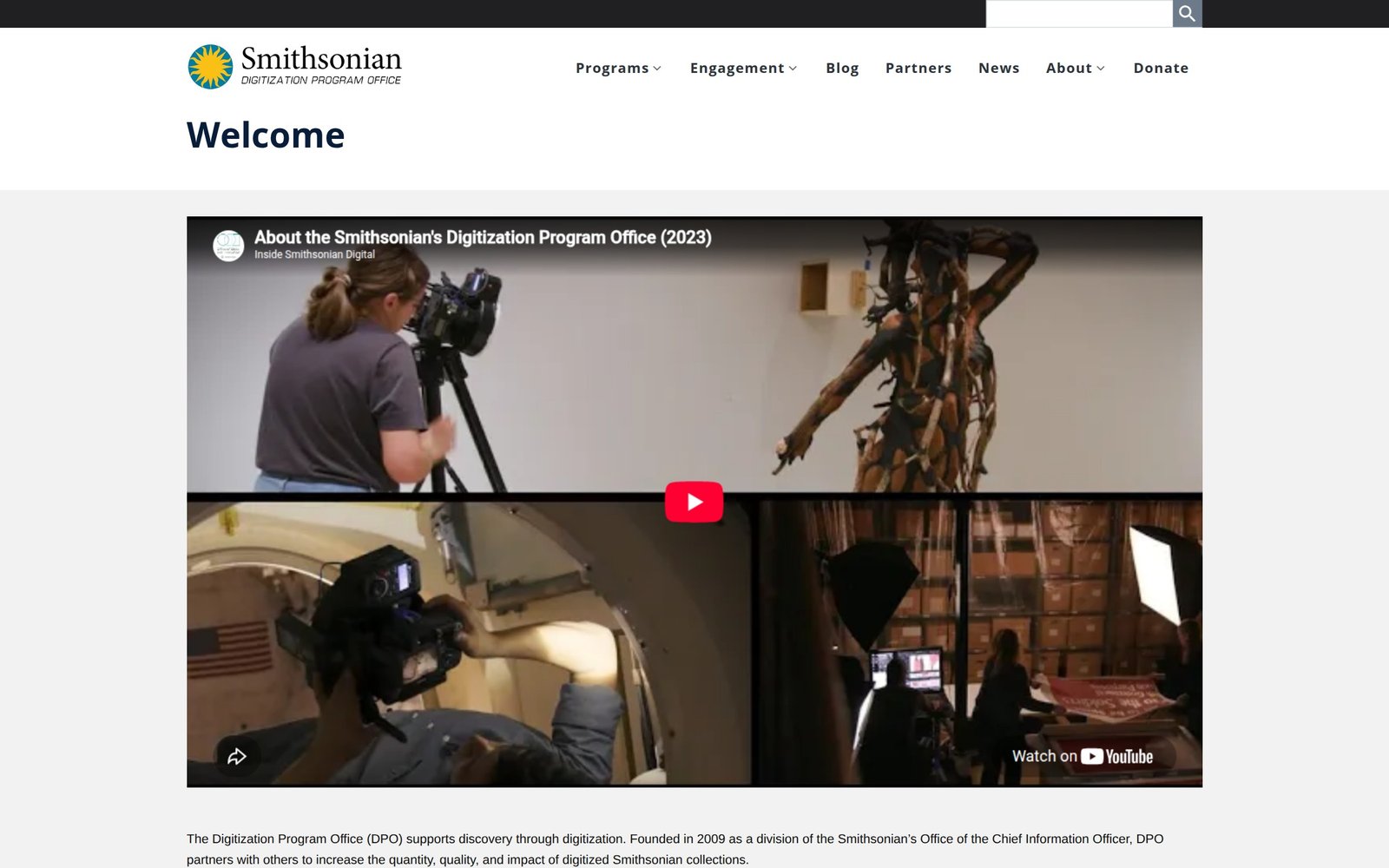
Being able to hold and examine priceless historical artifacts and millions of years old fossils protected behind glass cases of museums in 360 degrees was a privilege reserved only for senior archaeologists and museum curators before digitalization.Smithsonian Institution, the world’s largest museum and research complex, founded in 1846 Smithsonian 3D Digitizationprogram has completely eliminated these obstacles.[1][2].High resolution scans shared under Open Access and CC0 (Public Domain) licenses;From the Apollo 11 command module to mammoth skeletons, from historical masks to ancient statues, it brings the common heritage of humanity to everyone’s screen and 3D printer.[1][3].
⚡ Smithsonian 3D Digitization at a Glance
Scientific Survey Precision and the Smithsonian Voyager Experience
Experts at the Smithsonian DPO (Digitization Program Office) use industrial scanners with micron-level precision and advanced computed tomography (CT) systems when digitizing objects[2][4].The digital assets that result from this rigorous process are presented in two basic formats:
- In-Browser Voyager Viewer:Allows users to rotate objects, change lighting angles, take slices, and read interactive footnotes added by curators without installing any external software[1][5].
- Directly Downloadable 3D Printing and Rendering Files:Educators and modelers are offered OBJ/GLB packages containing cleaned manifold STL files and high-resolution texture maps for photorealistic visualization[1][3].

Creative Commons Zero (CC0) and the Open Access Revolution
Starting from 2020, the Smithsonian has registered the majority of its digital collections as CC0 (Public Domain)[1][3].The rights and freedom of use brought by this license policy are as follows:
| Area of Use | Permission and Copyright Status | Application Examples |
|---|---|---|
| Commercial Product and Game Development | 100% Free (No Copyright)[1][3] | Historical models can be added to commercial video games or cinema scenes |
| 3D Printing and Physical Replica | Free (Free for sale and exhibition) | Fossils or busts can be printed and sold in schools or stores |
| Academic Research and Education | Unlimited Open Access | Use as a reference in theses, virtual museum tours and course materials |
Smithsonian 3D Highlights and Limits
✅ Key Benefits
- CC0 public domain access to the world’s most trusted museum and historical collections.
- Millimeter scanning accuracy on real archaeological artifacts and fossils.
- In-depth interactive educational experience in the browser with Smithsonian Voyager.
- No copyright restrictions, including commercial projects.
- Optimized STL files that can be printed directly with 3D printers.
⚠️ Things to Consider
- The catalog is limited to the museum collection;does not contain contemporary industrial or fictional entities.
- High polygon raw scans may require decimation for real-time game engines.
- Scanning the entire museum inventory is an ongoing long-term process.
Conclusion and Evaluation
Smithsonian 3D Digitization is the world’s preeminent example of how digitalization can democratize cultural heritage[1][2].For every 3D artist and researcher working in the fields of history, science and paleontology, the CC0 open archive offered by the institution is an invaluable resource in terms of both academic credibility and artistic production.[1][3].
Verified Sources and References:
- Smithsonian 3D Digitization Official Portal – Open Access 3D Artifacts [3d.si.edu]
- Smithsonian Digitization Program Office (DPO) – Methodology & Technologies [dpo.si.edu]
- Smithsonian Open Access Initiative – CC0 Public Domain Terms & Scope [si.edu]
- All3DP – Top Smithsonian 3D Models to 3D Print & Artifact Guide [all3dp.com]
- Smithsonian Voyager Open Source Repository – 3D Storytelling Engine [github.com]