



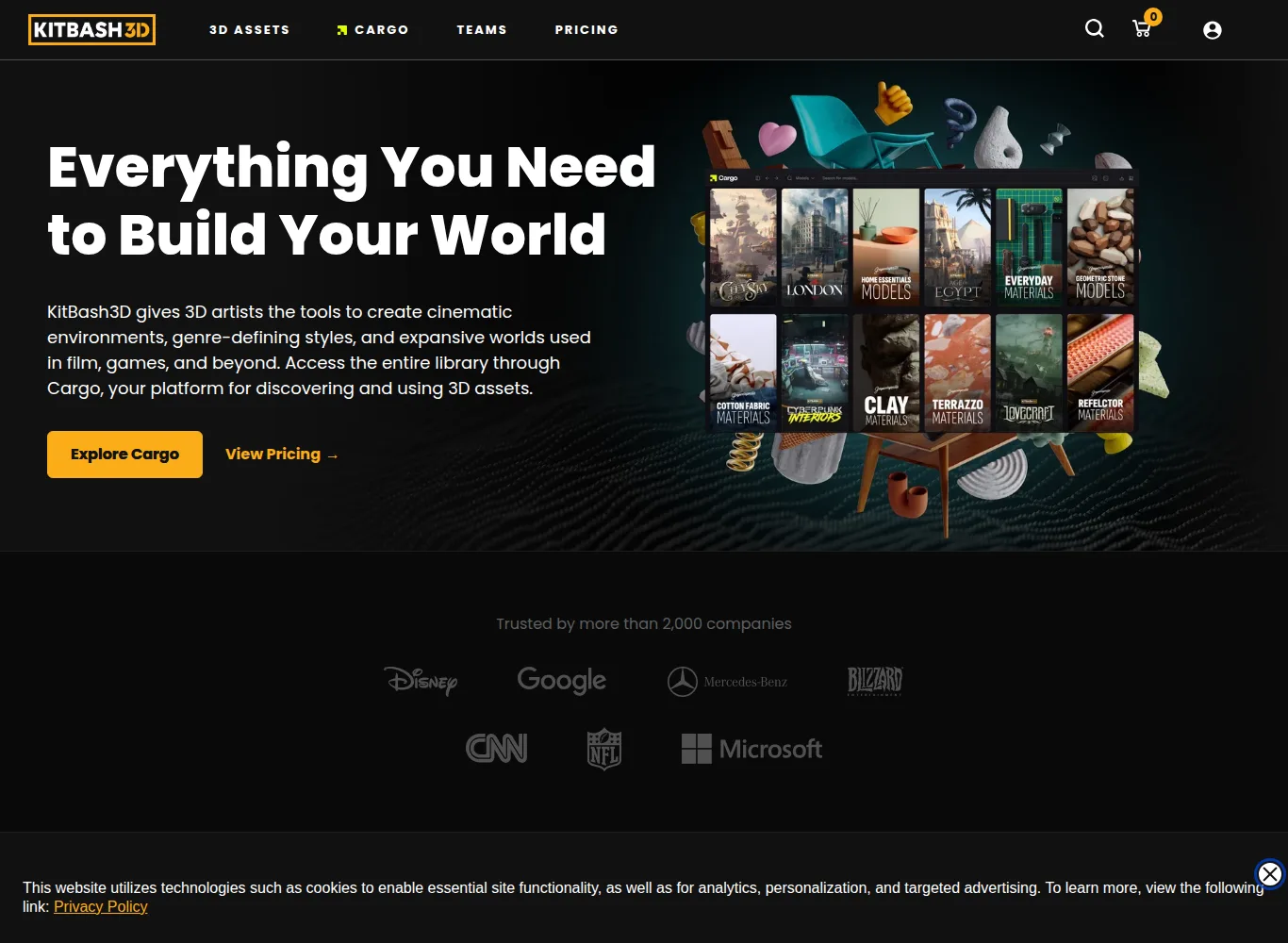
KitBash3D is the industry’s premier digital asset studio dedicated to building cinema-grade, modular 3D environment kits for major Hollywood motion pictures, AAA video games, and virtual productions [1][2]. Relied upon by visual effects departments at Marvel Studios, Warner Bros., HBO, Disney, and Ubisoft, KitBash3D eliminates months of manual set construction through its proprietary Cargo software—a Pixar USD-powered asset delivery engine that imports textured 3D models into major DCC packages with a single click [2][3].
⚡ KitBash3D Data at a Glance
Founding Vision: Eliminating Repetitive Labor in Studio Production
KitBash3D was established in 2017 in Los Angeles by film art director Maxx Burman and creative entrepreneur Banks Boutté [2][4]. Burman had accumulated a distinguished career supervising matte painting and concept art on productions including Iron Man 3, Godzilla, Game of Thrones, Westworld, and Titanfall [4][5].
The founding catalyst was a persistent structural inefficiency in visual effects: major studios repeatedly modeled skyscrapers, ancient temples, streetlamps, and modular walls from scratch for each independent production [2][6]. Up to 30% to 50% of early art department budgets were consumed modeling generic architectural assets that were subsequently mothballed in studio archives [2].
KitBash3D institutionalized the practice of physical “kitbashing”—combining standardized modular elements into complex scenes—into digital libraries calibrated for production [5]. From futuristic cyberpunk megacities to neoclassical Roman temples, each kit provides hundreds of architectural structures, connecting walkways, signage, and micro-props that snap together on a unified grid [1][5].

Cargo Ecosystem: 1-Click Pipeline via Pixar Universal Scene Description
Historically, 3D environment libraries required downloading 20GB to 40GB compressed archives, followed by manual FBX extraction and node reconnecting in DCC viewports [2]. In 2023, KitBash3D released Cargo, a standalone desktop asset manager that eliminates manual file handling [3][6]:
- Pixar Universal Scene Description (USD): Cargo utilizes Pixar’s open USD standard, transmitting complex hierarchies, UVs, and PBR shader parameters losslessly between disparate engines [3].
- 1-Click Direct Ingestion: Clicking an asset inside Cargo delivers the model directly into an active Unreal Engine, Blender, Maya, or Houdini scene with pre-assigned material nodes [1][3].
- Granular Asset Streaming: Rather than downloading entire 30GB kits, artists can stream individual buildings, vehicles, or streetlights on demand within seconds [3][6].
3D Environment & Modular Scene Libraries Benchmark Matrix
To evaluate how KitBash3D positions against scan libraries and generic model marketplaces, review this technical comparison [1][3][5]:
| Platform | Asset Architecture | Delivery Technology | Topology & Bevels | Metric Grid Modularity | Licensing Tiers |
|---|---|---|---|---|---|
| KitBash3D | Hollywood-grade modular architectural kits [1] | Cargo (Pixar USD 1-click import) [3] | Clean Sub-D quads with beveled edges [1] | Yes (Standard snap-together metric units) [2] | Individual / Small Studio / Enterprise [7] |
| Quixel Megascans | Photogrammetry scans of real-world surfaces & rocks | Quixel Bridge plugin | Decimated triangle scan geometry | No (Organic standalone elements) | Integrated into Epic Fab licensing |
| Unreal Engine Fab | Aggregated marketplace (Modular, characters, props) | Fab web portal & UE content browser | Varies by individual merchant author | Varies by author asset pack | Standard commercial / Personal |
| TurboSquid | Individual isolated commercial 3D assets | Manual archive ZIP download | CheckMate Pro verified quad topology | No (Standalone bespoke models) | Royalty-free with indemnity warranty |
| Sketchfab | Bespoke artistic assets & WebGL models | glTF / USDZ direct web download | Varies by model author | No | Creative Commons & Standard Editorial |
Technical Diagnostic & Workflow Troubleshooting Guide
When managing massive KitBash3D cityscapes in Unreal Engine, Blender, or Maya, deploy these performance and pipeline solutions [1][3][6]:
| Issue & Symptom | Underlying Technical Cause | Standard Technical Solution |
|---|---|---|
| Severe viewport stutter and high draw calls in dense urban scenes | Every building part placed as a unique Static Mesh Actor without GPU instancing [1]. | Convert repeated architectural modules into Hierarchical Instanced Static Meshes (HISM) in UE5 or use Geometry Nodes / Collections in Blender. |
| Nanite mesh faceting on beveled building cornices | Hard edge normal splits misinterpreted during Nanite fallback mesh generation [3]. | Enable “Preserve Area” and adjust “Fallback Relative Error” to 0 in Unreal Engine Static Mesh settings to retain chamfer silhouettes. |
| Missing PBR textures when transferring scenes across studio workstations | Cargo caches texture files in a local user profile directory with absolute file paths [3][6]. | Set a shared network drive in Cargo settings or execute a relative path texture repacking script inside Blender/Maya prior to scene handoff. |
| Modular wall and doorway modules failing to snap flush | Viewport grid snap setting differs from KitBash3D standard metric dimensions [1][2]. | Set viewport snapping to decimal increments (10cm, 50cm, or 100cm) and align pivot points to vertex corners using vertex-snapping hotkeys. |
Pros & Cons Summary
✅ Strengths
- Hollywood Studio Caliber: Assets engineered for close-up hero shots with beveled Sub-D quad topology [1][5].
- Cargo 1-Click Delivery: Seamless Pixar USD ingestion into Unreal Engine, Blender, Maya, and 3ds Max [3].
- Modular Metric Consistency: Wall segments, roofs, and architectural trims snap together flawlessly [2].
- Complete Environment Coverage: Monumental hero structures paired with comprehensive micro-prop collections [1].
⚠️ Considerations
- Premium Price Point: Individual kits cost $199, requiring studio budgets or active Cargo Pro subscriptions [7].
- Hardware Demands: High-density textures and complex polygon counts necessitate high-VRAM GPUs [1].
- Revenue Threshold Limits: Studios earning over $100K must upgrade to Small Studio or Enterprise licenses [7][8].
Frequently Asked Questions (FAQ)
What is KitBash3D Cargo?
Cargo is a desktop asset manager developed by KitBash3D. Built on Pixar USD, it enables artists to browse over 10,000 environment assets and import them directly into software like Unreal Engine, Blender, Maya, or 3ds Max with a single click [3].
Can I use KitBash3D assets in commercial video games?
Yes, commercial use is permitted across all license tiers. However, assets must be baked into compiled game binaries; redistributing raw 3D meshes or textures is prohibited [8].
Are KitBash3D kits compatible with Unreal Engine 5 Nanite?
Yes, KitBash3D models feature clean quad topology and beveled edges that convert smoothly into UE5 Nanite geometry, allowing entire cityscapes to render in real time with high visual fidelity [3].
What are the revenue thresholds for Individual vs Enterprise licenses?
The Individual License applies to freelancers and independent artists earning under $100,000 annually. Studios earning between $100,000 and $1,000,000 require the Small Studio License, while organizations exceeding $1,000,000 require an Enterprise agreement [7][8].
Explore Related 3D Platforms
Compare KitBash3D with other production asset libraries in our verified directory:
- TurboSquid 3D Models Review
- CGTrader 3D Marketplace Review
- Sketchfab Real-Time 3D Review
- Unity Asset Store Review
- Browse the full index: Ultimate List of 50+ 3D Model Sites
References & Technical Sources
- KitBash3D Official Platform & 3D Kit Catalog – Environment kit catalog and specs. [1]
- KitBash3D Founding Story & Hollywood Production Standards – Background history and client portfolio. [2]
- Cargo 3D Asset Manager & Pixar USD Integration – Technical documentation on 1-click import. [3]
- Maxx Burman Art Direction Portfolio – Industry credentials and matte painting credits. [4]
- Animation World Network: KitBash3D Cinematic World Building – Hollywood VFX workflow analysis. [5]
- Chaos Group Review: KitBash3D and Cargo Workflow Analysis – DCC integration benchmark. [6]
- KitBash3D Pricing Tiers & Subscription Models – Pricing schedule and tier qualifications. [7]
- KitBash3D Commercial License Agreement – Legal compliance and studio turnover conditions. [8]
More platforms like this one are compared in our list of 3D model sites.