




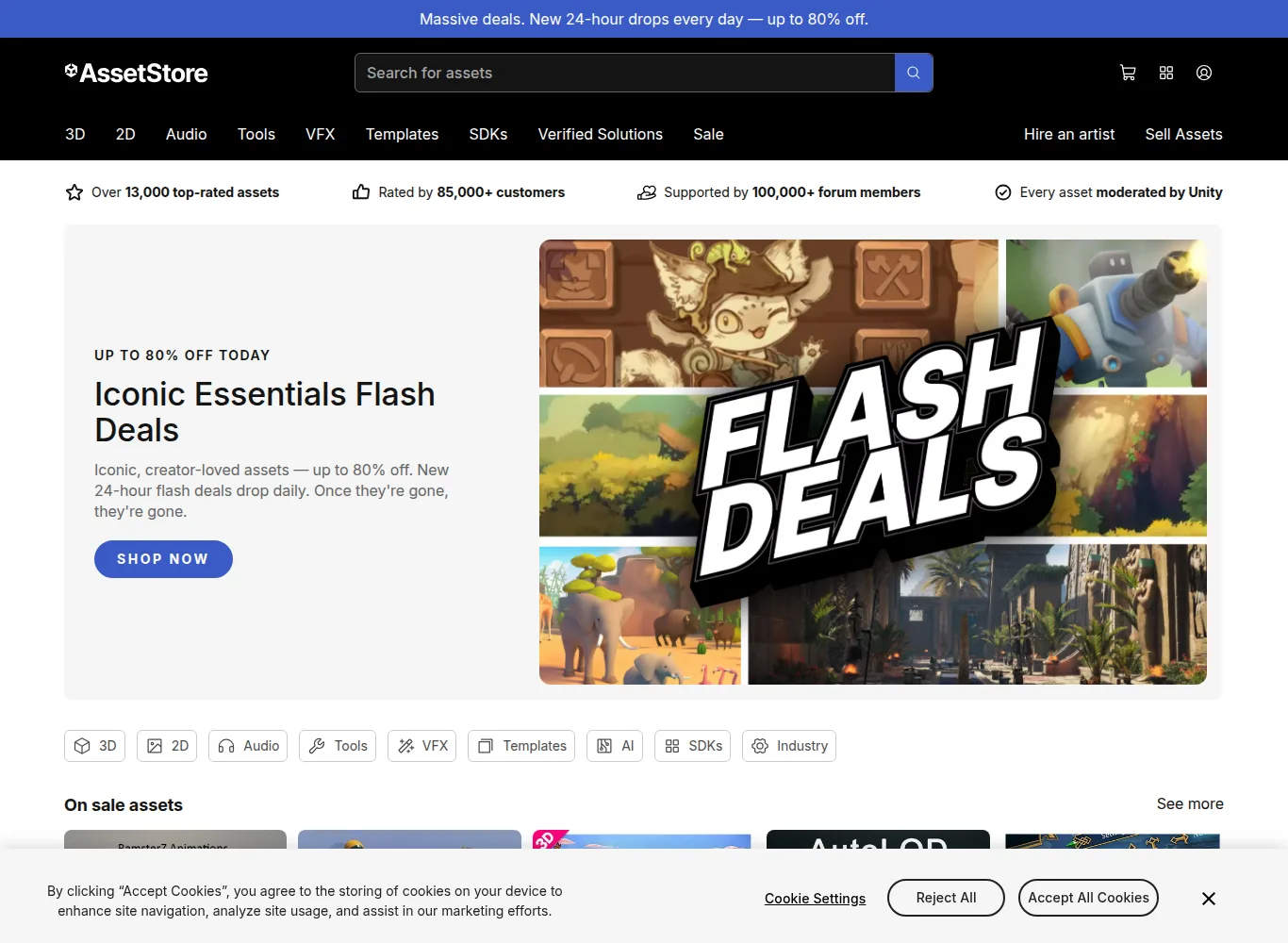
The Unity Asset Store is the built-in marketplace for Unity projects, carrying models, environment packs, shaders and C# tools that install through the Package Manager.
The Unity Asset Store is the flagship digital marketplace for real-time game developers, interactive simulation studios, and indie technical artists operating within the Unity engine ecosystem. Hosting an extensive catalog of over 70,000 game-ready 3D modular environments, rigged animated characters, specialized C# editor scripting tools, post-processing shaders, and audio libraries, it remains an indispensable foundation for rapid video game development. Unlike generic 3D model repositories that supply isolated polygon meshes, the Asset Store delivers complete, turnkey software packages via the Unity Package Manager (UPM) featuring pre-configured colliders, materials, and prefab hierarchies.
⚡ Platform Technical Standards at a Glance
Unity Package Manager (UPM) & Turnkey Prefab Architecture
While standard 3D asset portals provide detached polygon meshes (OBJ, FBX) that demand manual shader reconstruction and physics setup, the Unity Asset Store delivers integrated software assemblies. Importing an asset pack incorporates key engine-native frameworks:
- Nested Prefabs and Prefab Variants: Modular architecture, environmental props, and vehicles arrive with assigned PBR materials, collision meshes, and scene lighting configurations, allowing developers to extend variants without altering source components.
- Pre-Configured LOD Groups: Professional grade assets incorporate multi-tiered mesh hierarchies (LOD0 through LOD3) that dynamically transition based on screen percentage, preserving frame budgets on mobile and VR hardware.
- Optimized Physics Colliders: Meshes feature compound primitive colliders (Box, Capsule, Sphere) or convex mesh colliders constrained strictly under the PhysX 255-triangle boundary.
- Mecanim Humanoid Rig Standards: Bipedal character models arrive mapped to the universal Mecanim Avatar template, enabling instantaneous playback of standard animations from Mixamo or engine libraries.
Scriptable Render Pipeline Compatibility: URP vs. HDRP vs. Built-in
Modern Unity versions rely upon Scriptable Render Pipeline (SRP) architecture. Selecting assets requires validating pipeline compatibility to prevent shader initialization failures:
Universal Render Pipeline (URP)
Engineered for high framerate performance across mobile devices, Nintendo Switch, standalone XR headsets (Meta Quest 3), and mainstream PCs. Utilizes Single-Pass Forward and Forward+ clustered lighting with full SRP Batcher optimization.
High Definition Render Pipeline (HDRP)
Targeted at high-end PC, PlayStation 5, and Xbox Series X platforms. Implements physically based photometric lighting units (Lumen/Lux), volumetric cloudscapes, Screen Space Reflections (SSR), and hardware-accelerated Ray Tracing (DXR).
Game Engine Asset Ecosystems Comparison Matrix
The technical parameters of the Unity Asset Store relative to alternative engine-centric and DCC marketplaces are benchmarked below:
| Technical Parameter | Unity Asset Store | Fab (Epic Games / Unreal) | Godot Asset Library | Blender Market |
|---|---|---|---|---|
| Primary Ecosystem | Unity Editor (2021/2022 LTS, Unity 6) | Unreal Engine 5 / UEFN / Verse | Godot Engine 4.x / 3.x | Blender 3.x / 4.x |
| Distribution Format | .unitypackage & UPM Registry | .uasset / Fab Integrated Client | Native AssetLib tab or .zip archive | .zip addon package & .blend file |
| Publisher Revenue Split | 70% Publisher / 30% Platform Fee | 88% Publisher / 12% Epic Games | 100% Free / Donation-Based | 70% to 90% (Author Selected) |
| Scripting & Logic Stack | C# MonoBehaviour, Prefabs, Shaders | Blueprints, C++, Material Functions | GDScript, C#, GDExtension plugins | Python Add-on API, Geometry Nodes |
| Commercial License | Single Entity Royalty-Free | Fab Standard License | MIT / GPL v3 / CC0 Open Licenses | GPL v2/v3 & Royalty-Free Art |
Publisher Payout Economics, Tax Documentation & Thresholds
Developers distributing assets or programming tools via the Asset Store operate under clear legal and financial terms:
| Financial Metric | Standard Terms | Technical & Legal Specifications |
|---|---|---|
| Revenue Distribution | 70% Publisher / 30% Unity | Calculated from gross sales minus applicable sales taxes, VAT, and customer refunds. |
| Minimum Payout Floor | PayPal: $100 | Wire Transfer: $250 | Earnings below threshold roll forward to subsequent billing cycles without expiration. |
| Tax & Withholding | US IRS Form W-8BEN / W-9 | Non-US publishers are subject to 0% to 30% withholding based on bilateral tax treaties. |
| Remittance Schedule | Monthly Net-30 / Net-60 Cadence | Disbursements are issued by the final business day of the month following account reconciliation. |
Technical Troubleshooting & Optimization Guide
🛠️ Standard Integration Diagnostics
- Pink / Magenta Material Artifacts (Unresolved Shader Bindings): Occurs when importing assets compiled with Built-in Standard shaders into a URP project. Resolution: Navigate to Window > Rendering > Render Pipeline Converter, configure the converter to Built-in to URP, select Material Upgrade, and execute asset conversion.
-
Excessive Draw Calls & SRP Batcher Incompatibility: Custom HLSL shaders lacking
UnityPerMaterialconstant buffer definitions will break SRP Batcher integration, generating separate draw calls per instance. Ensure all uniform material properties are enclosed within a singleCBUFFER_START(UnityPerMaterial)structure. - Mecanim Character Rig Alignment Errors: If a imported mesh displays skewed deformation in gameplay, open the model’s Inspector > Rig tab, set Animation Type to Humanoid, and enter Configure mode to confirm bone mapping across Hips, Spine, and extremity nodes.
Strengths & Production Considerations
✅ Strengths
- Direct 1-click Package Manager integration directly inside the Unity Editor environment.
- Fully assembled prefabs with colliders, PBR materials, LOD levels, and Mecanim avatars.
- Unrivaled collection of C# visual scripting tools and editor extensions (Odin Inspector, Rewired, A* Pathfinding).
- Verified customer reviews, transparent release change-logs, and active publisher support channels.
⚠️ Considerations
- Asset assemblies are native to Unity; porting geometry to Unreal or Godot requires extracting raw FBX files.
- Pipeline fragmentation (URP vs. HDRP) necessitates verifying shader compatibility before acquisition.
- Commercial differentiation requires custom texture passes and architectural modifications to avoid uniform aesthetic styles.
Frequently Asked Questions
Can Unity Asset Store 3D assets be utilized in Unreal Engine or Godot?
Yes. Once the .unitypackage archive is unpacked inside a local Unity project directory, underlying raw FBX models and texture assets can be migrated. However, C# scripts, custom Shader Graphs, and prefab data structures operate solely within the Unity runtime.
Does the Single Entity License authorize commercial video game publication?
Yes. The purchasing individual or organization receives perpetual, royalty-free commercial rights to distribute compiled game binaries across Steam, PlayStation, Xbox, iOS, and Android. Raw asset distribution or open-source repository sharing remains strictly prohibited.
What occurs to acquired assets when upgrading to a newer Unity LTS version?
All acquired assets remain perpetually bound to the user’s Unity ID. When publishers update packages to maintain compatibility with new LTS releases (such as Unity 2022 LTS or Unity 6), these version iterations are accessible at no extra charge.
Verified References & Standards
[1] Unity Asset Store Provider Agreement & Terms of Service: Official contractual terms defining 70% publisher royalty distribution and Single Entity commercial usage provisions (See: assetstore.unity.com/legal/provider-agreement).
[2] Unity Manual – Scriptable Render Pipeline & SRP Batcher Architecture: Technical specifications covering CBUFFER memory layout and URP/HDRP converter workflows.
[3] Unity Asset Store Submission Guidelines: Architectural validation criteria for multi-tier LOD meshes, PhysX colliders, and Mecanim humanoid bone hierarchies.
More platforms like this one are compared in our list of 3D model sites.