




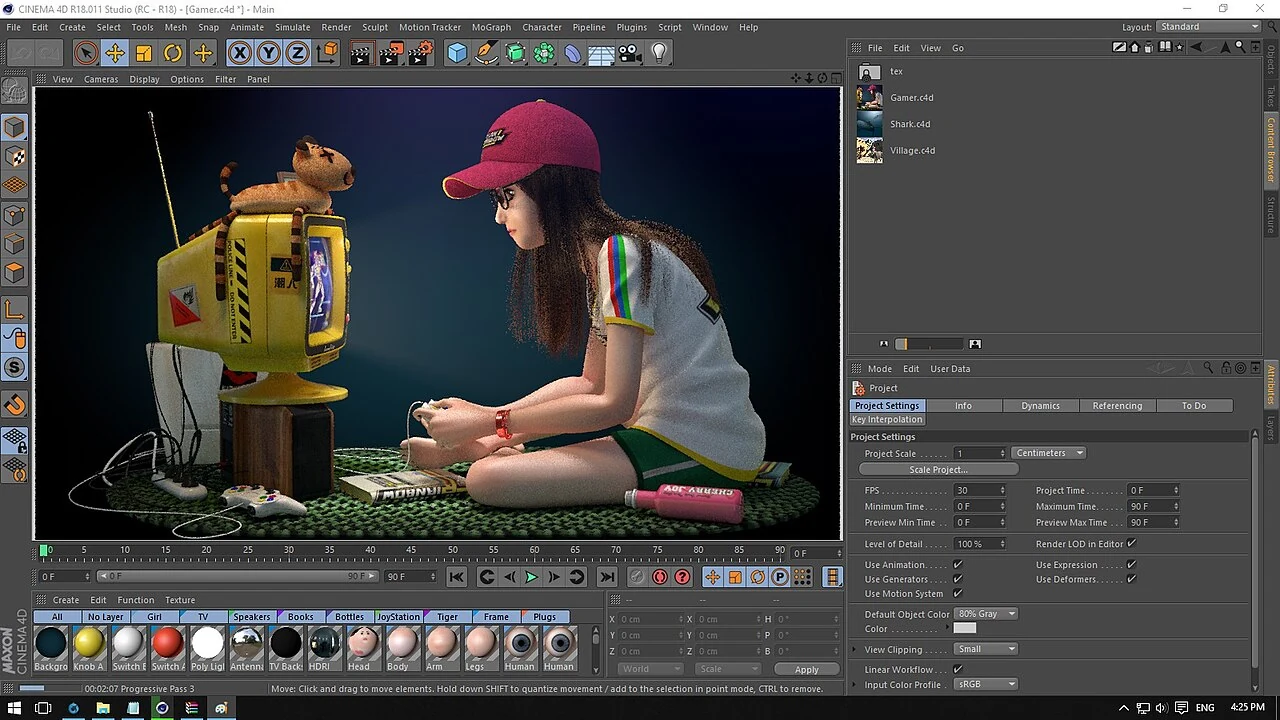
1990, Germany. Working inside Maxon—a young company founded for the Commodore Amiga—brothers Christian and Philip Losch entered a programming contest held by Kickstart magazine with a ray tracer they had written themselves, and won [2]. Released commercially in 1991 as FastRay, that engine evolved by December 1993 into the very first edition of Cinema 4D for the Amiga [2]. More than three decades later, Cinema 4D 2027.0—released on October 14, 2026—is no longer just a fast 3D companion for television broadcast packages. It is a unified studio suite featuring native Scatter environment distribution, Liquid FX with automatic secondary splash details, and an MCP server letting AI assistants drive Scene Nodes graphs directly [1].
Cinema 4D at a Glance
| Current version | Cinema 4D 2027.0, released October 14, 2026 [1][2] |
| Developer | Maxon (founded in Germany in 1986; part of the Nemetschek Group) [2] |
| Pricing | $109/month or $839/year; also bundled in Maxon One alongside Redshift and ZBrush [1][2] |
| License model | Commercial, subscription-only; perpetual licenses discontinued since 2024 [1][2] |
| Platforms | Windows 10 (22H2) or Windows 11 (including Windows ARM for CAD import), macOS 15.0+, Linux CLI render client [1][2] |
| File formats | .c4d, OBJ, FBX, Alembic, USD, Collada, STL, glTF, DXF/DWG, 3MF/AMF, 3DXML, IFC; plus CREO, NX, Inventor, and Solid Edge import [1][2] |
| Typical use | Motion graphics, broadcast packages, product visualization, advertising, and procedural animation [1][2] |
| Technical detail | MoGraph (Cloner, Effectors, Fields), Unified Simulation, 2027.0 Scatter Generator and Liquid FX (spray, foam, bubbles), 2026.4 Scene Nodes MCP server, and Redshift 2027.0 integration [1] |
What Cinema 4D 2027.0 changes
Built-in Scatter System is the headline addition many users have asked for over several cycles. Artists can now populate foliage, rocks, debris, or dense crowd assets directly inside the viewport using the Scatter Generator and Scatter Tag. Crucially, scattering does not live in an isolated plug-in island: it hooks straight into Cinema 4D’s existing MoGraph Effectors and Fields architecture [1]. Scaling terrain distribution by global coordinates or pulsing elements to an audio track requires zero format translation or external bridges.
Liquid FX and Redshift 2027.0: Added to the Unified Simulation system, Liquid FX evaluates fluid velocity and collisions to generate secondary details such as foam, spray, and bubbles automatically [1]. On the rendering side, Redshift 2027.0 shifts procedural fur, fibers, and woven fabric generation directly to render time, while redesigned VRAM management speeds up parallel scene loading across multiple GPUs [1]. Meanwhile, the MCP (Model Context Protocol) server introduced in the 2026.4 update enables assistants like Claude or ChatGPT to assemble and modify Scene Nodes graphs programmatically [1].
Product philosophy: Velocity of rhythm over steep learning curves
Cinema 4D has held its crown inside broadcast and advertising agencies for nearly forty years not by claiming the deepest polygon toolkit or the most extreme VFX solver, but by compressing the distance between an initial concept and the first animated preview. Introduced in Release 9.6 back in 2006, MoGraph—paired since R20 in 2018 with the Fields system—lets artists orchestrate hundreds of objects using falloffs, weights, and audio fields without authoring dense node graphs [2]. An illustrator or motion designer can import vector layers from After Effects or Illustrator and turn them into a polished 3D broadcast package in minutes.
First twist: From Amiga ray tracing to broadcast standards
The architectural discipline Maxon established on the Amiga helped Cinema 4D keep its interface remarkably coherent even as features multiplied [2]. Unlike suites where acquired plug-ins feel stitched onto an aging core, Cinema 4D’s Object Manager, tag system, and material workflow speak one consistent design language. For ad agencies working under tight client deadlines, that predictability translates straight into billable hours: a junior designer can deliver clean frames on day one without wrestling a sprawling technical pipeline for weeks.
Second twist: Closing the gaps beyond MoGraph
For years, Cinema 4D users voiced the same complaint: “You need Forester or Octane for scattering, RealFlow or Houdini for fluids, and third-party tools for UV and CAD prep.” Bringing Scatter Generator and Liquid FX into the core in 2027.0—alongside expanded CAD import support (3MF/AMF, CREO, Inventor, NX, Solid Edge) and tighter ZBrush/Redshift integration inside Maxon One—steadily trims that external plug-in bill [1].
At the same time, Blender’s free Geometry Nodes ecosystem has grown into a serious rival to MoGraph. Cinema 4D’s counterargument remains speed and tactile immediacy: for fast client iterations, the Fields + Cloner pairing still prototypes far more intuitively than building procedural node trees from scratch.
Third twist: The end of perpetual licenses and subscription cost
The sharpest disruption has happened on the commercial ledger. Maxon has not sold perpetual Cinema 4D licenses since 2024 [1][2]. A standalone Cinema 4D seat costs $109 per month or $839 per year, while Maxon One—bundling ZBrush, Redshift, and additional tools—demands an even steeper annual commitment. For studios that rely on ongoing software access simply to reopen archival client projects years later, subscription lock-in noticeably raises long-term total cost of ownership.
Hardware and performance notes
Maxon’s official 2027.0 requirements mandate Windows 10 (22H2) / Windows 11 (64-bit, with Windows ARM support for CAD import) or macOS 15.0 (Sequoia) or newer [1][2]. MoGraph responsiveness and viewport playback hinge strongly on high single-core CPU clock speeds, while demanding Unified Simulation setups (Liquid FX, cloth, and pyro) make 32–64 GB of system RAM essential.
Because Redshift now serves as Cinema 4D’s primary production renderer, a practical studio workstation benefits hugely from a modern NVIDIA RTX GPU with 12–24 GB of VRAM (or a high-unified-memory Apple Silicon M3/M4 Pro or Max machine). Studios running multi-GPU rigs gain directly from Redshift 2027.0’s parallel scene loading across cards [1].
Who should choose it—and who should look elsewhere
| Profile | Fit | Why |
|---|---|---|
| Motion graphics & broadcast designer | Excellent | MoGraph, Fields, and After Effects integration remain the fastest motion design pipeline on the market. |
| Product visualization & commercial studio | Excellent | Redshift 2027.0 paired with broad CAD import (STEP, 3MF, NX, CREO) speeds up client delivery. |
| Designer new to 3D | Very Good | Clean, approachable UI, though subscription-only pricing makes Blender a zero-risk starting point. |
| Character animation & AAA rigging studio | Conditional | Solid baseline character tools, but Maya still leads studio-scale rigging and USD character pipelines. |
| Heavy feature VFX / destruction & fluid sims | Poor | Liquid FX is a welcome step forward, yet Houdini remains unmatched for complex node-level control. |
| Organizations requiring perpetual licenses | Poor | No perpetual seats have been offered since 2024; one-time buyers look to Houdini Core/FX, Rhino, or Blender. |
Quick look at alternatives
| Tool | License model | Where it fits best |
|---|---|---|
| Blender | Free / GPL open source | Geometry Nodes, modeling, and Cycles/EEVEE rendering at zero seat cost. |
| SideFX Houdini | Perpetual (Core/FX) / Rental / Apprentice | High-end procedural simulations, crowds, destruction, and Solaris USD pipelines. |
| Autodesk Maya | Subscription (Indie tier available) | Character animation, rigging, and DAG pipelines in film, TV, and AAA games. |
| Autodesk 3ds Max | Subscription (Windows only) | Architectural visualization, modifier-stack modeling, and V-Ray/Corona integration. |
| Unreal Engine | Free / Revenue-based royalty | Real-time broadcast graphics, virtual production, and interactive scenes. |
Verdict
Cinema 4D 2027.0 takes a decisive step beyond the “motion-graphics-only tool propped up by third-party plug-ins” reputation. Together, Scatter Generator, Liquid FX, Scene Nodes MCP automation, and Redshift 2027.0 form a clean, fast, single-hub production environment tailored for agencies and product visualization teams [1].
At the same time, its subscription-only model and climbing annual seat cost push Cinema 4D away from hobbyists and budget-sensitive studios. If you run a broadcast, commercial, or brand design pipeline where billable turnaround time outweighs licensing fees, Cinema 4D pays for itself quickly; if you are learning independently or prioritizing zero fixed overhead, Blender is the more rational place to start.
Perhaps the secret behind Cinema 4D’s thirty-three-year run is not having the most complex tools in the room—it is turning a complex idea into motion on screen before the artist’s spark cools down.
Two questions worth asking as you decide today:
- In your team’s workflow, how many client projects does it take for the hours saved by MoGraph to pay back the $839/year (or Maxon One) subscription cost?
- Do you truly want to solve procedural scene layout with Scatter and MoGraph, or would investing time in free Geometry Nodes yield higher long-term returns?
References
All release dates, historical context, pricing, platform support, and Cinema 4D 2027.0 feature details above have been verified against the primary sources listed below.