




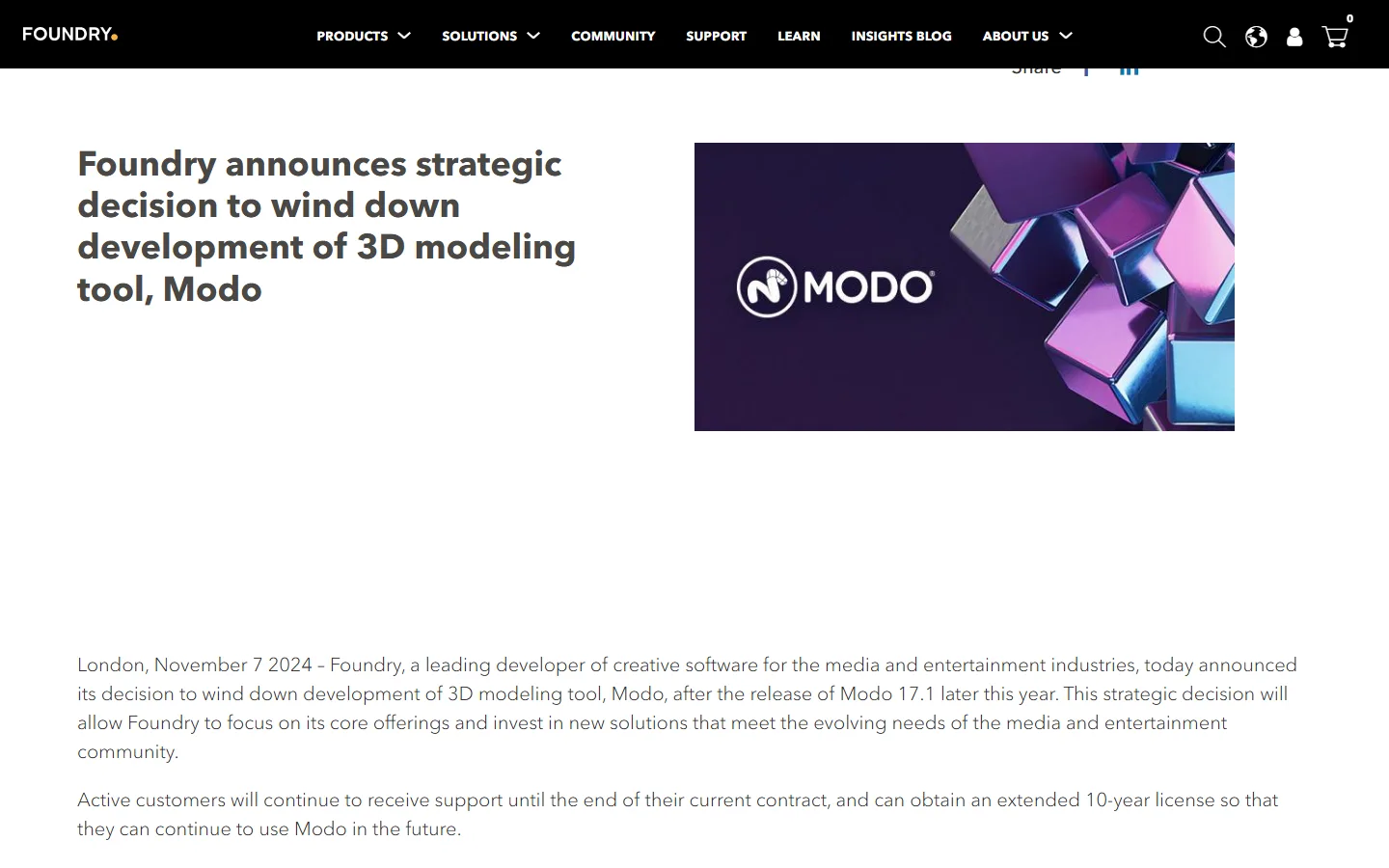
7 November 2024, London. Foundry announced that it would wind down development of Modo after the release of version 17.1. The software did not stop working that day. Existing customers received a ten-year end-of-life licence, the download stayed online, and in 2025 Foundry published the licence file publicly so that anyone, including people who had never used Modo, could install the final release and activate it until 7 November 2034. A discontinued tool with a decade of legal life is an unusual thing; it makes Modo worth reviewing on its merits rather than as an obituary.
Foundry Modo at a Glance
| Current version | 17.1v1, the final release (stable 17.1 dated 26 November 2024) [1][2] |
| Developer | Foundry, which merged with Luxology in September 2012 [1][3] |
| Pricing | Free download with a Foundry account; the public end-of-life licence runs until 7 November 2034 [2] |
| Licence model | Proprietary; development ended on 7 November 2024, with no updates, bug fixes or support [1][2] |
| Platforms | Windows 10/11, Rocky Linux 9, macOS 13–15 (Intel and Apple Silicon) [2] |
| File formats | OBJ, FBX, glTF, USD, Alembic, Collada, STL, 3DS, X3D and the native .lxo [1][2] |
| Typical use | Hard-surface modelling and concept design for games, VFX and product visualization [1][2] |
| Technical detail | Procedural mesh modelling and topology tools (Quad Draw, Edge Flow) with a deep subdivision-surface workflow; action centers, falloffs and the Tool Pipe; OctaneRender for Modo Prime included [1][2] |
What Modo did well
Modo’s reputation rests on a specific kind of modelling. Its procedural mesh tools let an artist keep operations live and reorder them, so a hard-surface shape could be refined without rebuilding it. Quad Draw and Edge Flow made retopology and clean edge loops feel direct, and the subdivision-surface workflow was deep enough for production assets. The Tool Pipe, action centers and falloffs let a small set of tools behave like many: click to set the pivot, drag to set the axis, and shape the influence with a radial or linear falloff.
The application also included 3D painting, a physically based renderer and an animation toolset, but its identity was always modelling. It was the tool a concept artist opened when a shape had to be blocked out quickly and then cleaned up for a game or film pipeline. That focus is why the retirement hurts: there is no single replacement that reproduces the same feel.
First turn: from LightWave’s team to Foundry
Modo was developed by Luxology, formed after a 2001 disagreement at NewTek about rewriting LightWave’s workflow. Brad Peebler, Allen Hastings and Stuart Ferguson left with several LightWave engineers and built a new modeller. Modo was demonstrated at SIGGRAPH 2004 and released in September of that year. Digital Domain adopted it in April 2005, and Pixar, ILM, id Software and other studios followed.
Foundry and Luxology merged in September 2012, bringing Modo into the same portfolio as Nuke, Katana and Mari. The application continued through version 17, adding a procedural modelling stack in 10.1 and improving the modelling and rendering toolsets. On 7 November 2024 Foundry announced the wind-down, saying that no significant feature release had been made for at least two years and that it would focus on its core products.
Second turn: the ten-year licence is the afterlife
The end-of-life licence is the most interesting part of the story. Customers on maintenance or subscription could obtain a ten-year licence, and in 2025 Foundry published the licence file publicly, so the final release can be installed and activated by anyone with a free Foundry account. The licence expires on 7 November 2034. That gives Modo a decade of legal use, which is longer than many active subscriptions last.
The catch is that a decade of legal use is not a decade of support. There will be no patches, no bug fixes and no compatibility guarantees for future operating systems. Modo may keep working on Windows 11 or macOS 15, but a future OS update can break it, and Foundry has said it recommends migrating to alternative workflows. The download page, documentation and forums may also be retired; Foundry only committed to keeping them available until at least November 2025.
Third turn: what to migrate to, and what to keep
The migration question is not “which tool is best” but “which tool preserves the part of Modo you actually use”. For pure hard-surface modelling, Blender is the most obvious free destination, with a large add-on ecosystem and a rapidly improving modifier stack. For production pipelines that need animation, rigging and rendering, Maya or 3ds Max remain the studio standards. For precision or CAD-adjacent work, Rhino or Plasticity are better fits, and Houdini is the choice for procedural asset generation.
The durable asset is the mesh, not the project file. Export OBJ, FBX or USD versions of anything you may need, keep the .lxo files as an archive, and test the exports in the destination application before the licence or the OS becomes a problem. A studio that waits until Modo stops launching will be migrating under pressure; a studio that exports now can choose the timing.
Hardware and performance notes
Modo 17.1v1 runs on Windows 10/11, Rocky Linux 9 and macOS 13–15, including Intel and Apple Silicon Macs. The renderer is a multithreaded physically based ray tracer that scales with CPU cores, and the application has historically handled large scenes with a modest GPU requirement because the viewport is not a path tracer. The OctaneRender for Modo Prime plugin is included, with Apple Silicon support limited to macOS.
The retirement changes the hardware advice: do not buy a workstation for Modo in 2026 unless it is also the workstation for your next tool. Keep a known-good OS image, avoid upgrading the OS on the machine that runs Modo until you have tested it, and treat the application as a long-lived utility rather than a platform for new production.
Who should choose it — and who should not
| Profile | Fit | Reason |
|---|---|---|
| Existing Modo user with a working pipeline | Good, with a migration plan | The free ten-year licence keeps the current work running; plan the move before the OS or the licence becomes a problem. |
| Hard-surface concept artist | Good for learning | The modelling tools are still excellent, and the price is now zero. |
| Studio starting a new pipeline | Weak | No support, no updates and no compatibility guarantee; Blender, Maya or 3ds Max are safer foundations. |
| Beginner choosing a first 3D tool | Conditional | Free and capable, but the lack of tutorials and community momentum matters for learning. |
| Open-source advocate | Weak | Modo is proprietary and discontinued; Blender is the sustainable choice. |
Alternatives at a glance
| Tool | Licence model | Where it fits |
|---|---|---|
| Blender | Free / open source | Hard-surface modelling, retopology, animation and rendering in one open pipeline. |
| Autodesk Maya | Subscription | Animation, rigging and VFX pipelines across Windows, macOS and Linux. |
| Autodesk 3ds Max | Subscription | Archviz and environment modelling with a deep modifier stack. |
| Houdini | Subscription | Procedural asset generation and simulation. |
| Rhino 3D | Perpetual / subscription | Precision NURBS modelling and industrial design. |
Verdict
Modo 17.1 is a discontinued tool that is still worth knowing. Its modelling workflow, action centers and falloffs remain a masterclass in direct manipulation, and the free ten-year licence gives it an unusually graceful afterlife. But a tool without updates is a tool with a clock on it, and the clock is already running.
The honest recommendation is conditional. If you already use Modo, download the final release and the licence, export your archive, and start testing a migration path. If you are choosing a modeller for a new project, start with Blender, Maya or 3ds Max and treat Modo as a reference for how good direct modelling can feel. The best tribute to a discontinued tool is not to pretend it will last forever; it is to learn what it did well and carry that into the next pipeline.
References
The version, licence, platform and EOL details below were checked against the primary sources listed here.