





1973, Cambridge. Doctoral student Ian Braid was developing a program named BUILD under the supervision of Charles Lang. The inquiry was technical yet fundamental: How can a computer recognize not merely the wireframe outline of an object, but its interior volume, mass properties, and closed boundary limits? One year later, in 1974, Lang, Braid, Alan Grayer, and Peter Veenman channeled this foundational question into a commercial venture: Shape Data. Released in 1978, Romulus became one of the earliest commercial solid modeling geometric engines.[1]
That foundational question remains active on engineering workstations today. Whether sketching a bracket in SolidWorks, rotating a large assembly inside a web browser via Onshape, or adjusting sketch dimensions within FreeCAD, the software running beneath the visible interface is a direct descendant of that Cambridge breakthrough.
Parametric CAD is a computer-aided engineering paradigm where geometry is governed not by immutable static coordinates, but by named variables, functional parameters, and geometric constraint networks; whenever a single value shifts, the geometry regenerates along that dependency chain. This concept defines a core working method rather than an isolated tool. It manifests as a sequential feature tree in SolidWorks, symbolic constraint systems in SolveSpace, computational graph networks in Grasshopper, or Python-driven workbenches in FreeCAD.
The overarching motif across this evaluation is simple: identical engines, divergent contracts. In 2026, we evaluate six capable solutions across geometric engines, licensing models, pricing, and operational profiles. Yet before analyzing the tools, engineers must distinguish where “parametric modeling” ends and “geometric kernel” begins.
This technical guide is part of our comprehensive 3D CAD Software Engineering & Design Guide. Turkish readers can also inspect our original pillar at 3D CAD Programları ve Mekanik Tasarım Rehberi.
Quick Summary: FreeCAD provides open formats with zero licensing fees; SolveSpace delivers pure constraint mechanics for single parts; Fusion unifies CAD, CAM, and PCB workflows for agile teams; SOLIDWORKS remains the supply-chain baseline for complex assemblies; Rhino + Grasshopper dominates algorithmic NURBS surfacing; and Onshape excels in real-time cloud collaboration.
What Parametric CAD Truly Means
Parametric CAD stores dimensional values and geometric relationships as an interconnected rule matrix, recalculating the underlying solids whenever rule values change. In classical 2D drafting, a line length is merely a static drawn element; in a parametric system, that length is an active variable mathematically bound to surrounding boundaries.
In modern industrial engineering, three distinct parametric paradigms intersect:
- History-based modeling: Geometry is recorded as a sequential execution tree. Operations such as sketches, extrusions, cuts, fillets, and patterns depend on antecedent features; modifying an early operation triggers downstream regeneration. Fusion and SolidWorks represent this conventional pathway.
- Constraint-based modeling: Geometry is solved through simultaneous algebraic equations governing distances, angles, coincidences, and tangencies. The core solver computes the exact coordinate state satisfying all criteria. SolveSpace is built directly around this solver architecture.
- NURBS and algorithmic graphs: Splines and analytical surfaces are mathematically evaluated via Non-Uniform Rational B-Splines; algorithmic nodes in tools like Grasshopper drive geometry parametrically through logic workflows. Rhino is the benchmark for this discipline.
A fourth methodology often complements these tools: direct modeling. Direct modeling dynamically translates or offsets faces without traversing a rigid feature history. While non-parametric in isolation, modern platforms frequently combine direct editing tools with parametric foundations. A platform qualifies as parametric through its constraint and dependency management layer, rather than merely its low-level kernel name.
Clarifying these boundaries is vital because marketing literature frequently conflates three separate concepts: parametric CAD, parametric design, and NURBS modeling. Parametric design is a broad design philosophy linking rules to functional decisions. Parametric CAD is a software implementation of that philosophy. NURBS represents the underlying surface mathematics. A single software environment may support all three, yet their underlying mechanics remain distinct.
Geometric Kernels: The Foundation Beneath the Interface
A geometric kernel is the foundational engine responsible for calculating solid and surface geometry in a CAD application. It manages Boundary Representation (B-Rep) topologies—vertices, edges, and faces—along with their underlying analytic geometries and NURBS patches. The graphical user interface, parametric history tree, and document handlers operate strictly as layers above this engine.
Importantly, a geometric modeling kernel is fundamentally separate from a dimensional constraint solver. The kernel resolves boundary inquiries: where two solids intersect, surface continuity, and volumetric mass properties. The constraint solver resolves relational equations: enforcing parallel faces, concentric bores, and sketch tangencies. In SOLIDWORKS, the Parasolid kernel handles geometry while the D-Cubed solver handles dimensional relations. In Fusion, the geometry kernel and sketch solver are similarly partitioned.
As of 2026, five primary geometric kernel families dominate workstation and cloud CAD ecosystems:
| Kernel | Maintainer | Topology & Architecture | Key Deployments | Licensing |
|---|---|---|---|---|
| Parasolid | Siemens Digital Industries | B-Rep, convergent modeling, XT transmission schema | SolidWorks, Onshape, NX, Solid Edge, Shapr3D | Proprietary OEM |
| ACIS | Spatial (Dassault Systèmes) | B-Rep, direct and history hybrid modeling, SAT schema | BricsCAD, IronCAD, specialized engineering packages | Proprietary OEM |
| ShapeManager | Autodesk | ACIS 7.0 derivative forked in 2001, B-Rep solid kernel | Autodesk Fusion, Autodesk Inventor | Proprietary Internal |
| Open CASCADE (OCCT) | Open Cascade (Capgemini) | B-Rep, STEP/IGES processors, modular C++ architecture | FreeCAD, SALOME, CAD Exchanger | LGPL 2.1 with Exception |
| openNURBS | Robert McNeel & Associates | NURBS geometric classes, native .3dm file container | Rhinoceros 3D, Grasshopper | Open toolkit; Rhino binary proprietary |
According to figures published by Siemens, Parasolid supports over 900 modeling functions and powers engineering software across 200 independent software vendors, securing data interchange across 350 commercial applications via the Parasolid XT pipeline.[2] Production documentation identifies version 39.0 as the active baseline through mid-2026.[3] Comparing these industry metrics confirms that the commercial kernel marketplace represents an extensive infrastructure of licensing covenants and geometry interchange agreements.
ACIS, maintained by Spatial for over three decades, serves over 350 active commercial applications with an installed base exceeding three million seats.[5] Autodesk branched ShapeManager from ACIS 7.0 in November 2001, debuting the engine in Inventor 5.3 in February 2002.[6] Autodesk technical documentation explicitly verifies that Autodesk Fusion executes shape generation through the Autodesk Shape Manager (ASM) kernel.[7]
Open CASCADE Technology delivers an open-source C++ solid modeling and STEP data translation foundation. The active 2026 release is version 8.0.1, distributed under the LGPL 2.1 license with developer exceptions.[8] FreeCAD utilizes OCCT as its fundamental geometric core.[21] Conversely, Rhinoceros relies on McNeel’s specialized mathematical NURBS library paired with the openNURBS toolkit, providing robust .3dm file input/output routines across engineering toolchains.[14][20]
Data at a Glance: Six Parametric CAD Solutions in 2026
The matrix below reflects current data verified on November 14, 2026, across official vendor release sheets, published pricing schedules, and independent verification logs. Quoted pricing represents standard commercial list levels, excluding regional sales taxes, enterprise volume tiers, or academic allowances.
| Application | Active Version | License Model | Geometric Kernel | OS Support | Pricing Schedule | Optimal Engineering Context |
|---|---|---|---|---|---|---|
| Autodesk Fusion | 2706.1.17 (October 2026)[17] | Commercial subscription; free restricted personal tier | Autodesk ShapeManager (ASM)[7] | Windows, macOS, Browser | Annual SaaS + paid extensions | Agile product teams integrating CAD/CAM/CAE and PCB design |
| SOLIDWORKS | SOLIDWORKS 2026 (November 2025)[18] | Proprietary VAR quote model | Siemens Parasolid[4][3] | Windows | Custom VAR quote | Heavy industrial engineering and established supply-chain manufacturing |
| Rhino 9 + Grasshopper | Rhino 9 (Commercial Release)[14] | Perpetual standalone license | NURBS / openNURBS[20] | Windows, macOS | $995 commercial one-time; $195 student[14] | Industrial design, architectural form-finding, computational surfacing |
| FreeCAD | 1.0 Stable; 26.3 RC2 (October 2026)[9][10] | LGPL-2.1-or-later[11] | Open CASCADE (OCCT)[21] | Windows, macOS, Linux | $0 | Zero-cost deployments, data sovereignty, and Python workflow scripting |
| SolveSpace | 3.3 (October 2026)[13] | GPLv3[13] | Native constraint solver; NURBS Booleans[12] | Windows, Linux, macOS | $0 | Rapid single-part modeling, linkage kinematics, and kinematic constraint study |
| Onshape | Continuous SaaS (~3-week sprint deployments)[16] | Proprietary SaaS | Siemens Parasolid[2][3] | Browser, iOS, Android | Free $0; Standard $1,500; Professional $2,500 /seat/yr[16] | Distributed design teams demanding built-in cloud PDM and collaborative modeling |
Pathway One: The Feature Tree and Two Divergent Contracts
History-based parametric CAD structures models as an ordered sequence of features, where each subsequent operation accepts antecedent geometry as input. Fusion and SOLIDWORKS are prominent implementations of this methodology. Yet while they share procedural philosophies, their geometric backbones diverge: Fusion is powered by Autodesk ShapeManager, whereas SOLIDWORKS runs on Parasolid. Even between platforms sharing the identical Parasolid kernel—such as SOLIDWORKS and Onshape—files cannot be opened interchangeably with parametric fidelity, illustrating that kernel parity does not equate to native document compatibility.
Autodesk Fusion: Unifying Four Engineering Disciplines
Autodesk Fusion is an integrated engineering suite uniting CAD, CAM, CAE, and ECAD toolsets within a single cloud-synchronized workspace. Build 2706.1.17, released in late October 2026, represents the platform’s active 2026 baseline.[17] Fusion’s geometric operations are executed directly through the Autodesk ShapeManager (ASM) engine.[7]
The principal operational advantage of Fusion lies in eliminating multi-software handoffs. Mechanical solid models, CNC toolpath setups, thermal simulations, and PCB designs reside within the same data container. Commercial pricing runs on an annual subscription, complemented by limited personal-use tiers.[17] The corresponding tradeoff centers on persistent cloud infrastructure: accessing files requires verified account connectivity, and advanced generative or manufacturing toolpaths demand supplemental extension subscriptions.
SOLIDWORKS: The Momentum of Industrial Precedent
Dassault Systèmes SOLIDWORKS is the entrenched desktop benchmark for parametric mechanical assembly design; version 2026 entered production in November 2025.[18] Its core geometry is calculated by Siemens Parasolid. This arrangement presents an intriguing industrial dynamic—a Dassault flagship licensing the foundational engine of competitor Siemens—yet the desktop architecture has maintained this pipeline across decades.[4][3]
The strength of SOLIDWORKS centers on its maturity: massive multi-part assembly handling, associative drafting engines, extensive PDM integrations, and vast supply-chain adoption. The primary drawbacks involve platform rigidity and total cost: desktop deployment is restricted strictly to Windows, and licensing requires negotiated quotes through regional value-added resellers (VARs).[18]
First Turning Point: SOLIDWORKS and Onshape share the identical Parasolid geometric kernel. However, identical kernels do not deliver interchangeable document structures. A SOLIDWORKS file is a binary SLDPRT or SLDASM container; an Onshape document is an active database transaction model residing on cloud clusters. Expecting feature tree exchange simply because both tools run Parasolid conflates kernel calculation with application-level data schemas. Identical engines, divergent contracts.
Pathway Two: The Constraint Engine as the Core Asset
Constraint-centric parametric CAD treats geometry as a simultaneous system of dimensional and relational equations; the geometric solver calculates the precise coordinates that fulfill all mathematical constraints. SolveSpace stands out as a lean, transparent embodiment of this approach. Operating as a standalone portable executable without formal installation routines, it embeds a custom symbolic equation solver.[12][13][22]
SolveSpace version 3.3, delivered on October 20, 2026, under the GPLv3 license, runs across Windows, Linux, and macOS.[13] Its technical features include sketch primitives (lines, arcs, Béziers), relational constraints (length, angle, tangency, perpendicularity, symmetry), basic solid operations (extrude, lathe, helix, Boolean), dynamic degrees of freedom (DOF) diagnostics, and interactive kinematic mechanism tracking.[12]
The technical boundaries of SolveSpace match its minimalist architecture: it omits native 3D edge fillet and chamfer tools, its procedural NURBS Booleans can fail on complex intersecting topologies, and it provides no comprehensive FEA or CAM modules.[19] Nonetheless, its capacity to output pristine 2D DXF, STEP, STL, OBJ, and raw G-code makes it highly capable for laser cutting, waterjet fabrication, and basic 2.5-axis machining.[12]
Second Turning Point: The greatest contribution of SolveSpace is not its drafting window, but its constraint solver. Its algebraic solving engine has been extracted and integrated into external open-source projects, including FreeCAD’s Assembly3 workbench and the CAD Sketcher add-on for Blender.[19] The engineering legacy of this lightweight tool thrives far beyond its own viewport.
Consequently, SolveSpace is best conceptualized not as “entry-level CAD,” but as an unencumbered window into geometric constraint logic. It is ideal for mechanical brackets and planar linkage validation, while intentionally unsuitable for complex ergonomic consumer enclosures.
Pathway Three: NURBS Splines and Algorithmic Logic
NURBS modeling formulates curves and surfaces via control point arrays, knot vectors, and rational weightings. Rather than approximating circular arcs through tessellated polygon segments, geometry is preserved through exact analytic equations, safeguarding tight manufacturing tolerances. Rhinoceros represents the foremost desktop realization of this mathematical approach.[14]
Rhino 9 is distributed under a perpetual commercial license priced at $995, with educational tiers at $195, avoiding mandatory recurring subscription fees.[14] Running natively on Windows and macOS, its native .3dm data model and openNURBS developer library facilitate transparent geometric handoffs across industry software suites.[14][20] Rhino 9 introduces enhanced SubD modeling workflows, updated Clipping Drawings, and optimized Direct3D display pipelines.
Grasshopper serves as the visual algorithmic environment embedded inside Rhino, enabling designers to construct complex associative logic by routing data streams between canvas components.[15] Integrated into Rhino core since version 6, the ecosystem expands with Grasshopper 2 alongside Rhino 9.[15][14] However, Grasshopper is not an autonomous geometric kernel; it operates as an associative algorithmic layer driving Rhino’s underlying NURBS engine.
Third Turning Point: Parametric design must not be conflated with parametric solid CAD. In Grasshopper, an engineer can mathematically drive thousands of facade panels according to sun-angle curves. Yet this workflow does not represent a mechanical feature tree populated with concentric mating constraints. Rhino equips the engineer with NURBS precision; Grasshopper adds algorithmic flexibility. Together, they excel in computational form-finding, but do not replace mechanical production CAD.[14][15]
Pathway Four: Open Source and Architectural Autonomy
Open-source parametric CAD presents an auditable technical stack extending from low-level geometric routines up to user interface code. This architectural openness represents a distinct engineering advantage beyond merely eliminating initial license fees. FreeCAD represents the leading open-source parametric modeler executing true B-Rep topology. Its underlying geometric processing is driven by Open CASCADE Technology, and the suite is distributed under LGPL-2.1-or-later.[11][21]
FreeCAD 1.0, published on November 18, 2024, integrated an algorithm designed to mitigate the topological naming problem (TNP). Official release documentation transparently notes that while the mitigation dramatically stabilizes feature trees, complete immunity requires ongoing development.[9] The 1.0 milestone also merged an integrated Assembly workbench utilizing the Ondsel constraint solver directly into the core distribution.[9]
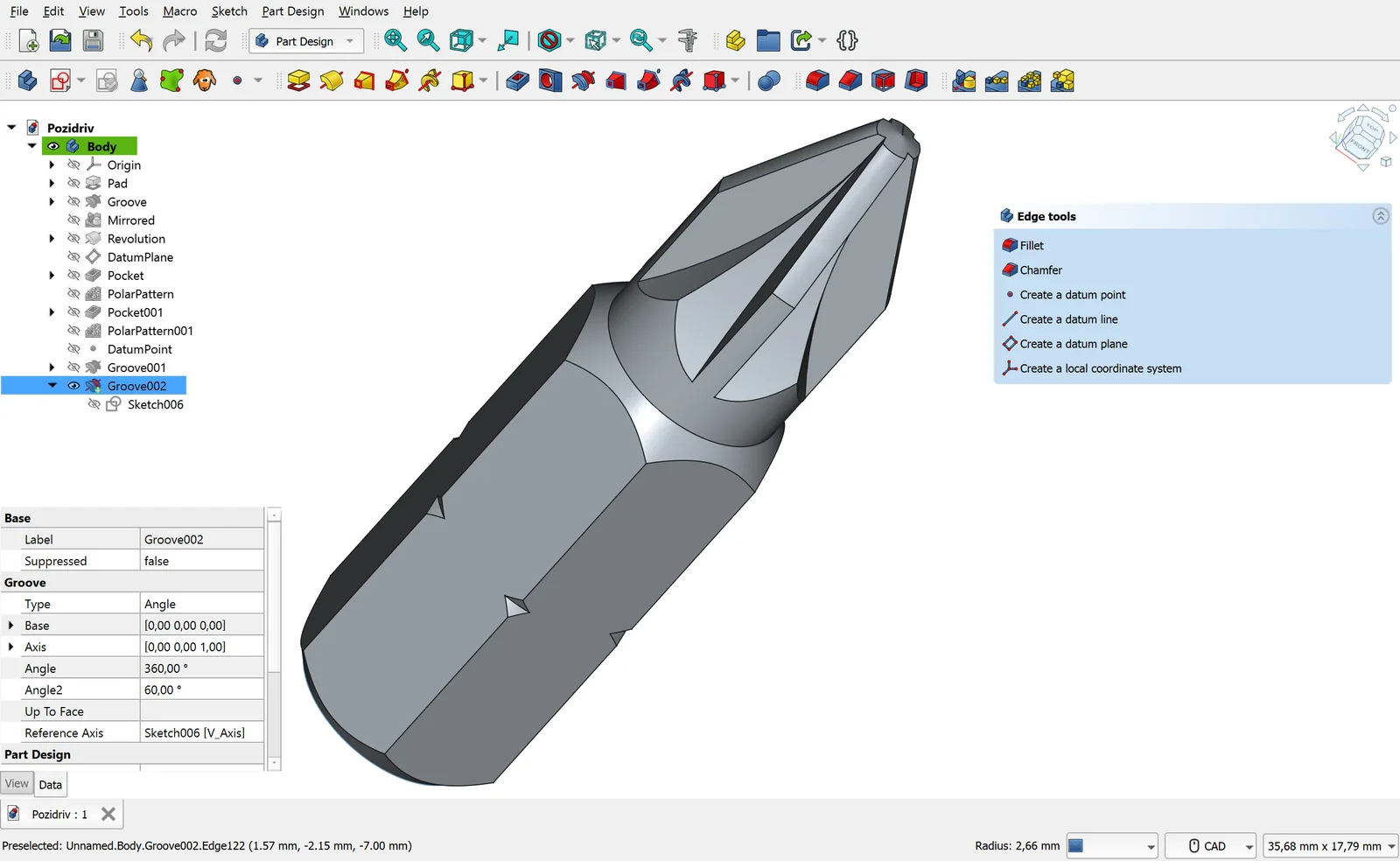
FreeCAD modified its release nomenclature in late 2026. The FreeCAD project announced Release Candidate 2 for version 26.3 on October 18, 2026, transitioning to date-aligned release cycles.[10] Consequently, “FreeCAD 1.0” remains the active stable production baseline, with 26.3 representing the forward development channel. Recognizing this distinction prevents confusion during industrial deployment.
Fourth Turning Point: Zero acquisition cost does not imply unconditional deployment rights. The LGPL permits internal commercial modeling; however, distributing modified underlying library binaries incurs obligations to disclose revised source code and maintain dynamic relinking capability.[11] Furthermore, third-party FreeCAD addons carry separate licensing terms. Enterprise legal teams must inspect both kernel and module licenses. Nevertheless, the strategic benefit remains unmatched: should corporate sponsors shift direction, the entire code repository and data formats remain fully preserved within the community.
FreeCAD’s primary mechanical asset is its comprehensive Python API. Engineers can navigate between PartDesign, CAM, FEM, and BIM workbenches, automate repetitive geometry via scripts, or execute headless automation runs on remote infrastructure via freecadcmd.[9] The practical constraint remains large assembly performance, complex surface stitching, and automated drafting standards, where mature commercial vendors maintain an edge.
Pathway Five: Cloud CAD and Data Boundary Realities
Cloud-native CAD executes geometric computation on remote server clusters rather than local client hardware, tracking engineering revisions through transactional database records rather than isolated file archives. Onshape exemplifies this cloud model: it operates directly inside web browsers, bypasses local file saves, and automatically records engineering modifications into a continuous audit log.[16][3]
Onshape leverages the Siemens Parasolid engine for geometric processing. Siemens literature highlights Onshape among premier cloud implementations of the engine, and industrial registries document Onshape’s core reliance on Parasolid.[2][3] Hence, Onshape’s technical innovation is not novel solid geometry mathematics, but a centralized cloud database architecture delivering simultaneous multi-user collaboration and native version control.
Subscription schedules verified in November 2026 outline four tiers: Free at $0, Standard at $1,500 per user/year, Professional at $2,500, and Enterprise available via quote.[16] The Free tier is limited strictly to non-commercial work and enforces that all hosted design documents remain publicly visible. In this context, zero-dollar software requires relinquishing proprietary IP privacy. While acceptable for educational or open hardware initiatives, it is categorically disqualified for proprietary client work.
Fifth Turning Point: In cloud-native CAD, the critical cost driver is not the license fee, but data residency governance and intellectual property visibility. Onshape Government is tailored for AWS GovCloud deployments to support ITAR and EAR regulatory boundaries, requiring custom enterprise agreements.[16] Organizations with strict data export controls must resolve these agreements in advance. Identical engines, divergent contracts: here, the contract governs data jurisdiction.
Comparative Evaluation: Selecting the Appropriate Platform
| Solution | Modeling Model | Primary Advantage | Architectural Boundary | Strategic Assessment |
|---|---|---|---|---|
| Fusion | History-based + hybrid cloud | Unified CAD, CAM, CAE, and PCB workflows | Mandatory subscription, cloud reliance, paid add-on modules | Optimal broad toolkit for agile hardware teams |
| SOLIDWORKS | History-based, desktop native | Heavy assembly handling, detailing, extensive supply-chain footprint | High total cost and strict Windows dependency | The entrenched baseline for traditional mechanical production |
| Rhino + Grasshopper | NURBS + algorithmic logic | Complex curvature, computational geometry, perpetual license | Limited traditional feature tree and assembly constraints | Indispensable for industrial, architectural, and marine design |
| FreeCAD | History-based, open-source | Zero license cost, Python scriptability, STEP/IFC native support | Steeper learning curve; assembly performance limits on massive files | Unmatched choice for data sovereignty and open tooling stacks |
| SolveSpace | Constraint-centric, ultra-lean | Compact footprint, rapid execution, transparent mechanism solver | No 3D fillets/chamfers, sensitive NURBS Booleans | Exceptional for single-part kinematics and constraint learning |
| Onshape | History-based, pure cloud SaaS | Real-time simultaneous editing, integrated cloud PDM, zero IT install | Constant network connection required; Free documents are public | Best-in-class for distributed teams needing frictionless revision control |
Decision Support Matrix: Engineering Contexts
Rather than designating an arbitrary “best” software, the matrix below pairs specific engineering operational profiles with primary and secondary tooling pathways.
| Engineering Profile | Primary Recommendation | Secondary Alternative | Technical Rationale |
|---|---|---|---|
| Student / Independent Maker, Zero Budget | FreeCAD | Onshape Free, Fusion Personal | Zero license overhead; unencumbered STEP output and Python scripting |
| Single-Part Fabrication & Linkage Kinematics | SolveSpace | FreeCAD | Direct degree-of-freedom diagnostics and instant mechanism simulation |
| Agile Hardware Team (CAD + CAM + PCB) | Autodesk Fusion | Onshape + Independent CAM | Single data model reduces export bottlenecks; predictable SaaS budgeting |
| Heavy Industrial Machinery & Supply Chains | SOLIDWORKS | Siemens NX, Solid Edge | Established Parasolid ecosystem, certified 2D drafting, and vendor network |
| Industrial Design, Architecture, Marine Lines | Rhino + Grasshopper | Autodesk Alias, CATIA | Unmatched NURBS surfacing precision with flexible algorithmic rule definition |
| Distributed Engineering with Cloud PDM | Onshape | Autodesk Fusion | Single cloud document model avoids file conflicts and IT infrastructure costs |
| Data Sovereignty, Open Formats, Long-Term Archive | FreeCAD + OCCT | SolveSpace | LGPL license, open STEP/IFC standards, and complete inspection of source algorithms |
Frequently Asked Questions
Is parametric CAD identical to parametric design?
No. Parametric CAD represents a specific category of mechanical solid modeling software. Parametric design is a broader computational design philosophy connecting dimensional rules and relational logic to geometric outcomes. While Rhino + Grasshopper serves as a premier parametric design environment, it does not function as a classical history-driven mechanical solid CAD package.
Which geometric modeling kernel is technically superior?
Engineering superiority depends on deployment requirements. Siemens Parasolid delivers an extensive commercial ecosystem and battle-tested B-Rep operators. Autodesk ShapeManager provides tight consistency across Autodesk’s portfolio. Open CASCADE Technology provides complete transparency and unmatched STEP translation capabilities. Spatial ACIS brings over three decades of verified commercial deployment.[2][5][8]
Can FreeCAD open native SOLIDWORKS files directly?
Directly importing native SLDPRT or SLDASM files with intact, fully editable parametric feature histories is not feasible. The standard interchange pipeline relies on neutral STEP (such as AP242) or IGES transmission. While neutral standards convey precise geometric boundaries, they do not transfer proprietary procedural feature trees.
Can Onshape’s Free tier be utilized for commercial engineering?
No. The Free subscription is restricted strictly to non-commercial, educational, or open-source activities, and all hosted documents are publicly searchable and copyable.[16] Commercial projects demand Standard or Professional subscriptions to secure confidentiality.
Is Rhinoceros fundamentally a parametric modeler?
Rhino’s native viewport commands operate primarily through direct geometric manipulation and explicit NURBS surface operations. Its parametric modeling capabilities are unlocked via Grasshopper. While Grasshopper constructs sophisticated relational rule networks, it does not replicate the conventional linear feature history of packages like SOLIDWORKS.[14][15]
Final Assessment: Document Longevity Across Decades
The foundational challenge articulated at Cambridge in 1973 remains unchanged: How does computational architecture define a physical solid? Parasolid and ACIS offer two mature commercial answers; OCCT represents the open-source community’s answer; ShapeManager supports Autodesk’s integrated ecosystem; and openNURBS establishes a neutral medium for spline definitions. Each of the six platforms evaluated builds on a geometric kernel and relational constraint network; the defining distinction lies in the contract governing the engine.
When selecting CAD infrastructure, look beyond superficial interface conventions. Address two essential engineering questions in writing: In what standardized file format will your organization inspect this engineering data ten years from today, and under what contractual boundaries will your team distribute that geometry? Answering those two questions reveals far more than any kernel specification sheet.
References
- Wikipedia — Shape Data and Romulus Modeling Kernel. Historical development of the Romulus B-Rep geometric kernel.
- Siemens — Parasolid Geometric Modeling Kernel. Technical specifications, XT data format, and OEM developer ecosystem.
- Wikipedia — Parasolid. Release milestone v39.0 and deployment registry.
- Siemens PLM Blog. Architectural analysis of geometric kernel integration in mechanical CAD.
- Spatial — 3D ACIS Modeler. Commercial deployment history and B-Rep engine capabilities.
- Wikipedia — Autodesk ShapeManager. Historical origin branching from ACIS 7.0 in November 2001.
- Autodesk Fusion Blog. Documentation of the Autodesk ShapeManager (ASM) geometric core.
- Open CASCADE Technology (OCCT). Release notes for version 8.0.1 and LGPL-2.1 licensing terms.
- FreeCAD 1.0 Release Notes. Topological Naming Problem (TNP) mitigation and integrated Assembly workbench.
- FreeCAD Blog — Version 26.3 Release Candidate 2. Introduction of date-aligned version nomenclature.
- FreeCAD License. Full GNU Lesser General Public License v2.1 with exceptions.
- SolveSpace — Feature Documentation. Kinematic mechanism constraints, geometric solver, and export pipelines.
- SolveSpace — Version 3.3 Release. Standalone GPLv3 multi-platform executable release notes.
- Robert McNeel & Associates — Rhino 9. Commercial licensing schedule, SubD workflows, and NURBS modeling tools.
- Wikipedia — Grasshopper 3D. Algorithmic modeling integration and computational graph design.
- PTC Onshape — Subscription Plans & Pricing. Commercial tiers, public workspace rules, and enterprise governance.
- Wikipedia — Autodesk Fusion. Production release builds, integrated disciplines, and licensing terms.
- Wikipedia — Dassault Systèmes SOLIDWORKS. SOLIDWORKS 2026 release schedule and Windows deployment requirements.
- LWN.net — A Survey of Open-Source CAD Systems. Evaluation of geometric constraints and solver portability.
- openNURBS Developer Guide. Technical standards for open .3dm file reading and writing.
- FreeCAD Documentation — OpenCASCADE Integration. B-Rep topology evaluation within FreeCAD.
- SolveSpace Source Repository. Mathematical formulation of symbolic constraint resolution.


