




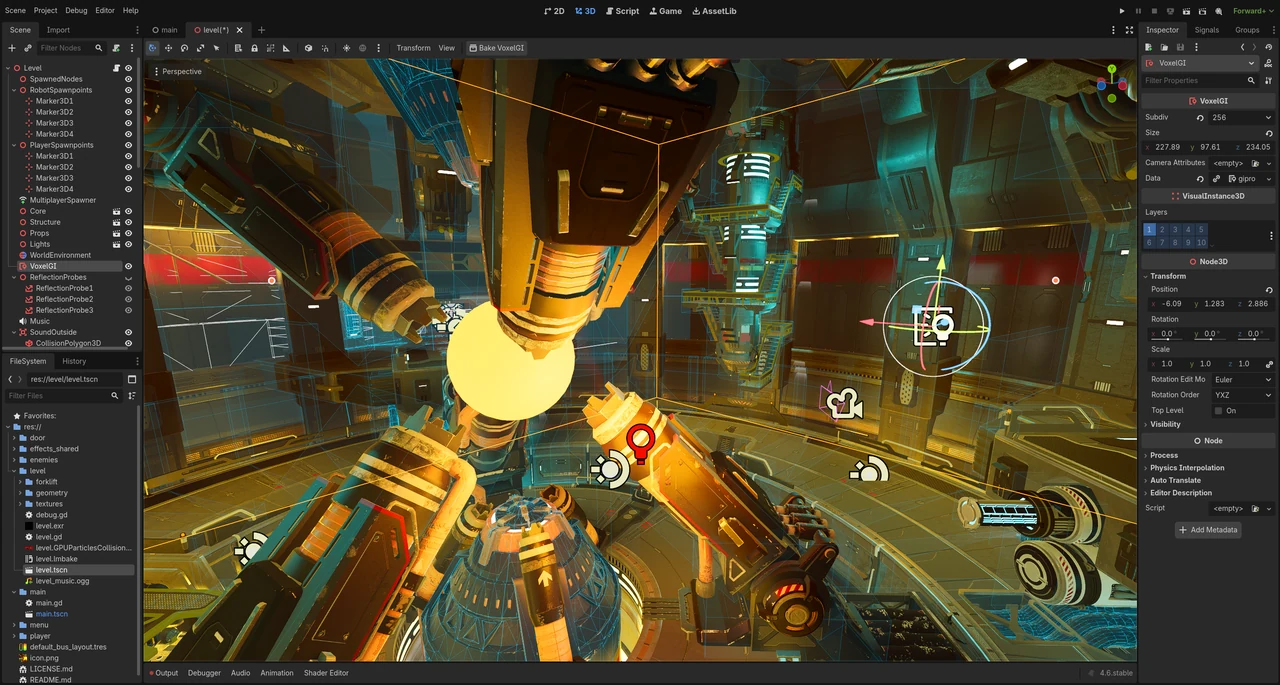
December 15, 2014, Buenos Aires → Global Open Source. When the internal engine that Juan Linietsky and Ariel Manzur had spent years refining for client work at Argentina’s OKAM Studio opened under the MIT license in early 2014, few observers imagined it would ever be weighed alongside AAA incumbents [3]. Twelve years later, Godot 4.7.2—the current stable maintenance build of the 4.7 family released on August 18, 2026—is no longer just a “lightweight 2D indie engine.” With native HDR display output, a real-time AreaLight3D node, a rebuilt integrated Asset Store, and Android XR support, it stands as a full-featured game workshop free of a single royalty clause [1][2][3].
Godot Engine at a Glance
| Current version | Godot 4.7.2 — August 18, 2026 [1][3] |
| Developer | Godot Engine Community & Godot Foundation (founders: Juan Linietsky & Ariel Manzur) [1][3] |
| Pricing | Completely free; zero royalties, subscriptions, or revenue thresholds [1][2] |
| License model | MIT License (open source; full permission for commercial and closed-source game distribution) [2][3] |
| Platforms | Windows, macOS, Linux, Android, iOS, Web (WebAssembly); consoles via third-party porting partners [1][3] |
| File formats | glTF 2.0 (.gltf/.glb — recommended), .blend (direct when Blender is installed), FBX (via ufbx), OBJ+MTL, DAE (COLLADA) [1][3] |
| Typical use | Indie 2D and 3D games, prototyping, educational software, tool interfaces, and OpenXR/WebXR experiences [1][3] |
| Technical details | True pixel-coordinate 2D engine rather than flattened 3D; unified node/scene tree; GDScript, C#, and C++ (GDExtension); 4.7 adds native HDR output, AreaLight3D, built-in Asset Store, and inline shader previews [1][3] |
What Godot 4.6 and 4.7.2 actually change
A 3D Lighting and Ecosystem Leap in 4.7: Following Godot 4.6’s early-2026 focus on editor shortcuts and performance, Godot 4.7 (released in June 2026) and its August 2026 4.7.2 maintenance update closed several long-standing gaps on the 3D front [1][3]. A real-time AreaLight3D node brings soft rectangular and studio-style lighting directly into the Vulkan/Forward+ pipeline, while native HDR display output unlocks wider dynamic range on modern monitors and televisions.
Built-In Asset Store and Inline Shader Previews: The cluttered legacy Asset Library gave way to a cleaner integrated Asset Store, and inline shader previews now tighten the feedback loop while authoring materials. On the XR side, Android XR and Steam Frame support join the existing OpenXR/WebXR foundation, simplifying portable mixed-reality prototyping [1].
Product philosophy: Node trees, true 2D, and a Blender-friendly pipeline
In most 3D engines, building a “2D game” really means pushing flat geometry across a Z-flattened 3D space under an orthographic camera. Godot takes a different route by housing a separate, true pixel-coordinate 2D engine [1][3]. Likewise, where Unity uses “GameObject + Component” and Unreal uses “Actor,” everything in Godot is a Scene built from nestable Nodes—allowing anything from a UI button to complex enemy AI to snap together as a reusable sub-scene.
For 3D assets, Godot and Blender operate like natural siblings: with Blender installed on your system, dropping a .blend file straight into the project folder works out of the box, alongside Godot’s recommended glTF 2.0 standard and built-in ufbx importer [1].
First turn: From in-house studio tool to MIT freedom
Unity’s late-2023 Runtime Fee crisis taught the industry one sharp lesson: on a proprietary engine, a studio’s multi-year investment ultimately sits at the mercy of another company’s boardroom. Godot’s MIT license flips that equation—your team can freeze an engine build forever, patch its source code freely, and ship commercial games without opening your own game code or paying a cent in royalties or revenue caps [2].
Second turn: Instant startup and GDScript velocity
Nearly every developer opening Godot for the first time pauses at the file footprint: an installer-free compressed binary hovering just over a hundred megabytes that launches straight into a scene in roughly a second. Because its native Python-inspired GDScript language is tailored directly to the node tree and signal system, gameplay iteration skips heavy compile waits—while C# and C++ (via GDExtension) remain available in the very same project whenever raw throughput or team familiarity calls for them [1][3].
Third turn: Consoles, C# on the Web, and AAA scale limits
To look at Godot honestly means putting three concrete boundaries on the table from day one:
- Console deployment: Because Sony PlayStation, Nintendo Switch, and Xbox SDKs sit behind strict NDAs, they cannot be shipped inside open-source Godot core; reaching consoles requires budgeting for third-party porting houses or commercial porting middleware [1][3].
- C# platform constraint: While GDScript exports across all targets including the web (WebAssembly), Godot’s C# support is currently limited to desktop and mobile platforms—a critical blocker if you intend to ship a browser game written in C#.
- Massive open worlds & turnkey ecosystems: For sprawling plugin marketplaces and Nanite/Lumen-class streaming of vast polygon counts and global illumination, Unreal Engine and Unity still command far deeper third-party libraries [3].
Hardware and performance notes
Godot is easily the most hardware-forgiving engine on the market: its official editor runs smoothly across Windows, macOS, and Linux even on modest machines with 8–16 GB of RAM and mid-range GPUs supporting Vulkan 1.0 or the OpenGL ES 3 / Compatibility backend [1][3]. For heavier 3D Forward+ scenes leveraging AreaLight3D and HDR output, an 8 GB VRAM GPU paired with 16–32 GB of RAM offers plenty of headroom.
Who should choose Godot—and who should skip it
| Profile | Fit | Rationale |
|---|---|---|
| Indie 2D & stylized 3D developers | Excellent | True 2D engine, GDScript iteration speed, fast testing, and zero royalty costs. |
| Studios seeking open-source & license certainty | Excellent | MIT license keeps the source code under your control with no revenue ceiling. |
| Rapid prototyping & web game teams | Excellent | Sub-second editor launches and lightweight WebAssembly builds with GDScript. |
| Teams targeting PS/Switch/Xbox on day one | Conditional | Requires a third-party porting partner or separate console middleware licensing. |
| AAA photorealistic open-world teams | Weak | Unreal Engine is far better equipped for massive asset streaming and cinematic lighting. |
A quick look at alternatives
| Tool | License model | Where it fits |
|---|---|---|
| Unity (6.3 LTS) | Free under $200K / Pro $2,310/yr | Mobile/XR market, turnkey C# Asset Store ecosystem, and direct console targets. |
| Unreal Engine | Free (5% royalty over $1M) | Peak 3D AAA realism powered by Nanite, Lumen, and C++/Blueprint. |
| Blender | Free / GPL open source | Direct 3D modeling and animation companion feeding Godot via .blend or glTF 2.0. |
Verdict
Godot 4.7.2 proves that the open-source ecosystem left the “hobby tool only” era behind long ago. While AreaLight3D, native HDR output, and the refreshed built-in Asset Store fill key pieces on the 3D side, the MIT license lifts every long-term licensing uncertainty off a developer’s shoulders [1][2].
If direct console SDK access or multimillion-dollar AAA photorealism is non-negotiable, Unreal or Unity remains the more pragmatic call; yet for 2D, indie 3D, desktop tools, or web-focused teams, Godot 4.7.2 is the cleanest, fastest, and freest starting line available today.
Perhaps what truly sets Godot apart isn’t a new shadow algorithm—it’s the simple guarantee that an engine tucked inside a hundred-megabyte folder will never send its developers a royalty invoice.
Two questions to ask yourself before committing today:
- Is a day-one PS5/Switch/Xbox release mandatory in year one, or is it wiser to launch on PC/Mac/Linux/Mobile/Web first and fund a third-party console port once traction hits?
- Does your team expect C# and WebAssembly browser builds together—and if so, have you accounted for C#’s desktop/mobile boundary up front?
Sources
All version details, release history, MIT license terms, and Godot 4.7 technical specifications above were verified against the primary references below.