




June 26, 1987, Toronto. After acquiring the rights to the orphaned PRISMS animation system from the bankruptcy of Omnibus Computer Graphics, Kim Davidson and Greg Hermanovic spent nine years rethinking how 3D work is built—and at SIGGRAPH 1996 unveiled Houdini 1.0, a system that turned every step into a visual node graph instead of manual vertex dragging [1]. Honored with an Academy Award of Merit (Oscar) in 2018 by the Academy of Motion Picture Arts and Sciences, that architecture takes another leap on July 15, 2026: skipping SideFX’s customary 21.5 point release, Houdini 22 (build 22.0.368) puts USD world building, faster Karma XPU rendering, and a full 3D Gaussian Splatting toolset right at the center of production [1][2].
Houdini Data at a Glance
| Current version | Houdini 22.0.368 — July 15, 2026 (SideFX skipped the 21.5 interim release) [1][2] |
| Developer | SideFX (Toronto, Canada — founded in 1987) [1][2] |
| Pricing | Houdini FX $4,495 and Core $1,995 (node-locked perpetual; rentals also available); Houdini Indie rental-only; Apprentice free [1][2] |
| License model | Commercial/proprietary; perpetual license (+ annual upgrade plan) or rental options [1][2] |
| Platforms | Windows 64-bit, macOS 11+ (Apple Silicon only), Linux (Ubuntu 22.04+, Debian 12+, RHEL 8+) [1][2] |
| File formats | .hip/.hiplc/.hipnc, USD, Alembic, VDB, OpenEXR, FBX, OBJ, SVG, Bgeo [1][2] |
| Typical use | Film and game VFX simulations (fire, liquid, destruction, cloth, crowds), procedural environment generation, and Solaris USD lighting [1][2] |
| Technical notes | Non-destructive node-based SOP/DOP/LOP graph; Mantra and Karma CPU/XPU renderers; Copernicus GPU image network; Houdini Engine (HDA); 3D Gaussian Splatting & KineFX updates [1][2] |
What Houdini 22 actually changes
USD World Building in Solaris: Houdini 22 upgrades Solaris, SideFX’s USD-native scene assembly and lighting environment, for large-scale environment layout. Artists can now use interactive instance painting tools alongside USD sub-nodes directly inside the SOP context to organize sprawling set assemblies before ever stepping into LOPs [2].
Karma XPU and 3D Gaussian Splatting: The physically based Karma renderer adds new MaterialX shaders—flake, curvature, and ambient occlusion—along with equiangular volumetric sampling to clean up noise in clouds, smoke, and fire [2]. GPU-accelerated Karma XPU cuts memory usage by up to half on subdivided (diced) meshes and renders iso-surface VDB volumes directly without intermediate mesh conversion. On top of that, Houdini 22 ships a full 3D Gaussian Splatting toolset supporting point-attribute deformation and dynamic relighting via spherical harmonics, alongside expansions to KineFX character tools and the GPU-based Copernicus image-processing network [1][2].
Product philosophy: Saving the recipe, not the result
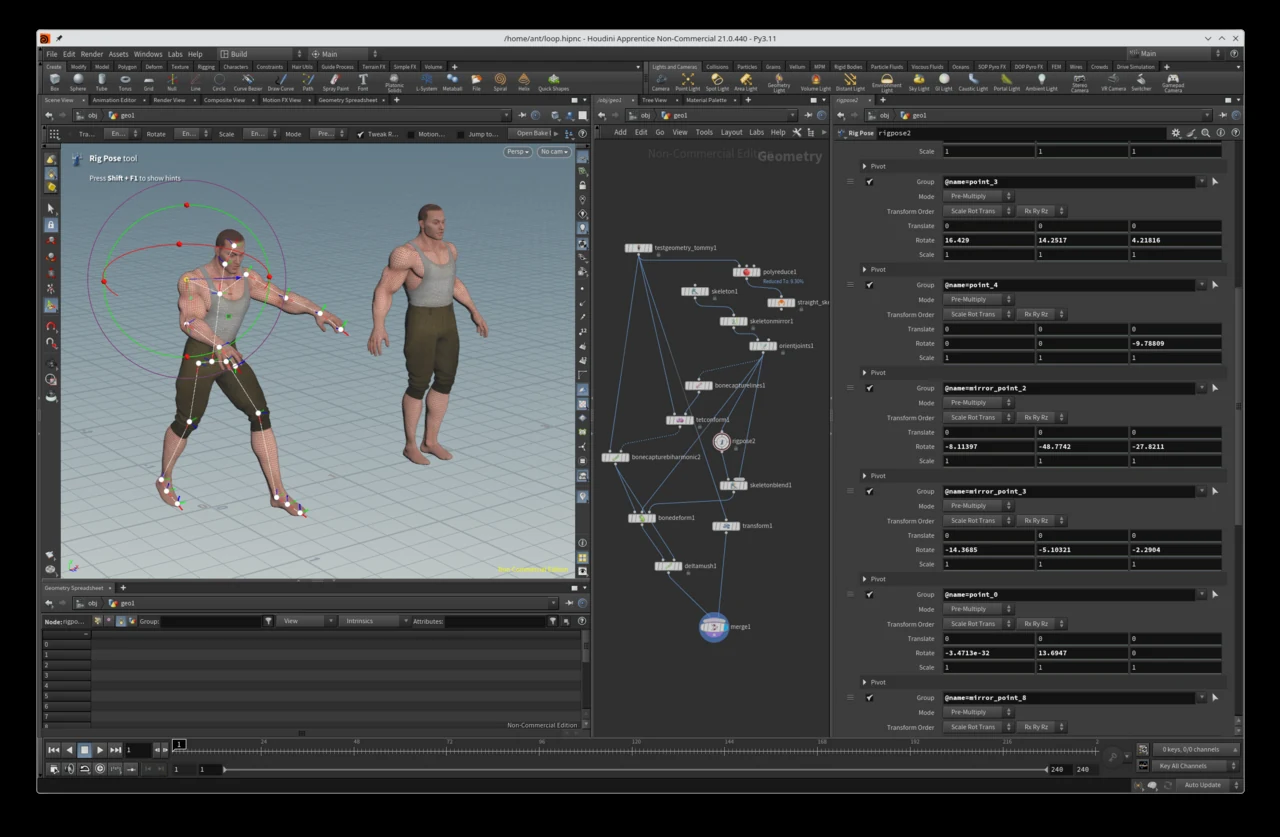
In conventional 3D software, raising a building’s floor height after modeling it means manually sliding dozens of edge loops into place. In Houdini, you do not sculpt the final mesh directly—you assemble the algorithmic recipe that generates it as a chain of nodes. Tweak one parameter near the top of the graph and every window array, UV layout, and fracture piece downstream recalculates in seconds.
Even better, those recipes are not trapped inside Houdini: through Houdini Engine, packaged digital assets (.hda) run as live slider-driven generators inside Maya, 3ds Max, Cinema 4D, Unreal Engine, and Unity [2]. A bridge or destruction setup engineered by one technical artist instantly turns into a time-saving studio generator for a hundred-person game team.
First turn: From PRISMS to cinema’s destruction monopoly
Houdini’s conquest of VFX studios starting in 1996 stemmed from a blunt pipeline reality: when a director decides at the last minute that an explosion needs to start three seconds later and throw debris to the left, nobody wants to rebuild the asset from scratch—you update two parameters and resubmit to the render farm [1]. Two Academy Awards—first for PRISMS in 1998, then for Houdini itself in 2018—explain why almost no major feature film ships fire, oceans, collapse sequences, or digital crowds without Houdini on the credits [1].
Second turn: A rare giant still selling perpetual licenses
In a 2026 market where Autodesk and Maxon have retired perpetual seats altogether, SideFX still sells node-locked perpetual licenses: Houdini Core (modeling, rigging, Solaris, Karma) runs $1,995, while Houdini FX—unlocking the full solver suite including Pyro, FLIP fluids, Vellum, and RBD destruction—costs $4,495 [2]. Independent artists below the annual revenue cap can bridge in via the rental-only Houdini Indie tier, while non-commercial learners get Apprentice completely free [2].
Third turn: The 12 GB VRAM floor and the steep mental shift
The biggest barrier to adopting Houdini is not pricing—it is hardware headroom and mental rewiring. SideFX’s updated system specs now require at least 12 GB of VRAM and OpenGL 4.0, and on macOS Intel Mac support has ended completely (Apple Silicon only) [1][2]. Meanwhile, artists coming from direct polygon modeling often feel slower during their first months; until VEX scripting and attribute-driven math click, even building a plain chair can feel unexpectedly involved.
.hipnc files cannot be converted directly into commercial Indie or FX scenes.Hardware and performance notes
Unlike many modeling suites, Houdini is notoriously memory-hungry. Caching large-scale Pyro, FLIP liquid, or Vellum simulations smoothly demands 64–128 GB of system RAM paired with high-core-count CPUs (Threadripper, high-core Ryzen, or Xeon). For Copernicus GPU compositing, Karma XPU, and viewport responsiveness, the official 12 GB VRAM minimum is really only a starting baseline; 16–24 GB NVIDIA RTX GPUs and multi-terabyte NVMe SSDs for heavy .bgeo and .vdb caches are practically mandatory in production.
Who should choose it—and who should skip it
| Profile | Fit | Reasoning |
|---|---|---|
| VFX simulation & destruction specialist | Excellent | Unrivaled industry standard across Pyro, FLIP, Vellum, and RBD solvers. |
| Game studio technical artist (TA) | Excellent | Builds procedural world tools via Houdini Engine (.hda) straight into Unreal or Unity. |
| USD / Solaris lighting & LookDev artist | Excellent | Houdini 22 + Karma XPU + MaterialX unify massive scene assembly in one place. |
| Independent developer (Indie tier) | Very Good | Near-full FX capability at an accessible rental price, subject to revenue caps. |
| Fast hand-sculpted character / hard-surface artist | Conditional | For rapid manual polygon pushing, Blender, Maya, or Modo feel noticeably nimbler. |
| Low-VRAM laptop user or casual beginner | Poor | The 12 GB VRAM floor and steep learning curve add friction to starter projects. |
A quick look at alternatives
| Tool | License model | Where it fits best |
|---|---|---|
| Blender | Free / GPL open source | Zero-cost procedural modeling via Geometry Nodes with a gentler entry curve. |
| Autodesk Maya | Subscription (Indie tier available) | Character rigging, keyframe animation, and established film/TV DAG pipelines. |
| Cinema 4D | Subscription | Fast motion graphics with MoGraph and Liquid FX commercial workflows. |
| Unreal Engine | Free / Revenue-based royalty | Real-time PCG world building and Lumen rendering hosting Houdini Engine assets. |
| Chaos V-Ray | Subscription | External production renderer across existing Houdini/Solaris, 3ds Max, or Maya pipelines. |
Verdict
Houdini 22 (22.0.368) is a formidable step forward that reinforces SideFX’s procedural crown with Solaris USD world building, lean Karma XPU rendering, and native 3D Gaussian Splatting tools [1][2]. Keeping perpetual licenses alive gives studios rare long-term certainty, while Indie and Apprentice keep the talent pipeline open.
If your projects revolve around a handful of static characters or architectural interiors, Houdini’s learning overhead is overkill. Yet whenever one rule set needs to generate hundreds of terrain tiles, dynamic city blocks, or believable physical simulations, Houdini remains an engineering tool with no real equal.
Perhaps a single sentence sums up what separates Houdini from every other 3D suite: in other tools you build one scene; in Houdini you build the factory that produces a thousand scenes.
Two questions to ask yourself before committing today:
- Are your assets one-off bespoke shapes, or procedural systems where changing a single rule should spin out hundreds of variations?
- Can your workstation meet SideFX’s 12 GB+ VRAM and 64 GB RAM reality to sustain Karma XPU renders alongside Vellum and Pyro caches?
Sources
Version numbers, history, pricing, licensing terms, and Houdini 22 capabilities above were verified against the primary sources below.