




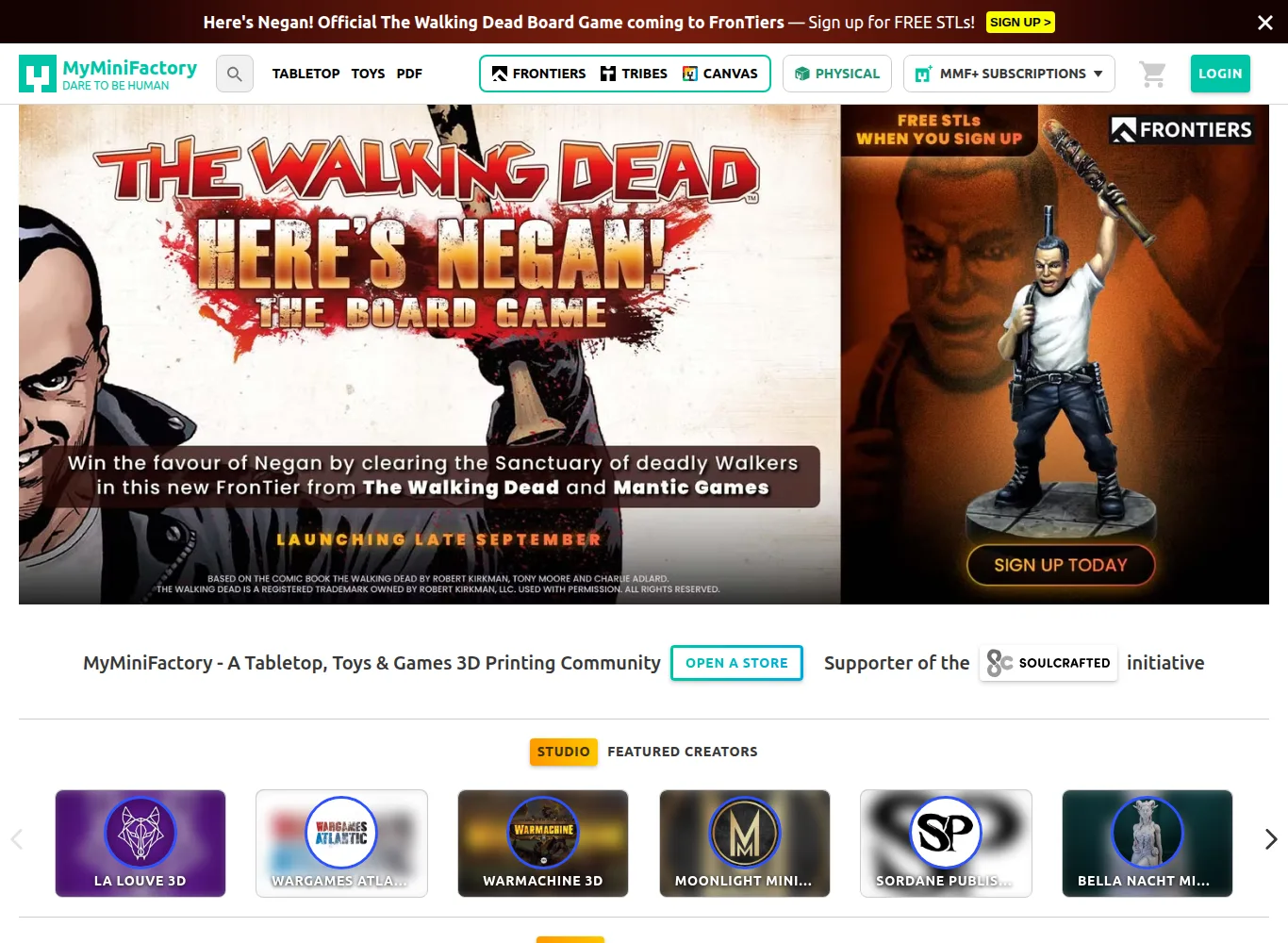
MyMiniFactory is a London-based digital asset marketplace known for tabletop role-playing games (TTRPGs), wargaming miniatures, and resin (SLA) 3D printing [1][2]. Distinguished by its rigorous “Guaranteed Printable” testing protocol, monthly Tribes subscription ecosystem, and open-access Scan the World cultural heritage archive, MyMiniFactory provides tabletop hobbyists and digital sculptors with reliable, production-tested 3D models [2][3].
⚡ MyMiniFactory Data at a Glance
Founding Story: From iMakr to Independent Miniature Marketplace
MyMiniFactory was established in London in 2013 by Sylvain Preumont, founder of the prominent 3D printing retail pioneer iMakr [2][4]. Under the corporate leadership of Romain Kidd, who assumed the Chief Executive role, the platform evolved into a self-standing independent entity focused on curated quality over unfiltered catalog volume [2].
During the early 2010s, open 3D model repositories were notorious for non-manifold meshes, inverted surface normals, internal voids, and broken geometries that failed mid-print [2][3]. MyMiniFactory changed this by introducing physical slicing and print verification, establishing a quality benchmark in desktop manufacturing [3].
“Guaranteed Printable” Certification: Zero-Failure Protocol
Models bearing the Guaranteed Printable badge undergo a rigorous multi-stage qualification protocol before entering the public marketplace [1][3]:
- Automated Mesh Diagnostics: Computational geometry tools scan uploaded files for self-intersecting faces, non-manifold edges, zero-thickness shells, and unclosed boundaries [3].
- Physical Test-Print Validation: Miniature models must be test-printed on standard FDM or resin SLA hardware by the designer or the community testing network, with photographic proof of successful fabrication [3].
- Pre-Supported Lychee & Chitubox Files: Miniature sculptors provide tested support scaffolding calibrated to preserve fine weapons, wings, and facial features without tearing or pockmarking [1].
Tribes, FronTiers & The Digital Miniature Economy
In 2021, MyMiniFactory transformed tabletop miniature monetization by introducing Tribes—an integrated recurring subscription system designed as an alternative to external platforms like Patreon [3][5]:
| Ecosystem Feature | Operational Mechanism | Value to Makers & Sculptors |
|---|---|---|
| Tribes Subscriptions | Members back miniature sculptors monthly; release packages are automatically deposited into user cloud libraries [5]. | Eliminates external file download links, expired cloud drives, and manual file organization. |
| FronTiers Crowdfunding | Integrated campaign engine offering early-bird tiers, stretch goals, and modular campaign bundles [1][6]. | Enables sculptors to finance comprehensive wargaming armies with immediate digital asset distribution. |
| Merchant Tier Licensing | Commercial subscription tier granting legal authorization to sell physical 3D prints of monthly releases [5]. | Empowers independent Etsy sellers and tabletop game stores with licensed production rights. |
Scan the World: Open Cultural Heritage Digitization
MyMiniFactory hosts Scan the World, the world’s foremost non-profit community initiative dedicated to digitizing global cultural artifacts through high-precision photogrammetry and 3D scanning [1][7]:
- Prestigious Museum Collaborations: Artifacts from the British Museum, the Louvre, the Rodin Museum, and the Vatican have been digitized into watertight 3D meshes [7].
- Open-Access & Public Domain: All sculptures in the archive are accessible free of charge for educational institutions, art scholars, and tactile teaching programs for the visually impaired [1][7].
Tabletop Miniatures & 3D Printing Marketplaces Benchmark
To evaluate how MyMiniFactory compares against alternative 3D printing and miniature platforms, examine the following benchmark matrix:
| Feature / Metric | MyMiniFactory | Cults3D | Printables | MakerWorld | CGTrader |
|---|---|---|---|---|---|
| Primary Specialty | Tabletop Miniatures & Resin STLs | Artistic Sculptures & Cosplay | Functional & Engineering STLs | Multi-Color 3MF & Bambu Profiles | General Stock 3D & VFX |
| Author Monetization | Store (85%–90%) + Tribes + FronTiers | Store (80% Net) | Prusameter Points + Clubs | MakerWorld Points System | Store (70%–80%) |
| Printability Guarantee | Guaranteed Printable Badge | Community Photo Makes | Verified Makes & G-code Scanner | Print Profile Ratings | None for 3D Printing |
| Pre-Supported Resin Files | Industry Standard (Lychee / CHT) | Available on select models | Limited (primarily FDM) | Rare (FDM-focused) | Rare |
| Hardware Tie-in | Independent / Agnostic | Independent / Agnostic | Prusa Research Ecosystem | Bambu Lab Ecosystem | Independent / Agnostic |
Technical Diagnosis & Workflow Troubleshooting Guide for Resin Printing
Tabletop RPG miniatures feature fragile fine details (spears, swords, capes) requiring calibrated resin printing workflows. Follow this technical diagnosis guide:
| Defect / Symptom | Root Technical Cause | Actionable Resolution Pipeline |
|---|---|---|
| Support Pockmarks & Surface Scarring on Miniatures | Removing supports after post-curing, or using excessively heavy support contact diameters (>0.4mm) on visible surfaces. | Submerge the washed, uncured print into warm water (50°C–60°C) for 30 seconds before peeling supports away by hand. Supports will soften and snap cleanly without pitting. Perform final UV curing only after support removal. |
| Layer Separation / Delamination on Fine Sword Blades | Insufficient normal exposure time, high peel lift speeds, or zero “Rest Time After Retract” causing resin turbulence. | Run a resin exposure test (The Cones of Calibration V3 or XP2 validation matrix). Add a 1.0s–1.5s Rest Time After Retract / Light-off Delay to ensure resin settles completely before exposure begins. |
| Pre-Supported Model Fails When Rescaled in Slicer | Scaling a pre-supported model reduces the support contact tip diameter proportionally (e.g., scaling down by 50% reduces 0.3mm tips to 0.15mm, causing peel detachments). | Never rescale pre-supported files. Instead, import the unsupported base STL, scale to your desired gaming scale (e.g., 28mm to 32mm heroic), and generate fresh supports in Lychee or Chitubox. |
| Warped Miniature Display Bases | Printing bases flat against the build plate causes intense bottom layer exposure suction and shrinkage warping during curing. | Angle miniature bases at 45° relative to the build plate. Place heavy supports along the lowest perimeter edge to resist peel forces, ensuring a crisp flat bottom. |
Pros & Cons Summary
✅ Strengths
- “Guaranteed Printable” verification standard.
- Large catalog for D&D, Warhammer, and tabletop RPG miniatures.
- Integrated Tribes subscription and FronTiers crowdfunding ecosystems.
- High availability of pre-supported files optimized for resin 3D printing.
- Free open-access cultural heritage archive via Scan the World.
⚠️ Considerations
- Commercial focus means significantly fewer free models than Thingiverse or Printables.
- Curated catalog is specialized toward tabletop figurines rather than mechanical engineering CAD.
- Subscription management requires tracking multiple Tribes tiers across favorite artists.
Frequently Asked Questions (FAQ)
What is MyMiniFactory Tribes?
Tribes is an artist-support subscription system built directly into MyMiniFactory. Subscribers pay a monthly fee to their preferred miniature sculptors, receiving instant access to exclusive monthly model releases deposited straight into their digital library.
Can I sell physical 3D prints of MyMiniFactory miniatures?
Standard purchases are for personal use only. However, many sculptors offer active Merchant Tiers through Tribes or FronTiers that grant commercial physical printing licenses for a monthly subscription fee.
What does the “Guaranteed Printable” badge mean?
The badge certifies that the 3D model’s mesh topology has passed automated non-manifold geometric error checks and has been verified through a successful physical test print on desktop 3D printing equipment.
Are Scan the World 3D models really free to download?
Yes. All 3D scans hosted under the Scan the World initiative are 100% free and open-access for educational, artistic, and research applications.
Explore Related 3D Printing Platforms
Compare MyMiniFactory with other leading 3D printing repositories in our directory:
- Cults3D Review: The Artistic & Cosplay 3D Printing Marketplace
- Printables Review: The Modern Gold Standard in 3D Printing
- MakerWorld Review: Multi-Color 3D Printing & Bambu Ecosystem
- Browse the complete directory: Ultimate List of 50+ 3D Model Sites
References and Verified Sources
[1] MyMiniFactory Official Platform and Tabletop Miniatures Catalog: myminifactory.com
[2] All3DP, MyMiniFactory History, iMakr and Guaranteed Printing Standards: all3dp.com
[3] 3DPrint.com, MyMiniFactory Quality Verification and Curation Review: 3dprint.com
[4] Romain Kidd Biography and MyMiniFactory Corporate Leadership Vision: myminifactory.com/about-us
[5] MyMiniFactory Tribes Ecosystem and Miniature Sculptor Subscriptions: myminifactory.com/tribes
[6] MyMiniFactory FronTiers Crowdfunding Platform: myminifactory.com/frontiers
[7] Scan the World Cultural Heritage 3D Scanning Initiative and Museum Partnerships: myminifactory.com/scantheworld
More platforms like this one are compared in our list of 3D model sites.