





3DShook is gone. What you need may be here.
As of 1 November 2026, 3dshook.com resolves to a parked domain and startup database Tracxn lists the company as inactive. These five active options do the same job today:
The piece below is a retrospective file on how 3DShook worked and why it is still worth talking about. For the detailed comparison, jump to this section.
16 April 2015. New York. 3D Print Week.
Five people arrived with more than 600 3D models and a simple promise: every model would be printed in-house, and anything that failed would never reach the catalog.
The press called it the “Netflix of 3D Printing.” The company liked the label. For a while, it looked like the start of a new subscription era.
Then the story went quiet.
Today 3dshook.com is a parked domain. Startup database Tracxn lists the company as inactive. There is no public closure announcement; only archived pages, a handful of articles and one number: 20%.
This article follows that number.
⚡ The Case File
A Star Trek fan, a Replicator and a five-person team
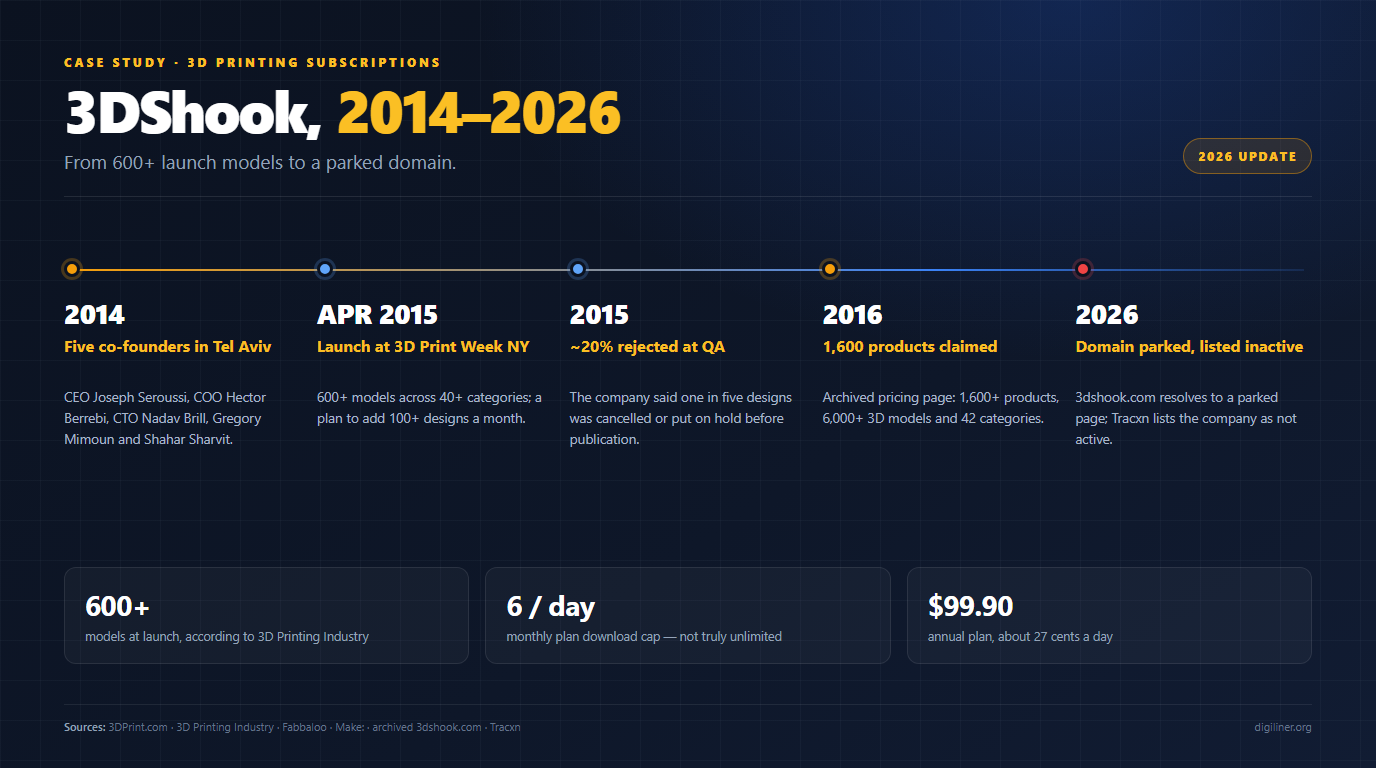
Here is the part the story usually skips: 3DShook was not one designer’s personal project. It was founded in Tel Aviv in 2014 by five people: CEO Joseph Seroussi, COO Hector Berrebi, CTO Nadav Brill, sales lead Gregory Mimoun and collections manager Shahar Sharvit [1][9][10].
That structure explains both halves of the platform: product and design on one side, operations and quality control on the other. 3DShook looked like a design studio. In practice, it was a testing and logistics operation.
The first turn.
Berrebi’s background was not industrial design but video and film post-production. He had co-run a technology consulting firm for TV channels and post-production houses [1]. In an interview with 3DPrint.com he called himself a “closet Trekkie” and said life would not be complete without a Holodeck and a Replicator.
That sounds like a hobby story. But it is exactly where the product logic lives. Berrebi had watched 3D printing spread online for three years and felt the content lagged the hardware. In his words, it was “messy, mostly unattractive, seldom curated, and not packaged in a desirable way” [1].
The company raised a seed round from Kima Ventures in the summer of 2014 and opened its platform on 16 April 2015, during 3D Print Week in New York [1]. 3DPrint.com’s launch story used “Netflix of 3D Printing” in its headline. 3DShook embraced the label; its homepage carried the phrase for years [7].
“We cancel or put on hold roughly 20% of our designs during QA. We want to assure the best possible 3D printing experience, so any design that does not print well will not make it to the collection.”
— Hector Berrebi, 3DShook co-founder, 3D Printing Industry interview (translated)
The Netflix comparison: where it holds, where it breaks
In 2015, most 3D model sites followed one of two models: a free, messy archive or a per-file payment. 3DShook tried a third way with subscription logic. A monthly membership gave access to the catalog and a download allowance; an annual membership lowered the unit cost [1][2][3].
It sounds familiar, doesn’t it? But there is a catch.
The second turn: “unlimited” wasn’t.
In Fabbaloo’s April 2015 coverage, CEO Joseph Seroussi said downloads were capped so that nobody could drain the whole library in a month. The limit was set at a multiple of what a person could reasonably print in a day [3]. The company’s pricing page confirms it: the monthly plan allowed 6 designs a day, the annual plan 8 a day [5].
So “all-you-can-print” was not a feast. It was a measured plate. That is not necessarily a bad thing, but you should know where it sits in the Netflix comparison.
The size of the catalog is the other half. Fabbaloo noted that Thingiverse had reached roughly 700,000 models by April 2015, while 3DShook’s live catalog was just over 500 [3]. The point was never “more models”; it was “fewer, but more reliable models.”
The same choice is still in front of you today: a huge, messy archive or a small, tested catalog?
20%: why one QA number matters
3DShook’s most interesting claim is not “every model is tested.” It is that the test had a measurable result. Berrebi’s 20% rejection figure is a company claim, but at least it is falsifiable.
In the same interview he said the company ran its own design and quality-control teams, and that designs which did not print well were kept out of the collection [2]. That is far more concrete than “someone probably tested it”: one in five files went into the bin before publication.
Make: magazine’s launch impression makes the picture more concrete. After meeting the team at the 3D Print Show, Matt Stultz reported that every 3DShook model was prepared by its own design and modeling team, then passed to the in-house printing team. According to Stultz, the head of printing and testing was the man who “drives them all crazy” by throwing away large amounts of completed work; but that was exactly what made the customer experience work [4].
The distinction matters: “100% tested” can be a marketing line; “20% rejected” is a process claim. The second explains why the platform ran a smaller catalog and why it looked more expensive than a free archive.
The 1,500-model myth
The third turn.
Many reviews of 3DShook repeat the phrase “1,500+ models.” The sources show where that number came from: in April 2015, Fabbaloo wrote that the live catalog had over 500 models, but the company had around 1,500 models in the queue [3].
In other words, 1,500 was not the shop window. It was the kitchen.
The company’s own numbers later shifted to different units. An archived 2016 pricing page said “over 1,600 products and 6,000+ 3D models” across “42 categories” [5][6]. At launch, 3D Printing Industry reported “600+ models” and “40+ categories” [2]. Fabbaloo counted 49 categories [3].
| Source / date | Model count | Categories | Note |
|---|---|---|---|
| 3DPrint.com, April 2015 | 500+ (launch target) | 40+ | Berrebi’s pre-launch statement [1] |
| 3D Printing Industry, 28 April 2015 | 600+ | 40+ | Post-launch report [2] |
| Fabbaloo, 26 April 2015 | 500+ live; ~1,500 in queue | 49 | “In queue” is the key phrase [3] |
| 3DShook pricing page, 2016 archive | 1,600+ products; 6,000+ 3D models | 42 | The company’s own claim [5][6] |
The gap shows why model counts deserve caution. “Product,” “model,” “variant” and “design in the queue” are not the same thing. In 3DShook’s case, the 1,500 figure was a signal from the production pipeline, not the live catalog.
Pricing: the fine print of “unlimited”
The 2015 coverage does not agree on every price; that reflects the campaigns and package structure of the period. The table below sets out the historical prices side by side. These are not current prices; the service is no longer accessible.
| Plan | Price | Download allowance | Source |
|---|---|---|---|
| Free Trial Gallery | $0 | Trial collection only | [5][7] |
| 48-hour “Weekend” plan | $4.99 | 48-hour access | [1][3] |
| Monthly subscription | $14.90 (some sources say $15; $8.99 in 2015) | 6 designs a day | [1][2][3][5] |
| 6-month subscription | $75 | Not specified | [3] |
| Annual subscription | $99.90 (about $8.33/month; ~27 cents a day) | 8 designs a day | [1][3][5][6] |
| K-12 education annual | $69.90 | 8 designs a day | [5] |
| 12-file pack | $10 | 12 files, no time limit | [5] |
| 40-file pack | $25 | 40 files, no time limit | [5] |
| 100-file pack | $50 | 100 files, no time limit | [5] |
| Commercial license | On request | Right to sell physical prints | [5] |
As the table shows, this was not a “credit pack” system but a file pack and single-file purchase model. The 12-file pack cost $10, less than $1 per file. The 100-file pack brought the unit price down to 50 cents.
On the subscription side, “unlimited” was limited by a daily download allowance [5]. 3DShook gave you the keys to a library, but a gatekeeper counted how many books you could carry out each day.
These prices have no practical meaning today because the service is not active. They are still interesting historically: 3DShook was an early attempt to bridge “buy a single file” and “subscribe to a library.”
More than files: Appz and physical prints
The overlooked side of 3DShook is that it was not only a model library. The company also offered Appz, a set of browser-based tools that let members scale and adjust models [4][5]. According to Make:, you could measure the diameter of a hole and resize the entire model to that measurement, or combine STL files to add embossed or engraved text [4].
More interesting still was the physical output option for people without a printer. The company’s homepage said 3DShook designs could be ordered through print services such as Shapeways and 3D Hubs [7]. The company called itself “the world’s first Subscription Print on Demand (SPoD) service” [6].
In other words, it tried to combine the model, the customization tools and physical production in one subscription experience. An early sketch of today’s integrated slicer and customization workflows.
Its “What We Do” page also said every design was exclusive and IP-clean, and that new designs were added bi-monthly [6]. That carried the curated-catalog claim into licensing as well.
In 2015, however, the tools were in beta and carried a watermark on the free plan [5].
Where it stumbled
✅ What worked
- Measurable quality control: rejecting about 20% of designs showed the test process was real.
- In-house design: the source was one team, not a scattered community.
- Packaged experience: model page, photos, description and customization tools in one place.
- Flexible access: free trial, single file, file packs and subscriptions.
- Physical output: Shapeways/3D Hubs ordering for people without a printer.
⚠️ What held it back
- Small catalog: 500–1,600 products could not compete with the volume of open archives.
- Daily cap: the “unlimited” subscription was limited to 6–8 downloads a day.
- STL-first: the catalog was built around print-ready STL files, not editable parametric CAD.
- Niche categories: home, decor, kitchen, office and gifts dominated; it was not built for tabletop miniatures or cosplay.
- Subscription wall: most of the catalog was paid.
- Unavailable today: the end of the service is the most practical drawback.
Which 2026 alternative fits you?
3DShook’s closure does not remove the need for “tested models.” There are five strong options today, but none offers exactly the same “curated subscription” model.
The choice depends on whether you want a broad free archive, a curated catalog, or a way to support a specific designer.
| Platform | Strength | Watch out for | Best for |
|---|---|---|---|
| Printables | Large free archive; strong Prusa ecosystem integration | Quality varies by model; check comments and photos before printing | People who want range and community feedback |
| MakerWorld | Focused on the Bambu Lab ecosystem; free and point-based | On non-Bambu printers, check slicer settings separately | Bambu ecosystem users |
| Thangs | Geometric search across multiple archives | Not a single curated catalog; check the license per model | People hunting a specific part across sources |
| MyMiniFactory | Curated mix; free and paid content side by side | Check the license scope on paid content | People who want selected content |
| Cults3D | Large paid marketplace; direct support for designers | Quality and license vary by designer | People who want to support a specific designer |
Verdict: what remains of a parked domain?
3DShook was a quality-over-quantity bet. Its catalog looks tiny next to today’s open archives, but the 20% rejection rate was concrete evidence that the filter it promised was actually working.
The platform’s real legacy may not be the “Netflix” label but that number: the idea that a model should be printed before it is published.
A 3D model site’s soul may lie not in how many models it offers, but in how many it refuses to publish.
You cannot subscribe to 3DShook today. Its story still leaves two questions worth asking when choosing a 3D model: who tested this model, on which printer? And does the license allow me to sell the print?
Frequently Asked Questions
Sources and Verification Links
[1] 3DPrint.com — “Netflix of 3D Printing: 3DShook to Launch Subscription Service” (8 April 2015) — founding team, Berrebi’s background, Kima Ventures funding, launch date and 2015 pricing.
[2] 3D Printing Industry — “3DShook Shakes Up Marketplaces with Unlimited 3D Printing Subscription Plan” (28 April 2015) — 600+ models, 40+ categories, the 20% QA rejection figure and monthly pricing.
[3] Fabbaloo — “3D Shook’s All You Can Eat 3D Models” (26 April 2015) — 500+ live models, ~1,500 in the queue, download caps and the price list.
[4] Make: — “3DShook Offers a Curated Collection of 3D Designs” (23 April 2015) — in-house design and print team, Appz tools and launch impressions.
[5] 3DShook — Pricing page (2016 archive) — subscription allowances, three file packs, Trial Gallery, commercial license and the “1,600+ products / 6,000+ models” claim.
[6] 3DShook — “What We Do” page (2016 archive) — 42 categories, the “Subscription Print on Demand (SPoD)” description and testing/exclusivity claims.
[7] 3DShook — Homepage (2016 archive) — the “Netflix of 3D Printing” quote, free trial and the Shapeways/3D Hubs physical print option.
[8] Tracxn — 3DShook company profile — “not active” status, $600K total funding and a single investor record.
[9] MarketScreener — Nadav Brill / 3DShook Ltd. — 6 October 2014 incorporation date and the five co-founders.
[10] Crunchbase — 3DShook — co-founder list.
[11] 3dshook.com — parked domain as of 1 November 2026.
More platforms like this one are compared in our list of 3D model sites.