




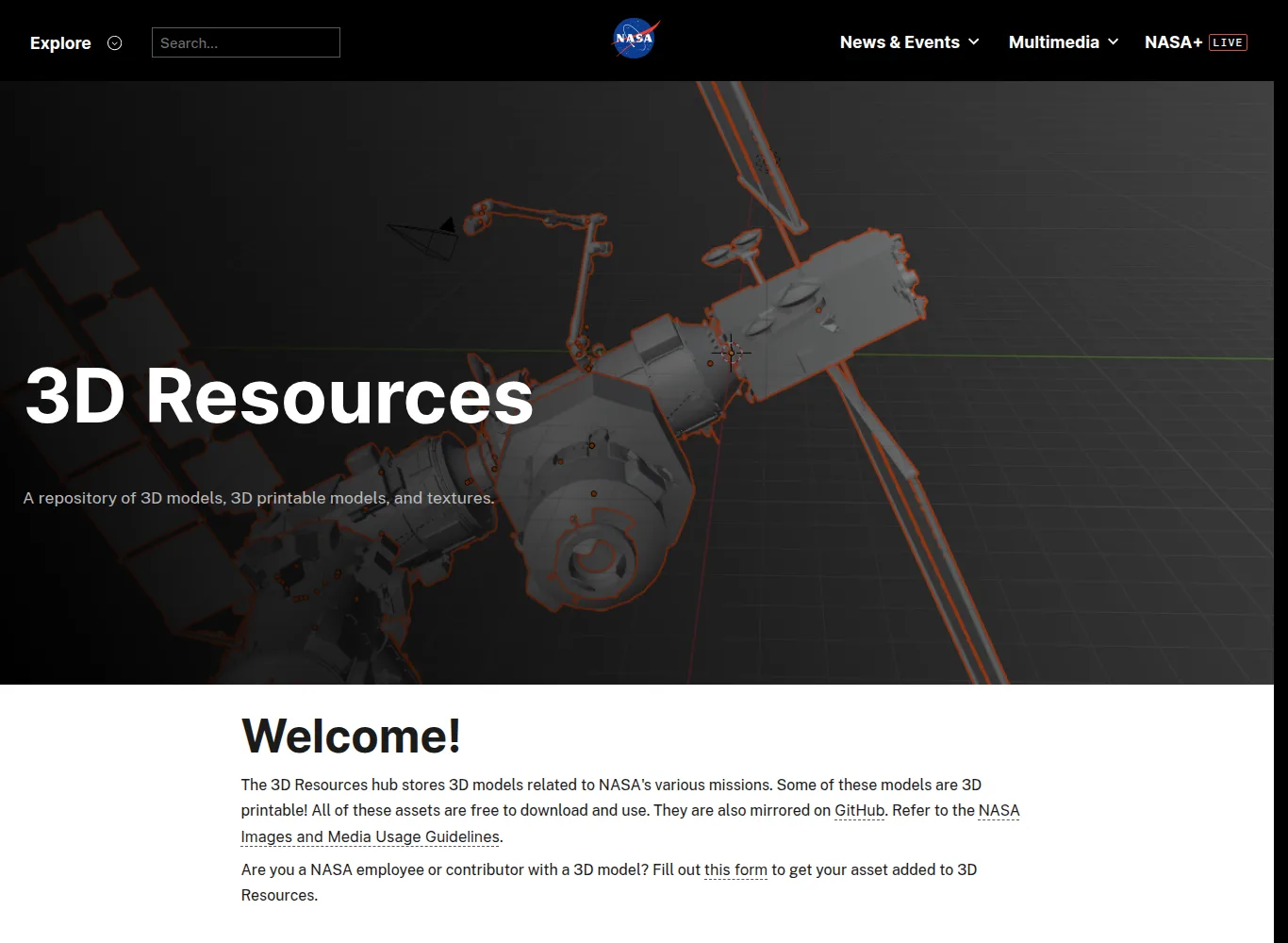
NASA 3D Resources serves as the premier open-access repository for authentic aerospace engineering models, laser-scanned celestial topography, and deep-space mission hardware. Featuring direct flight digital assets from NASA JPL, Goddard, and Ames Research Centers—including the James Webb Space Telescope, Mars Perseverance rover, and orbital elevation maps—the portal provides scientific visualizers, game developers, educators, and makers with 100% public domain 3D models.
⚡ Platform At a Glance
Aerospace Flight Schematics & Mission Engineering CAD
In cinematic documentaries, astronomical simulations, and aerospace games, technical accuracy is paramount. Rather than relying on speculative artist interpretations, NASA 3D Resources provides 3D models developed directly from official flight hardware schematics, orbital telemetry, and spacecraft design blueprints [1]. Managed by NASA’s multimedia teams across the Jet Propulsion Laboratory (JPL), Ames Research Center, and Goddard Space Flight Center, the repository represents the ultimate digital archive of space exploration.
The collection bridges historical milestones and active deep-space exploration [2]. Visualizers can explore true-to-scale models of the Apollo 11 Lunar Module (Eagle), the Space Shuttle Discovery, the International Space Station (ISS), the James Webb Space Telescope (JWST), the Mars Perseverance and Curiosity rovers, the Ingenuity helicopter, and the Artemis Space Launch System (SLS).
Planetary Telemetry Elevation & Asteroid Photogrammetry
In addition to human-made space exploration hardware, NASA 3D provides scientifically rigorous 3D digital elevation models (DEM) of solar system bodies [3]:
- Lunar Reconnaissance Orbiter (LRO): Ultra-high-resolution topological displacement spheres and localized meshes of lunar impact basins, including Shackleton Crater and the Apollo landing sites, derived from the Lunar Orbiter Laser Altimeter (LOLA).
- Mars Global Surveyor (MGS): Complete digital terrain models generated by the Mars Orbiter Laser Altimeter (MOLA), providing exact elevation profiles for Olympus Mons, Valles Marineris, and Jezero Crater [4].
- Asteroids & Small Bodies: Photogrammetric 3D surface reconstructions of Near-Earth Asteroid Bennu (OSIRIS-REx mission), Comet 67P/Churyumov-Gerasimenko, and Asteroid Vesta.
Scientific & Open-Access 3D Repositories Benchmark Matrix
To evaluate how NASA 3D Resources compares with other premier public-domain, educational, and cultural heritage 3D repositories, review the benchmark matrix below:
| Platform | Specialization | Scientific Rigor | License Model | 3D Printing (STL) | File Formats |
|---|---|---|---|---|---|
| NASA 3D Resources | Aerospace flight hardware & planetary topography | Direct flight CAD, radar & laser altimetry | 100% Public Domain (US Gov) | Yes (Pre-scaled rovers & probes) | OBJ, FBX, STL, GLTF, USDZ |
| Smithsonian 3D | Museum artifacts, paleontology & historical relics | Sub-millimeter optical photogrammetry | Creative Commons Zero (CC0) | Yes (Museum-grade fossil prints) | OBJ, glTF, Draco, Voyager WebGL |
| ESA 3D (European Space) | European spacecraft (Rosetta, Ariane, Euclid) | Official ESA engineering CAD models | CC BY-SA 3.0 IGO | Select mission STL models | OBJ, 3DS, STL |
| Sketchfab Cultural | Global museum, heritage, and archaeological scans | Institutional photogrammetry & LiDAR | CC0, CC-BY & Commercial | Varies by uploading museum | glTF, USDZ, OBJ |
| NIH 3D Print Exchange | Biomedical models, anatomical structures & viruses | Cryo-EM & medical imaging (CT/MRI) | Public Domain / Creative Commons | Dedicated medical 3D printing | STL, VRML, OBJ |
Technical Diagnostics: Materials, Topography & 3D Printing
To optimize NASA models for modern ray tracing engines, game viewports, and additive manufacturing slicers, apply these verified technical procedures:
1. Upgrading Legacy Shaders to Modern PBR in Blender & Unreal Engine
Symptom: Older NASA OBJ models (such as Voyager or Apollo components) import with flat Phong/Lambertian materials and unlinked diffuse textures, rendering without specular reflections or metallic solar foil properties.
Resolution: Rebuild materials using the Principled BSDF in Blender or an Unreal Engine PBR Master Material. For gold kapton insulation blankets (e.g., Lunar Module or JWST sunshields), set Metallic to 1.0, Roughness to 0.15–0.25, and plug a crinkled foil normal map into the Normal input with anisotropic rotation [5].
2. Repairing Non-Manifold Geometries on 3D Printable STL Models
Symptom: Slicers like PrusaSlicer, Bambu Studio, or Cura show red boundary warnings, hollow hulls, or missing antenna struts when slicing NASA rover STL files.
Resolution: In your slicer, right-click the model and select Fix through Netfabb (Windows) or import into Autodesk Meshmixer. Thin antenna wires and solar panel edges often have zero thickness; apply a 1.0mm shell offset or thicken fragile struts before exporting to G-code [6].
3. Adhering to NASA Insignia & Commercial Usage Guidelines
Symptom: Commercial game developers or filmmakers mistakenly believe that public domain 3D models allow unrestricted commercial use of the NASA “meatball” or “worm” logos.
Resolution: While NASA 3D models are in the public domain, the official NASA insignia, logo, and identifier names are protected by US Federal Law (14 CFR 1221). They may not be used on commercial merchandise or in video games in any way that implies NASA endorsement without prior written approval from the NASA Media Department [7].
Supported File Formats & Software Compatibility
| Format | Host Software / Engine | Ideal Application |
|---|---|---|
| .OBJ / .MTL | Blender, Maya, 3ds Max, Cinema 4D, Houdini | Standard textured spacecraft models and surface terrain meshes |
| .STL | PrusaSlicer, Bambu Studio, Cura, Chitubox | Watertight models optimized for desktop 3D printing and educational builds |
| .GLTF / .GLB | Three.js, WebXR, Mobile AR, Godot Engine | Interactive real-time web exploration with embedded PBR textures |
| .USDZ | Apple iOS AR Quick Look, Reality Composer | Augmented reality spacecraft previews on iPhone and iPad |
| 16-bit .TIF DEM | Unreal Engine 5 Landscape, World Machine, Gaea | Sub-pixel accurate heightmaps of Martian craters and lunar rilles |
Licensing & Public Domain Rights
NASA 3D Resources operates under the provisions of United States Public Domain Law governing works of the US Federal Government [7]:
- Commercial Film & Game Production: You may freely incorporate NASA 3D meshes and planetary textures into commercial video games, Hollywood films, scientific publications, and VR educational experiences without paying licensing fees or royalties.
- Attribution Best Practice: While not legally mandated for public domain assets, standard academic and industry etiquette recommends attributing models as “3D model courtesy of NASA / JPL-Caltech”.
- Logo & Insignia Restriction: The NASA “meatball” logo, the “worm” logotype, and agency seals are legally protected trademarks and may not be used to imply sponsorship or endorsement.
Pros & Considerations Summary
✅ Strengths
- 100% Public domain with zero licensing fees or commercial royalties.
- Direct engineering accuracy derived from official flight blueprints and telemetry.
- Pre-scaled, watertight 3D printable STL files ready for desktop fabrication.
- Scientific elevation heightmaps of the Moon, Mars, and major asteroids.
- Immediate free downloads without requiring accounts or subscriptions.
⚠️ Considerations
- Older legacy models require manual PBR material reconstruction.
- NASA insignia and agency emblems are protected and cannot be used commercially.
- Some engineering models contain unmerged parts or non-manifold mesh borders.
Frequently Asked Questions
Can NASA 3D models be used in commercial video games or movies?
Yes, as works of the US Federal Government, NASA 3D models are in the public domain and can be utilized in commercial films, games, documentaries, and publications without license fees [7].
Are Mars rover models ready for desktop 3D printing?
Yes, NASA provides dedicated STL files that are scaled and pre-configured for consumer 3D printers, ideal for classrooms, hobbyists, and museum exhibits [6].
Where does NASA obtain its planetary 3D elevation data?
Topographical datasets originate from orbital instruments including the Lunar Orbiter Laser Altimeter (LOLA) and the Mars Orbiter Laser Altimeter (MOLA) [4].
Verified References & Authoritative Sources
- NASA 3D Resources Official Portal — Public-domain aerospace 3D models and astronomical assets.
- NASA Jet Propulsion Laboratory (JPL) — Mars exploration and robotic spacecraft engineering models.
- NASA Lunar Reconnaissance Orbiter (LRO) Data Portal — Scientific elevation data and lunar topography.
- NASA Mars Exploration Program — Planetary terrain models and Mars rover telemetry.
- Blender Manual: Principled BSDF Shader — Metallic and roughness calibration for aerospace thermal foil.
- NASA 3D Printable STL Models Directory — Watertight files engineered for additive manufacturing.
- NASA Media Usage Guidelines & Regulations — Official policy on public domain works and protected insignias.
- USGS Astrogeology Science Center — Planetary GIS datasets and digital elevation maps.
More platforms like this one are compared in our list of 3D model sites.