



⚡ Unity at a Glance
| Current Version | Unity 6.6 (6000.6) mainline; 6.3 LTS (6000.3) is the current LTS — September 2026[1][2] |
|---|---|
| Developer | Unity Technologies [1][2] |
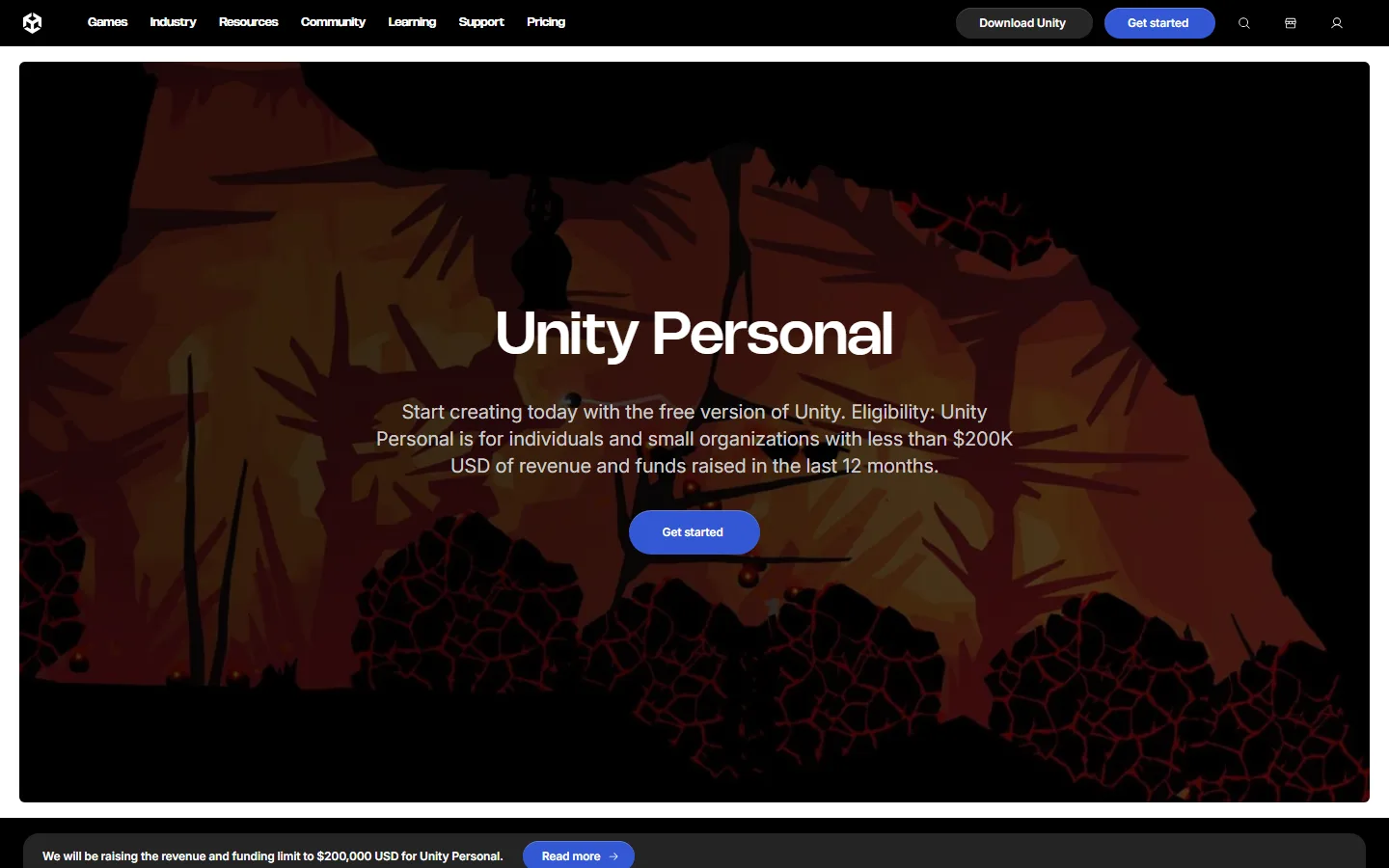
| Pricing | Personal free (under $200,000 revenue/funding); Pro $210/mo or $2,310/yr; Enterprise custom pricing[1][2] |
| License | Proprietary; subscription model (the 2024 runtime fee was cancelled)[1][2] |
| Platforms | Editor on Windows, macOS and Linux; targets Windows, macOS, Linux, iOS, Android, WebGL, consoles (PS5, Xbox Series, Switch) and Vision Pro[1][2] |
| File Formats | FBX, DAE (Collada), DXF, OBJ; .ma/.mb, .blend, .max, Modo, SketchUp and SpeedTree via conversion to FBX (the source application must be installed)[1][2] |
| Typical Use | Cross-platform real-time 3D games and apps; XR training, automotive and architectural visualization.[1][2] |
| Technical Detail | C# scripting and a large Asset Store and Package Manager ecosystem (URP/HDRP, Cinemachine, Addressables, Burst/IL2CPP); dedicated 2D tools including tilemaps; separate Industry/Enterprise plans for automotive, manufacturing and XR.[1][2] |
| Important Note | Cinema 4D files are not supported natively.[1][2] |
History and Background
Unity Technologies was founded in Copenhagen on 2 August 2004 as Over the Edge Entertainment by David Helgason, Nicholas Francis and Joachim Ante. Unity 1.0 launched at Apple’s WWDC in June 2005 as a Mac-only game engine and won the Best Use of Mac OS X Graphics award there. The company adopted the name Unity Technologies in 2007, and the engine later spread to Windows, mobile and consoles.
Sources for this section: en.wikipedia.org, cbox.dk (checked 5 November 2026).
Strengths
- C# scripting with a huge Asset Store and Package Manager ecosystem makes team standardization easy.
- Two render pipelines cover different targets: URP for phones, web and lower-end hardware, HDRP for high-end PC and console. A project runs on one of them at a time.
- The 2D tilemap workflow works with true 2D pixel coordinates.
- Cross-platform deployment: mobile, console, web, VR and Vision Pro.
What You Should Know
- Above $200,000 in revenue the Pro plan becomes mandatory at $2,310 per year.
- Some file formats, notably Cinema 4D files, are not supported natively.
- Proprietary formats such as Maya, Blender and 3ds Max require the source DCC installed for import.
Who Is It For?
Indie game developers, XR training and simulation teams, and automotive and product visualization teams.
References
The independent sources below were used to verify the version, pricing, license and technical details in this review.
This review belongs to our Popular 3D Modeling Software comparison.