




📊 Data at a Glance: Tracker Culture, Paula Silicon & The MOD Format
Authored by Karsten Obarski in 1987, the Ultimate Soundtracker and the MOD file format broke the recording studio monopoly, combining raw digital audio samples and musical sequencing into a compact, democratic binary standard.[1][3][4]
| Pioneering Author | Karsten Obarski (1965–) — Ultimate Soundtracker (September 1987, EAS) |
|---|---|
| Hardware Foundation | MOS Technology 8364 “Paula” (4 independent 8-bit PCM DMA channels, 2 left / 2 right stereo) |
| Key Architectural Feature | Bundling raw PCM waveform samples and pattern note sequencing into a single binary file |
| Critical Contributors | Lars Hamre (Protracker), Mahoney & Kaktus (NoiseTracker), Fredrik Huss & Magnus Högdahl (Fasttracker II) |
| Format Evolution | MOD (4-channel Amiga) → S3M (Scream Tracker 3, 16-channel) → XM (Fasttracker II, 32-channel) → IT (Impulse Tracker) |
| Historical Climax | Urban Shakedown’s “Some Justice”, produced solely on an Amiga 500 with Protracker, reaching #23 on the 1992 UK Top 40 |
September 1987. Gütersloh, West Germany.
In a small shared office of Rainbow Arts and EAS (Electronic Arts Software), twenty-two-year-old freelance composer and programmer Karsten Obarski had spent days without sleep in front of his Commodore Amiga 1000. Scattered across his desk were half-labeled floppies, cold coffee cups, and the prerelease build of an upcoming arcade title: an Arkanoid-inspired brick-breaker called *Amegas*.[1]
The graphics were complete, but the game had no soundtrack.
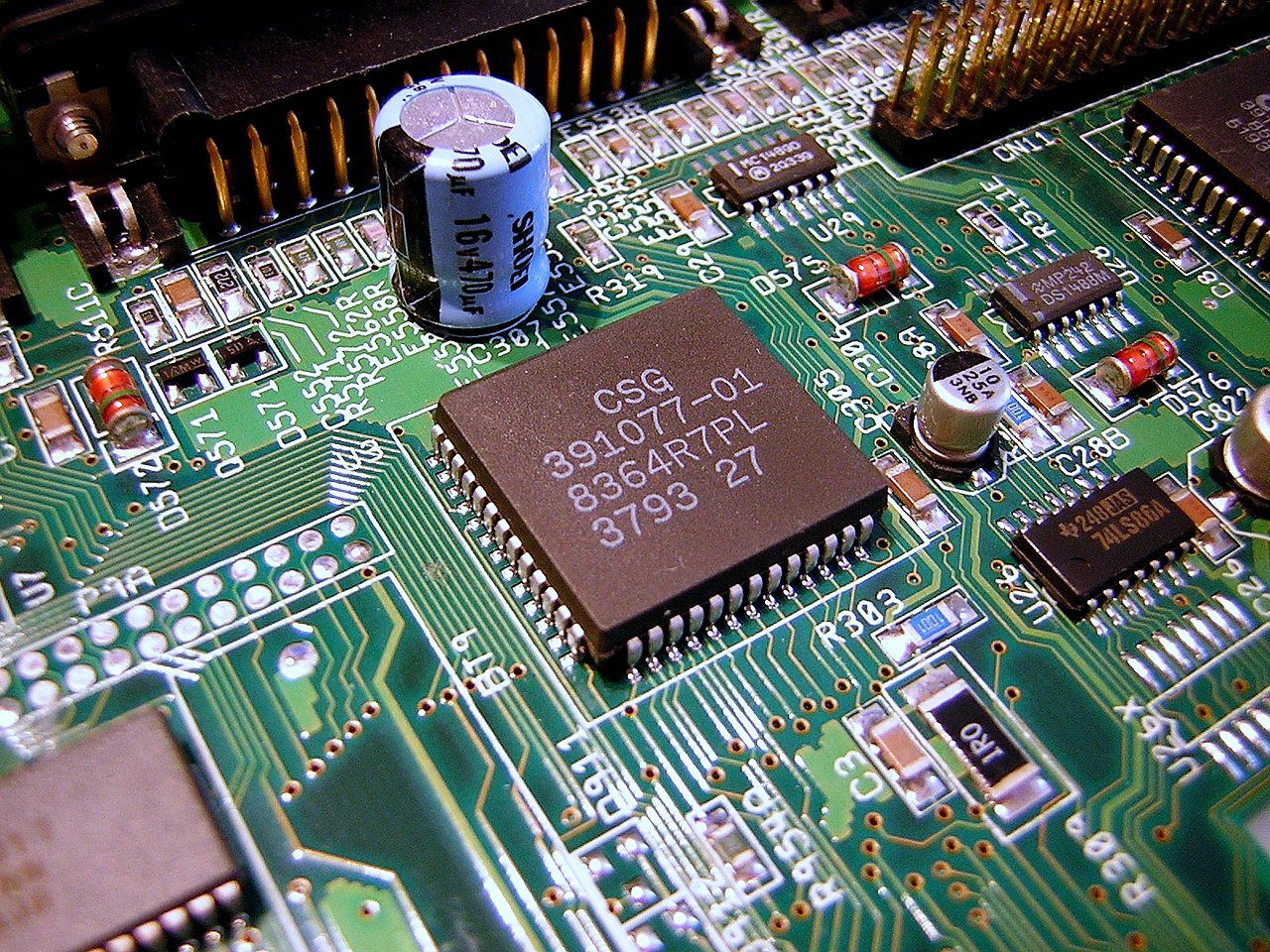
The obstacle was not lack of musical talent. In 1987, getting a computer to play music required the precision of a missile guidance engineer rather than an artistic ear. The Amiga’s revolutionary MOS 8364 Paula chip possessed direct memory access (DMA) capable of streaming 8-bit digital audio across four hardware stereo voices.[2] Yet instructing Paula to play music required either writing raw Motorola 68000 assembly instructions to hardware registers (AUD0LCH, AUD0LEN, AUD0PER, AUD0VOL) or connecting cumbersome, multi-thousand-dollar MIDI synthesizer keyboards.[1][2]
Obarski pushed the piano keyboard aside and discarded traditional centuries-old horizontal musical staves.
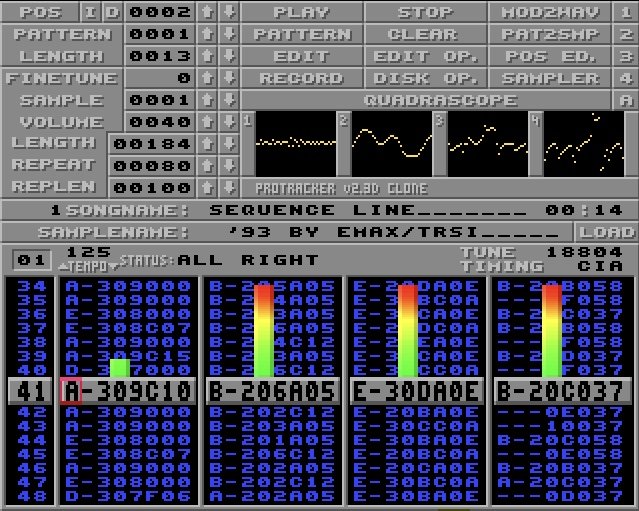
Instead, he divided the computer display into four vertical columns scrolling downward like a ticker tape, a player piano roll, or a factory assembly line.[1][3] Each column was hardwired to one of Paula’s hardware DMA voices. Each row contained a compact four-byte hexadecimal instruction:
C-3 01 C20
Translated: “Play note C in the 3rd octave, using instrument sample 01, and set volume level to hex 20 (50% amplitude).”
When Obarski saved the file, he appended a three-letter extension: .MOD (Module).[1]
Neither Obarski nor his studio managers anticipated the seismic shift that would follow: that unassuming file format would dismantle the multi-million-dollar recording studio monopoly, launching a populist revolution spanning bedroom producers, demoscene hackers, chart-topping dance anthems, and iconic video game soundtracks.
1. Why Was It a Revolution? The Anatomy of the MOD File
Until the late 1980s, digital audio existed in two impractical extremes:
- MIDI Files: Extremely compact (a few kilobytes), but containing zero actual audio waves—only instructions telling external instruments when to strike a note. The final playback depended entirely on the user’s sound card or synthesizer.
- Digital Wave Files (WAV / PCM): High-fidelity studio recordings, but requiring upwards of 10 Megabytes per minute of stereo sound. In an era when floppy disks held just 880 Kilobytes, distributing digital music files on magnetic media was impossible.
Karsten Obarski’s MOD (Module) format bridged this divide with a brilliant architectural compromise:[1][4]
The composer recorded short, raw 8-bit digital waveforms—such as a single snare drum strike, a plucked bass guitar note, or a vocal stab—and embedded them directly inside the file header. The tracker engine then adjusted the playback pitch of that single snare or bass sample on the fly, transposing it across musical octaves by varying Paula’s hardware DMA playback period.[2][4]
The outcome was unprecedented: an entire three-minute stereo orchestral piece with authentic acoustic drums, synth leads, and vocal stabs consumed merely 80 to 150 Kilobytes.[3] A single 880 KB Amiga game disk could easily hold the executable game code, hundreds of graphical assets, and five full-length stereo MOD tracks.
2. Twist One: The 99-Mark Prison and the Demoscene Jailbreak
Karsten Obarski did not design Ultimate Soundtracker as an open-source gift to humanity; his intent was purely commercial: compose game audio for his employer and monetize the tool on software shelves.[1]
In late 1987, publisher EAS put Ultimate Soundtracker on retail shelves for 99 Deutsche Marks (DM), protected by strict disk-copy encryption routines.[1][5]
Yet the commercial release was deeply flawed:
Twist One: Obarski’s Rigid Walls and the Hacker Rebellion
Obarski’s Soundtracker was limited to only 15 instrument samples. Its editing workflow was rigid, and most fatally, Obarski bundled custom low-level disk-access code that bypassed AmigaDOS. On standard consumer Amiga configurations, saving or loading files frequently crashed the operating system, destroying hours of musical composition in a fraction of a second.[1][5]
Frustrated by commercial barriers, the European demoscene mobilized. Swedish hacker groups Unknown and Mahoney & Kaktus decompiled Obarski’s binary, stripped away the copy protection, replaced the faulty disk routine with clean AmigaDOS calls, expanded the instrument limit from 15 to 31, and distributed the software worldwide for free as NoiseTracker.[1][6]
By 1990, Lars Hamre of the Amiga Freelancers refined the code into the definitive tracker: Protracker.[6]
Featuring single-keystroke octave switching, an integrated waveform editor, and a versatile command vocabulary (0xy Arpeggio, 1xx Portamento Up, 2xx Portamento Down, 3xx Tone Portamento, 4xx Vibrato, 9xx Sample Offset), Protracker became the universal creative standard. Karsten Obarski’s proprietary 99-Mark utility faded into obscurity, while the community’s unlocked software transformed musical history.
3. Twist Two: Paula’s Silicon Hardware vs. PC Software Mixing
To Amiga musicians, the Paula sound chip felt like effortless magic. Paula mixed four stereo audio streams in pure hardware DMA without consuming a single cycle of the Motorola 68000 CPU.[2]
Yet under the hood lay a deep hardware dependency:
Twist Two: Melodies Hardwired to the Amiga Color Crystal
Obarski and Protracker engineers did not store note pitches as standard frequencies (Hertz); instead, they recorded the raw period divisor of the Amiga’s motherboard color subcarrier crystal.[2][4]
The PAL Amiga system clock ran at 3.546895 MHz. A note’s playback period was derived directly from the hardware formula: Period = 3546895 / (Frequency × 2). Middle C (C-3) possessed a fixed hardware period of 428, while A-3 was 357.[4] The music was physically locked to the Amiga’s silicon architecture.
When the IBM PC world adopted the Creative Labs Sound Blaster in the early 1990s, PC developers suffered a rude awakening: the Sound Blaster had only a single mono DMA channel and zero hardware mixing channels! To play a 4-channel Amiga MOD file on a PC, programmers had to push Intel 386 and 486 CPUs to their limits with hand-crafted assembly “software mixers.”[7]
This technical challenge inspired PC software authors. Sami Tammilehto (Psi) of Finnish demogroup Future Crew developed Scream Tracker 3 (S3M), delivering 16 channels and stereo panning.[7]
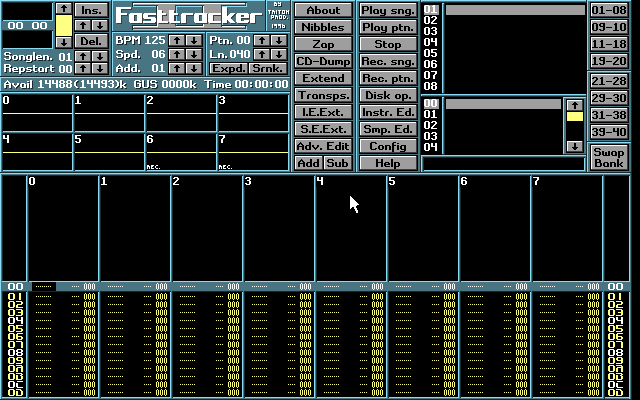
Shortly thereafter, Fredrik Huss and Magnus Högdahl of Swedish crew Triton authored Fasttracker II (FT2).[8] Expanding up to 32 channels with 16-bit sound and volume/panning envelope controls, the XM (Extended Module) format crowned the PC as a dominant tracker workstation.
4. Twist Three: From the Bedroom to the UK Top 40 — The Amiga Rave Anthem
1992. The United Kingdom was gripped by the breakbeat hardcore and illegal rave explosion.
In London, booking time in a professional commercial recording studio cost hundreds of pounds an hour. Purchasing an Akai S950 hardware sampler cost thousands; multi-track tape machines and mixing consoles were strictly reserved for major label artists.[9]
In East London, two young producers—Gavin King (DJ Aphrodite) and Mickey Finn—sat in a bedroom with zero capital. Their entire production studio consisted of a stock Commodore Amiga 500 with 1 Megabyte of RAM and a pirated Protracker floppy disk.[9][10]
Twist Three: The Zero-Budget Rave Hit That Rewrote the Charts
Using an inexpensive 8-bit microphone connected to a turntable, Aphrodite and Mickey Finn sampled James Brown’s iconic “Amen Break” drum fill and vocal stabs directly into the Amiga’s memory.[9]
They used no external analog synthesizers, no studio compressors, and no reel-to-reel tape. They entered every note, pitch shift, and breakbeat slice into Protracker’s four-column pattern grid with mathematical precision. The track was titled “Some Justice” (Urban Shakedown).[9][10]
Propelled by pirate radio broadcasts and warehouse raves, the single tore through the charts. In June 1992, “Some Justice” surged to #23 on the Official UK Singles Chart, selling over 100,000 physical vinyl copies.[10] The studio monopoly had been dismantled by a 1 MB home computer and freely shared software.
That track marked the definitive genesis of modern electronic bedroom production across Jungle, Drum & Bass, and Breakbeat.
5. The Evolution of Tracker Formats (1987 – 1996)
| Format / Software | Author / Year | Platform | Channel Count | Audio Fidelity | Defining Innovation |
|---|---|---|---|---|---|
| MOD (Soundtracker) | Karsten Obarski (1987) | Amiga | 4 Channels | 8-bit Mono PCM | First vertical hexadecimal pattern matrix, 15-sample limit |
| MOD (Protracker) | Lars Hamre / Freelancers (1990) | Amiga | 4 Channels | 8-bit Mono PCM | 31 samples, onboard sample editor, robust effects (0xy – Fxx) |
| S3M (Scream Tracker 3) | Sami Tammilehto / Future Crew (1994) | MS-DOS | 16 Channels | 8-bit / 16-bit Panning | Stereo channel panning, AdLib FM synthesis support |
| XM (Fasttracker II) | Triton (Huss & Högdahl) (1994) | MS-DOS | 32 Channels | 16-bit 44.1 kHz | Volume and panning envelopes, multi-sampling per instrument |
| IT (Impulse Tracker) | Jeffrey Lim (1996) | MS-DOS | 64 Channels | 16-bit Stereo | Resonant digital filters, New Note Action (NNA) voice logic |
6. Video Game Soundtracks and Enduring Legacy
The tracker workflow conquered the gaming industry throughout the 1990s:
- Chris Hülsbeck: Composed the timeless Turrican II: The Final Fight soundtrack using his customized TFMX tracker architecture, pushing Commodore audio to symphonic heights.[11]
- Jesper Kyd: Multi-award-winning composer for Assassin’s Creed, Hitman, and Borderlands, Kyd began his career in 1989 writing Protracker modules for the Amiga demogroup The Silents.[12]
- Alexander Brandon & Michiel van den Bos: The dynamic interactive soundtracks of Unreal (1998) and Deus Ex (2000) were composed directly in tracker formats (IT and XM).[13] The game engine seamlessly shifted pattern sequences and instrument layers as players transitioned into combat.
- Modern Descendants: Contemporary digital audio workstations like Renoise, OpenMPT, and the standalone hardware unit Polyend Tracker remain direct lineage holders of the four vertical columns Obarski sketched in 1987.
Frequently Asked Questions
Verified References and Sources
- Wright, Mark. “Retrospective: Karsten Obarski & The Ultimate Soundtracker”, Amiga Format Retro Special (1998).
- Commodore-Amiga Inc. Amiga Hardware Reference Manual: Paula Audio Architecture (Addison-Wesley, 1985).
- Collins, Karen. Game Sound: An Introduction to the History, Theory, and Practice of Video Game Music (MIT Press, 2008). ISBN: 978-0262033787.
- Lars Hamre et al. The Protracker 2.3A Specification and File Format Documentation (Amiga Freelancers, 1992).
- Reimer, Jeremy. “Total Amiga: The Tracker Phenomenon”, Ars Technica (2014).
- Carlsson, Anders. “Power Users and Software Piracy in the Amiga Demoscene”, WiderScreen Journal (2008).
- Tammilehto, Sami (Psi). “The Making of Scream Tracker and the S3M Format”, Future Crew Keynote Archives (1994).
- Triton. Fasttracker II v2.08 Documentation and XM Architecture Specs (Triton Production, 1995).
- Reynolds, Simon. Energy Flash: A Journey Through Rave Music and Dance Culture (Faber & Faber, 1998). ISBN: 978-0571289134.
- Official UK Singles Chart Archive. “Urban Shakedown – Some Justice Chart History” (June 1992, Peak #23).
- Hülsbeck, Chris. “Composing for the Amiga: From Paula to TFMX”, Sound on Sound Magazine (2004).
- Kyd, Jesper. “From Amiga Demoscene to Hollywood Soundstages”, D.I.C.E. Summit Keynote (2018).
- Brandon, Alexander. Audio for Games: Planning, Process, and Production (New Riders, 2004). ISBN: 978-0735714137.