 EN
 TR
 DE
 FR
 ES
📊 Data at a Glance: Amiga OCS Hardware Architecture & The Lorraine Project
Pioneered by Jay Miner and his close-knit engineering team, the Amiga OCS (Original Chip Set) architecture liberated personal computers from the CPU bottleneck, introducing independent hardware controllers for graphics, audio, and memory arbitration.[1][3][4]
| Lead Architect | Jay Glenn Miner (1932–1994) & Core Team (RJ Mical, Dave Needle, Dale Luck, Carl Sassenrath) |
|---|---|
| Development Codename | Lorraine (1982–1984, Hi-Toro / Amiga Corporation) |
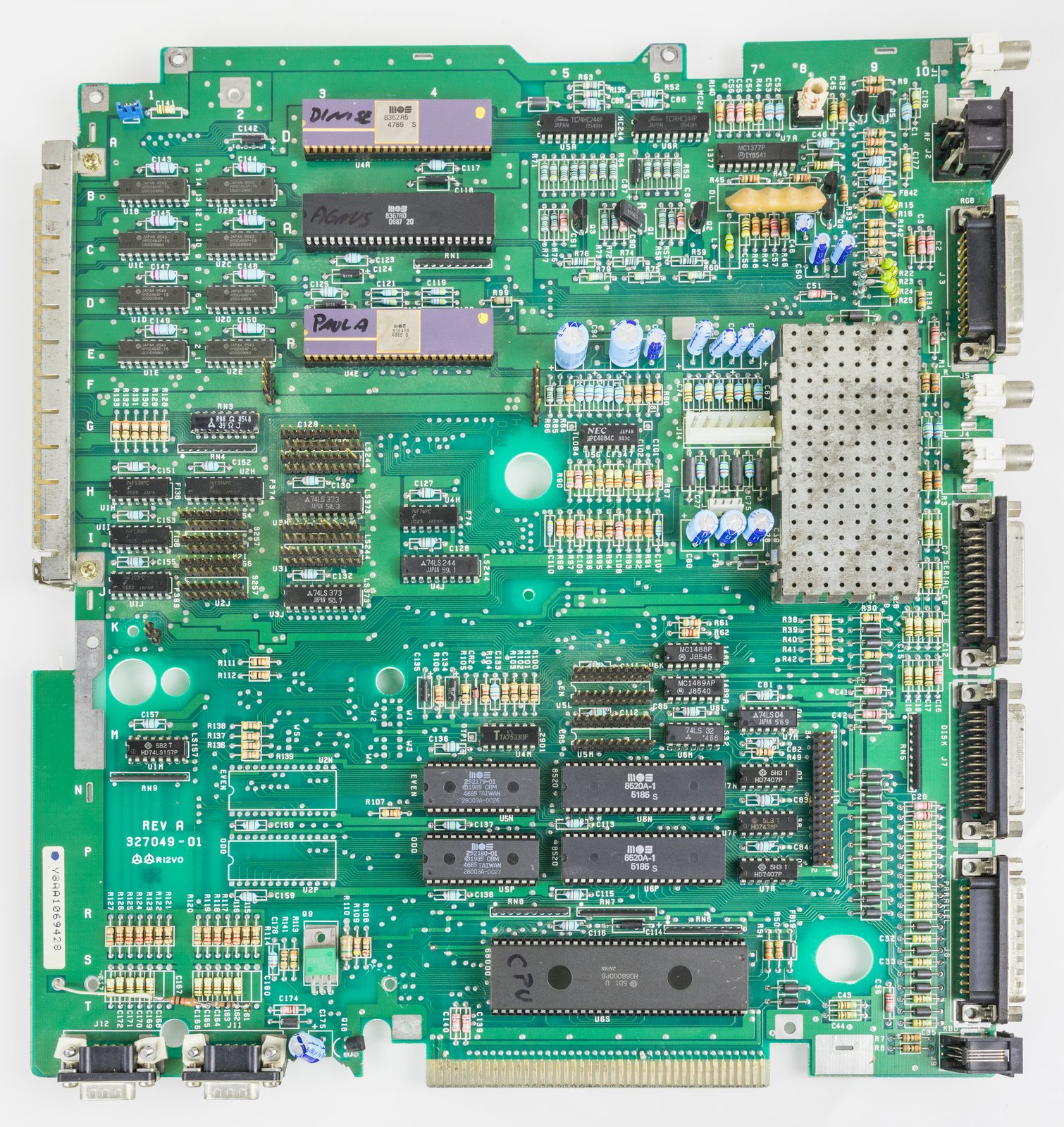
| Custom Chipset (OCS) | Agnus (MOS 8361/8367), Denise (MOS 8362), Paula (MOS 8364) |
| Coprocessors | Copper (Raster-synchronized display processor), Blitter (Hardware 2D block manipulation & fill engine) |
| Graphics Standards | 320×200 (32 colors), 640×200/400 (16 colors), HAM Mode (Hold-And-Modify) displaying 4,096 colors |
| Audio Architecture | 4 independent channels, 8-bit PCM DMA stereo audio, analog filtering (Paula) |
| Historical Turning Point | Atari’s $500,000 predatory loan clause and Commodore’s 11th-hour acquisition ($27 million, July 1984) |
January 4, 1984. Las Vegas, Nevada. The Winter Consumer Electronics Show (CES).
Outside, the desert air was biting cold. Inside a locked suite in the labyrinthine rear corridors of the Las Vegas Hilton, the atmosphere was dense with the sharp smell of rosin soldering flux and hot silicon. On a simple wooden coffee table in the center of the room sat neither a sleek computer casing nor a corporate logo. Instead, the tabletop was covered by an unhoused assembly of breadboards, joined across 28 separate circuit layers by hundreds of rainbow wire-wrap leads. This fragile prototype was nicknamed “Lorraine”—named after the wife of Amiga Corporation president Dave Morse.[1]
A monitor flickered to life. Suddenly, a massive red-and-white checkered sphere materialized in 320×200 resolution: the legendary “Boing Ball”.
The sphere didn’t merely rotate on its axis with convincing three-dimensional physics; it bounced smoothly against the screen boundaries at a flawless 60 frames per second, accompanied by a deep, resonant rubber thud booming from the audio speakers with each collision.[2] The computer executives and visiting engineers invited into the suite were stunned. Several bent down to lift the tablecloth, convinced a refrigerator-sized VAX minicomputer was hidden beneath the table—because in 1984, no personal computer CPU (the Motorola 68000) could execute 3D polygon calculations, stereo audio streaming, and fluid multitasking on its own.
Beneath the table, there were no hidden cables and no mainframe. There was only a quiet man sitting on a folding camp chair, and a sleeping cockapoo curled at his feet.
The man was Jay Miner. The dog was Mitchy.
And nestled within those fragile breadboard wires lay the architectural foundation of modern graphics processing units (GPUs), direct memory access (DMA) parallelism, and the personal computing industry’s first true preemptive multitasking operating system.
1. The Silicon Triumvirate: Agnus, Denise, and Paula
In the early 1980s, microcomputers were held hostage by a single architectural chokepoint: the Central Processing Unit (CPU). On both the IBM PC and the early Apple Macintosh, plotting a pixel on screen, scrolling a line of text, or emitting a musical note required the main processor to halt everything and write bytes directly into memory addresses.
Jay Miner had previously designed the legendary TIA chip for the Atari 2600 and the groundbreaking ANTIC/CTIA chipset for the Atari 800.[3] Miner’s guiding philosophy was simple yet radical: “Free the CPU from the menial drudgery of pushing pixels and audio samples; allow it to act strictly as the orchestra conductor.”
The Amiga OCS architecture assigned dedicated silicon to every heavy computational workload:[1][4]
Agnus: The Master Conductor, Copper, and Blitter
Agnus was far more than an address generator; it housed two autonomous hardware coprocessors:
- Copper (Display Coprocessor): Synchronized directly with the CRT monitor’s electron raster beam, the Copper operated entirely on its own instruction set containing just three commands:
MOVE(write to register),WAIT(await raster beam coordinates), andSKIP(conditional jump).[4] Because it bypassed the CPU completely, the Copper could rewrite the entire 32-color palette on every single scanline with zero percent CPU overhead. The iconic 256-color gradient sunset skies of 1980s Amiga games (Copper rainbows) were generated entirely by this chip. - Blitter: A dedicated hardware direct-memory-access engine engineered to manipulate rectangular pixel blocks at speeds exceeding 1 million pixels per second. It could copy bitmap graphics, execute Boolean logic (AND, OR, XOR), mask transparencies, and fill solid polygons in a single clock cycle. Smooth multi-directional screen scrolling was handled entirely by the Blitter, leaving the 68000 free to calculate game logic.
Denise: Visual Artistry and HAM Mode
Denise was the display encoder. While a 1985 IBM PC equipped with CGA could produce only four harsh colors simultaneously, Denise delivered 32 distinct colors in standard modes.[5]
Yet Denise’s true triumph was HAM (Hold-And-Modify) mode. Utilizing six bitplanes, each pixel either selected one of 16 palette colors or modified the Red, Green, or Blue component while holding the other two constant. The result was astonishing: on a standard 1985 home monitor, the Amiga could display all 4,096 colors of its 12-bit RGB palette simultaneously, bringing photorealistic image rendering to consumer computing.[4][5]
Paula: The 4-Channel Stereo Revolution
Paula controlled peripheral I/O and audio. While rival PCs produced tinny square-wave beeps through internal piezoceramic speakers, Paula read 8-bit PCM audio samples directly from RAM via DMA across four hardware voices (two left, two right) into high-fidelity analog stereo filters.[1] This autonomous audio engine served as the technical bedrock for Karsten Obarski’s 1987 Soundtracker, sparking the global tracker (MOD) music phenomenon.

2. The First Twist: Atari’s $500,000 Predatory Loan
In the autumn of 1983, the video game industry experienced its catastrophic crash. Retailers folded, home consoles piled up unsold in warehouses, and tiny startup Amiga Corporation (originally named Hi-Toro) completely depleted its cash reserves.[6]
Desperately needing capital to fabricate custom silicon from the Lorraine breadboard, Amiga turned to industry giant Atari Inc. (then owned by Warner Communications).
In June 1984, Atari agreed to loan Amiga Corporation $500,000.[1][6] However, embedded in the legal boilerplate was an aggressive clause:
⚡ Twist One: Silicon Valley’s Most Predatory Pledge Clause
Under the terms of the promissory note, Amiga Corporation was required to repay the $500,000 loan in full within 30 days (by June 30, 1984). If Amiga defaulted, the entire Lorraine project—including all patents and intellectual property for Agnus, Denise, and Paula—would forfeit directly to Atari for that exact $500,000 sum.[1][6]
Amiga had zero dollars in its bank accounts. Atari executives were confident they had cornered the startup and would seize the revolutionary chipset for pocket change.
Jay Miner and Dave Morse scrambled across Silicon Valley looking for venture backing, but in the wake of the 1983 crash, investors slammed their doors.
3. The Second Twist: Jack Tramiel’s Revenge and the 11th-Hour Raid
In January 1984, Commodore founder Jack Tramiel was forced out of his own company following an acrimonious showdown with chairman Irving Gould.[3][7] Embittered and fiercely competitive, Tramiel vowed to annihilate Commodore.
By July 1984, Tramiel bought the distressed consumer division of Atari from Warner Communications, forming Atari Corporation.[6][7]
Reviewing Atari’s contracts, Tramiel discovered the Amiga note: the 30-day deadline was expiring! Tramiel immediately approached Amiga with a take-it-or-leave-it offer: “I will pay 98 cents a share. Surrender the company to me, or I will take all your chips for the $500,000 debt in three days.”[1][7]
Jay Miner and Dave Morse knew Tramiel would strip Lorraine down into a bare-bones game console. At that decisive moment, the phone rang. It was Tramiel’s former stronghold: Commodore International.
⚡ Twist Two: The Wire Transfer That Outmaneuvered Tramiel
Commodore management realized their mortal enemy was about to seize a 16-bit workstation chipset capable of dominating the decade. Commodore offered Amiga shareholders $4.25 per share in cash, acquiring Amiga Corporation in an all-cash buyout valued at $27 million.[1][6]
Crucially, before Atari’s deadline expired, Commodore attorneys wired a certified $500,000 check directly to Atari’s account to extinguish the debt. When Jack Tramiel arrived at his desk, he found his loan repaid in full, while the Lorraine chipset had slipped into the hands of his fiercest rival.
Furious, Tramiel filed a massive lawsuit against Commodore alleging breach of contract and theft of trade secrets.[6]
Left without custom silicon, Tramiel ordered his engineers to rush an alternative into production using off-the-shelf parts (Motorola 68000 plus an off-the-shelf Yamaha sound chip). The result was the Atari ST. While the ST arrived slightly earlier and retailed at a lower price, it lacked hardware scrolling, Blitter acceleration, and independent DMA audio.

4. The Third Twist: Mitchy’s Paw Print in the Tooling Mold
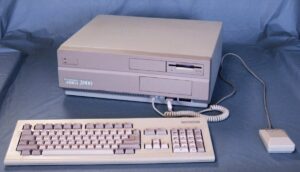
July 23, 1985. Vivian Beaumont Theater, Lincoln Center, New York. Commodore unveiled the Amiga (later designated the Amiga 1000). Andy Warhol live-painted Debbie Harry on stage,[8] while the computer rendered overlapping video windows, animations, and voice synthesis simultaneously.
Yet behind the scenes, corporate tension simmered. Commodore executives issued an unbending directive: “Commodore tradition mandates that engineers remain anonymous. No names will appear on the packaging or in the user manual.”[1][9]
Jay Miner and his team had second-mortgaged their homes and sacrificed their health to build Lorraine. Having corporate bureaucracy erase their contribution was unacceptable.
Miner and his core designers (RJ Mical, Dave Needle, Dale Luck, Carl Sassenrath) orchestrated a clandestine act of defiance:
⚡ Twist Three: The Clandestine Inscription Inside the Case
Before the Amiga 1000 injection molds were hardened in production, the design team secretly etched their signatures in reverse relief onto the inner surface of the upper casing.[9][10]
The crowning mark, however, belonged to no human. Jay Miner brought his beloved cockapoo, Mitchy—who carried an official Amiga Corporation badge as “Morale Officer”—and pressed the dog’s paw into the wet mold clay.[10]
Commodore management remained completely oblivious. Across the first 300,000 Amiga 1000 units manufactured, every owner possessed an invisible work of defiance: Jay Miner’s signature standing proudly next to Mitchy’s genuine paw print.
5. Historical Benchmark: 1985 Personal Computer Platforms
A technical comparison highlights why the Amiga OCS felt like an arrival from the future in 1985:
| Specification | Commodore Amiga 1000 (1985) | Apple Macintosh 512K (1985) | IBM PC / AT + EGA (1985) | Atari 520ST (1985) |
|---|---|---|---|---|
| Main CPU | Motorola 68000 @ 7.16 MHz | Motorola 68000 @ 7.83 MHz | Intel 80286 @ 6 MHz | Motorola 68000 @ 8.0 MHz |
| Dedicated Coprocessors | Agnus (Blitter+Copper), Denise, Paula | None (CPU handles all tasks) | None (CPU handles all tasks) | Standard Glue Logic only |
| Color Capabilities | 320×200: 32 Colors HAM Mode: 4,096 Colors |
512×342: Monochrome (1-bit B&W) | 640×350: 16 Colors (EGA) | 320×200: 16 Colors |
| Audio Architecture | 4-channel 8-bit PCM DMA Stereo | Single-voice PWM (CPU-bound) | Internal PC speaker beep | Yamaha YM2149 (3-channel FM chiptune) |
| Multitasking | True Preemptive Multitasking | Single-tasking (Finder) | Single-tasking (MS-DOS) | Single-tasking (TOS / GEM) |
| Launch Price (1985) | $1,295 (base unit) | $2,795 (integrated display) | ~$3,995 (complete system) | $799 (with monitor) |
| Design Philosophy | Parallel Media & Graphic Workstation | Minimalist Desktop Publishing | Corporate Spreadsheets & Database | Budget MIDI & Home Computing |
6. Jay Miner’s Legacy and Conclusion
The Amiga 1000 bequeathed to computing far more than an elegant graphical interface; it pioneered hardware parallelism for graphics, sound, and preemptive multitasking. Modern GPU pipelines, raster-synchronized display buffers, and DMA audio architectures trace their lineage back to the 28-layer wire-wrapped breadboard of Lorraine.
Yet the corporate saga ended in tragedy. Subsequent Commodore leadership starved Amiga R&D, cancelled the next-generation AAA (Advanced Amiga Architecture) chipset, and forced Commodore into bankruptcy in the spring of 1994.[1][7]
A few months later, on September 10, 1994, Jay Miner passed away from kidney failure at the age of 62.[3]
If you unfasten the screws of an Amiga 1000 today and inspect the underside of the yellowed plastic housing, you will find that humble paw print molded into the casing. It stands as an enduring monument proving that engineering at its finest is never just silicon and balance sheets—it is a labor of loyalty, passion, and artistic spirit.
Frequently Asked Questions
Verified References and Sources
- Bagnall, Brian. Amiga a History: The Early Years (Variant Press, 2017). ISBN: 978-0994015907. [Origins of Lorraine, Atari loan terms, and Commodore acquisition].
- Reimer, Jeremy. “A history of the Amiga, part 3: The first prototype”, Ars Technica (2007). [1984 CES Boing Ball demonstration and hardware testing].
- Computer History Museum. “Oral History of Jay Glenn Miner” (Accession No: X3236.2006). [In-depth interview covering Atari TIA, ANTIC, and Amiga custom silicon].
- Commodore-Amiga Inc. Amiga Hardware Reference Manual (Addison-Wesley, 1985). [Technical registers for Agnus, Copper instruction set, Blitter logic, and Paula audio DMA].
- Maher, Jimmy. The Future Was Here: The Commodore Amiga (MIT Press, Platform Studies, 2012). ISBN: 978-0262017206. [Analysis of HAM mode and 1985 PC/Mac benchmarks].
- Kent, Steven L. The Ultimate History of Video Games (Crown, 2001). ISBN: 978-0761536437. [The 1983 crash, Warner-Atari transition, and the $500k loan].
- Chaline, Eric. Fifty Machines that Changed the Course of History (Firefly Books, 2012). [Jack Tramiel’s departure, Atari ST development, and rivalry with Commodore].
- The Andy Warhol Museum. “Andy Warhol and the Amiga 1000” (1985 Lincoln Center launch archive).
- Mical, RJ & Needle, Dave. “The Making of the Amiga”, Classic Gaming Expo Keynote Transcripts. [The secret case signatures and resistance to corporate anonymity].
- Amiga History Guide. “The Signatures Inside the Amiga 1000 Case”. [Tooling mold history of Jay Miner and Mitchy’s paw print].