 EN
 TR
 DE
 FR
 ES
📊 Data at a Glance: MOS Technology 6581/8580 SID (Sound Interface Device)
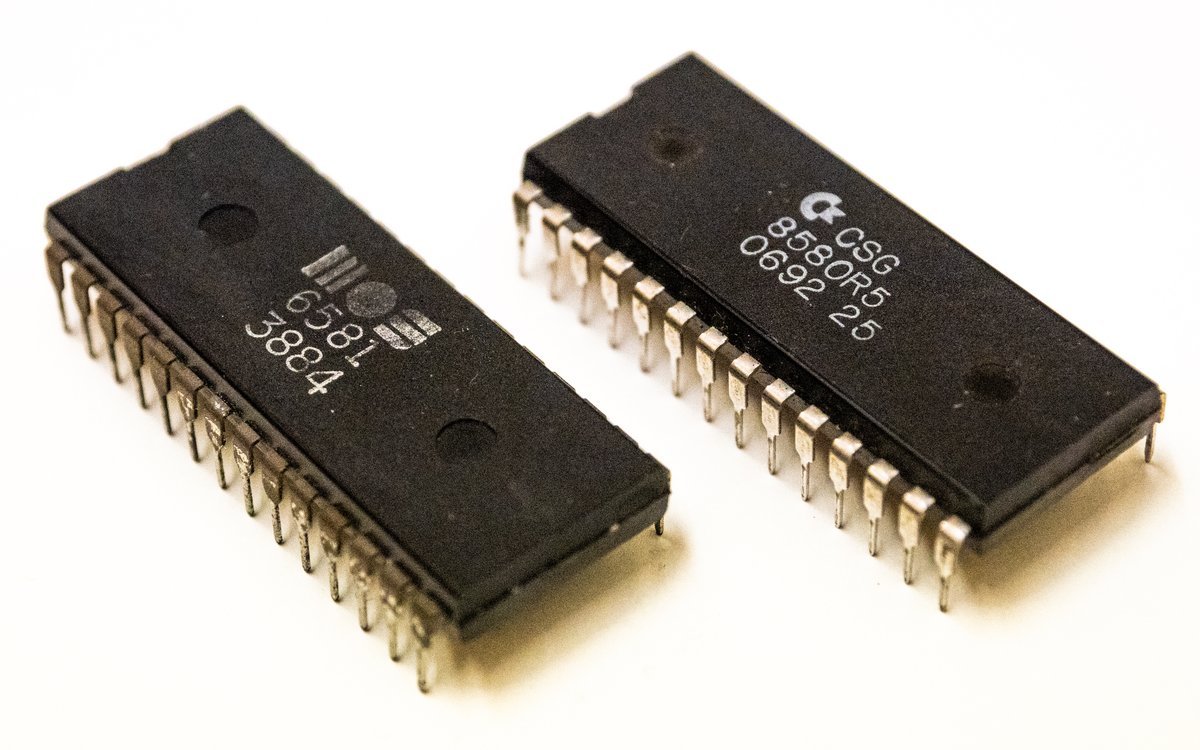
Integrated into the Commodore 64 motherboard in 1982, the MOS 6581 SID chip elevated personal computer audio from primitive mechanical beep-generators into a genuine analog synthesizer. Engineered by Robert Yannes in just five months, this silicon architecture established the chiptune subculture and fundamentally influenced modern electronic music production.[1][2][8]
| Initial Release | January 1982 (CES Debut), August 1982 (Retail Launch) |
|---|---|
| Lead Architect | Robert “Bob” Yannes (MOS Technology / Commodore) |
| Silicon Process | NMOS 12V (MOS 6581), later HMOS-II 9V (MOS 8580, 1987) |
| Audio Channels | 3 independent programmable oscillators (16 Hz – 4 kHz range) |
| Waveforms | Triangle, Sawtooth, Variable Pulse (PWM), Pseudo-Random Noise |
| Filter Architecture | 12 dB/octave state-variable analog multi-mode filter (Low-Pass, High-Pass, Band-Pass, Notch) |
| Pioneering Composers | Rob Hubbard, Martin Galway, Chris Hülsbeck, Ben Daglish, Jeroen Tel |
| Industry Legacy | Founding of Ensoniq, Ensoniq Mirage sampler, Elektron SidStation, contemporary chiptune culture |
November 1981. Norristown, Pennsylvania.
Sitting at his workbench in the MOS Technology laboratory, twenty-four-year-old engineer Bob Yannes studied Robert Moog’s patented analog synthesizer schematics while reviewing engineering blueprints for Commodore’s upcoming winter Consumer Electronics Show (CES) entry. Commodore founder Jack Tramiel and corporate leadership had delivered a direct mandate: build an affordable 64-kilobyte home computer in time for the Christmas shopping rush, and equip it with a simple audio circuit.[1][2]
In that era, microcomputer sound consisted of primitive square-wave bleeps and mechanical clicks intended for arcade collisions. Industry staples like the Atari TIA and Texas Instruments SN76489 were designed by digital logic engineers who had virtually no background in music theory or acoustics.[1][4]
Bob Yannes, however, was an accomplished keyboardist and synthesizer enthusiast. He despised the harsh, tinny bleeps emitted by personal computers. Discreetly shelving corporate instructions to build a rudimentary buzzer, Yannes embarked on an ambitious engineering project that would transform computer gaming and electronic music forever.[1][3]

A Moog Synthesizer Cast in Silicon: The SID Architecture
When designing the Sound Interface Device (SID), Bob Yannes discarded the existing conventions of digital sound. At the core of the chip, he implemented three completely independent audio oscillators. Each voice could generate triangle, sawtooth, variable pulse-width (PWM), and pseudo-random noise waveforms.[1][8]
Critically, each oscillator was paired with an independent ADSR (Attack, Decay, Sustain, Release) envelope generator. This allowed game composers to shape individual notes organically—mirroring the sharp strike and long decay of a piano, or the gentle, swelling onset of orchestral strings.[1][2]
Yet Yannes’s defining innovation was dedicating nearly a third of the chip’s physical silicon die to pure analog circuitry: a 12 dB/octave state-variable analog multi-mode filter.[1][8] The filter could route any combination of the three voices through Low-Pass, High-Pass, Band-Pass, and Notch configurations, with programmable resonance providing warm, authentic analog presence.[2][8]

— Bob Yannes, Compute!’s Gazette Interview [1]
⚡ Plot Twist #1: A Five-Month Sprint and the “Flawed” Filter Reality
The timeline allotted to Yannes was astonishingly brief: work commenced in August 1981, and working silicon was required for CES in January 1982. Bob Yannes designed the entire SID chip single-handedly in just five months.[1][4]
This intense velocity carried an unexpected consequence. Yannes lacked sufficient time to calibrate the analog filter curves and digital-to-analog converters completely. When the chip entered commercial NMOS fabrication, minute manufacturing variations caused the filter cutoff frequencies of individual MOS 6581 chips to vary substantially from batch to batch.[1][6]
On paper, this represented a production flaw. A Commodore 64 produced in one plant might sound bass-heavy, while another unit sounded resonant and bright. Yet this unpredictability gave the C64 an organic warmth, transforming an assembly-line computer into an instrument with acoustic individuality.[4][6]
The British Invasion: Rob Hubbard and Martin Galway
During the mid-1980s, a vanguard of European composers seized upon the C64. Classically trained musician Rob Hubbard revolutionized game audio in 1985 with his soundtrack for Commando.[3][5]
Hubbard synchronized the three audio channels with remarkable mathematical discipline: channel one carried soaring lead melodies, channel two drove dynamic slap-bass lines via pulse-width modulation, and channel three delivered lightning-fast arpeggios simulating polyphonic chords alongside white-noise snare percussion.[3][5]
Monumental compositions followed, including Monty on the Run, International Karate, and Sanxion. Hubbard’s tracks attained such acclaim that players plugged cassette decks into their monitors to record game audio for portable Walkman listening.[3][5]
⚡ Plot Twist #2: Digital Audio Born from Hardware Distortion — The 4-Bit Sample Hack
The MOS 6581 possessed another undocumented characteristic: register $D418, which controlled master volume across a 4-bit range (0 to 15), leaked a small direct current (DC bias) spike to the output pin whenever its value changed.[6][7]
To an audio engineer, this was an annoying hardware artifact. But visionary Irish composer Martin Galway and demoscene programmers engineered an audacious exploit: by updating register $D418 thousands of times per second using CIA timer interrupts (at 4 kHz to 8 kHz rates), the clicking pulses could be shaped into 4-bit digital pulse-code modulation (PCM) audio samples![6][7]
The gaming world was stunned. Players loading Impossible Mission heard synthesized speech echoing from their televisions: “Another visitor! Stay a while, stay forever!” Digitized speech and percussion soon followed in Ghostbusters, Arkanoid, and Skate or Die! The chip had no native sampling hardware; programmers had repurposed an engineering flaw into digital audio playback.[4][6]
In 1987, Commodore introduced the redesigned MOS 8580 with the C64C. Its revised silicon eliminated the DC bias leak. Paradoxically, this fix silenced digitized voice and percussion playback in classic games! Dedicated enthusiasts had to solder a small resistor (“Digi-Fix”) across pin 26 to reintroduce the leak deliberately.[6][8]
MOS 6581 vs. MOS 8580: Technical Architecture Comparison
The architectural distinction between the two silicon generations remains a topic of spirited analysis among audio professionals and chiptune musicians:
| Architectural Characteristic | Original MOS 6581 (1982 – 1986) | Revised MOS 8580 (1987 – 1993) |
|---|---|---|
| Fabrication Process | NMOS (12V Supply Voltage) | HMOS-II (9V Supply Voltage) |
| Filter Behavior | Non-linear, warm, gritty, with notable chip-to-chip variations [6] | Mathematically precise, linear, clean, and highly predictable [6][8] |
| Noise Floor | Audible analog baseline hum and oscillator crosstalk [8] | Very low noise floor, clean dynamic range [8] |
| 4-Bit Sample Output | Plays loudly without modification via native DC bias leak [6][7] | Requires hardware resistor modification (Digi-Fix) [6] |
| Combined Waveforms | Combined waves (e.g., Saw + Pulse) yield gritty, unpredictable textures [4] | Combined waveforms operate predictably and stably [4] |
| Musical Alignment | Aggressive synthwave, driving basslines, authentic vintage chiptune | Pristine melodic leads, precise polyphony, clean electronic ambient |
⚡ Plot Twist #3: Departure from Tramiel and the Birth of Ensoniq
While the Commodore 64 achieved global sales exceeding ten million units, its engineering architects encountered corporate austerity. Commodore founder Jack Tramiel refused to grant bonuses, royalties, or equity to technical staff.[1][2]
Frustrated by this management philosophy, Bob Yannes and VIC-II architect Al Charpentier resigned from Commodore in late 1982 to pursue their own venture.[1][2]
Their new enterprise: Ensoniq![1][2]
Yannes channeled the hybrid analog-digital synthesis insights gained on the SID chip into professional instruments. In 1984, Ensoniq introduced the Ensoniq Mirage. While high-end Fairlight and Synclavier sampling workstations commanded $30,000, the Mirage retailed at $1,695, placing digital sampling into the hands of independent studios worldwide. The acclaimed ESQ-1 and SQ-80 synthesizers that followed were direct descendants of Yannes’s Commodore 64 engineering.[1][2]
Enduring Legacy: Modern Chiptune and Hardware Synthesizers
Decades after Commodore’s dissolution, the SID architecture remains vibrant. In the late 1990s, Swedish synthesizer manufacturer Elektron salvaged original 6581 and 8580 chips to produce the SidStation hardware synthesizer—an instrument featured prominently on productions by Daft Punk, The Prodigy, Machinae Supremacy, and Timbaland.[8][9]
Today, Chris Hülsbeck’s compositions from Turrican and Giana Sisters are performed by full symphony orchestras, while musicians preserve the authentic SID tone through modern FPGA designs such as FPGASID and ARM2SID.[5][8]
Perhaps the immortality of a sound chip is measured not by mathematical perfection, but by how memorably its analog imperfections resonate in the human ear.
Frequently Asked Questions
References and Archival Sources
[1] Commodore History — Bob Yannes Interview and SID Design History — MOS 6581 genesis, CES 1982 deadlines, and Ensoniq founding.
[2] Wikipedia — MOS Technology SID — Architectural parameters, 6581 vs. 8580 revisions, filter modes, and register map.
[3] Sound On Sound — Rob Hubbard: Master of Commodore Chiptune — Composition workflows, pulse-width modulation, and arpeggio structures.
[4] IEEE Spectrum — Microchip Hall of Fame: MOS Technology 6581 SID — Formal IEEE induction analysis and technical impact review.
[5] Wikipedia — Chris Hülsbeck & Soundmonitor — Turrican, Giana Sisters, C64 Soundmonitor tracker software, and TFMX audio engine.
[6] The SID Homepage FAQ — Michael Schwendt Archive — $D418 DC bias analysis, 4-bit sample mathematics, and 8580 Digi-Fix resistor specifications.
[7] C64-Wiki — Sound Interface Device Programming Reference — Detailed register layouts, ADSR curves, ring modulation, and oscillator synchronization.
[8] Elektron Music Machines — SidStation Product Archive — Hardware SID synthesizer utilized by Daft Punk, The Prodigy, and Timbaland.
[9] Compute!’s Gazette (May 1986) — The Sound of Commodore — Contemporary computing press review of C64 audio architecture and music utility software.
[10] Vintage Computer Federation — Ensoniq Mirage & Bob Yannes Engineering Papers — Transition documentation from Commodore microchips to Ensoniq sampling hardware.


