 EN
 TR
 DE
 FR
 ES
SENSIBLE WORLD OF SOCCER 96/97
The Bird's-Eye Football Sanctuary Born in Essex, Single-Button Aftertouch Physics, and 27,000 Living Profiles
| Lead Designers & Authors | Sensible Software (Jon Hare, Chris Yates, Chris Chapman) |
|---|---|
| Publisher & Distribution | Renegade Software / Warner Interactive (United Kingdom) |
| Initial Release Date | 1994 (SWOS Original), October 1996 (96/97 Definitive Amiga Release) |
| Target Architectures | Commodore Amiga (OCS/ECS/AGA, MC68000 @ 7.14 MHz / 020), MS-DOS (VGA) |
| Audio Architecture | Paula 8364 (4-Channel 8-bit PCM Stereo Sampling) - Richard Joseph & Jon Hare |
| Archive Preservation IDs | Amiga TOSEC: Sensible_World_of_Soccer_96-97.zip | TOSEC ID: swos9697.adf |
Spring 1994. Chelmsford, a market town in rural Essex, southeast England. The global football simulation landscape had just been rattled by EA Sports' FIFA International Soccer, with its glamorous isometric broadcast view and weighty, multi-frame running animations. Yet inside Sensible Software's modest office, Jon Hare and Chris Yates envisioned an entirely different destiny for the digital pitch. To this tight-knit studio, football was never meant to mimic the passive perspective of a television broadcast; it was an art form of blistering pace, split-second instincts, and reading the pitch like an open chessboard from high above.
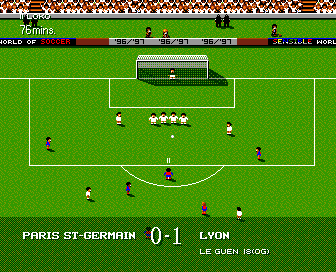
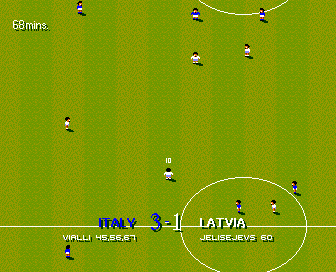
Jon Hare shrunk the footballers down from cumbersome polygons into nimble, bird's-eye micro-pixel sprites. They refused to magnetically anchor the ball to the player's boots. Every pass, every deflection, and every soaring strike adhered to a liberated set of momentum-driven physics. And most audaciously of all: into two standard 880 KB Amiga floppy disks, they compressed an unprecedented global encyclopedia of 27,000 real players across 1,500 clubs. That defiant vision produced what remains arguably the purest, most compulsive football experience ever developed.
Turning Point 1: Untethered Ball Physics and Single-Button 'Aftertouch'
By the mid-1990s, virtual football was divided between two opposing design philosophies. On one flank was Dino Dini's revered Kick Off series, where the ball bounced like a billiard ball on Teflon, sending players scurrying in chaotic panic. On the other flank stood FIFA, where the ball adhered to the player's toes like a magnetized tether, never drifting unless deliberately kicked.
Sensible Software charted an inspired middle course. In SWOS, the ball was neither glued nor wildly adrift. It maintained an intuitive "influence zone" around each athlete. Sprinting pushed the ball forward into space, and changing direction meant wrestling with genuine kinetic momentum.
The crowning breakthrough lay in the control scheme. While rival consoles introduced four-, six-, and eight-button controllers, Amiga gamers held a solitary Competition Pro or Zipstick joystick with a single fire button. Sensible Software mapped an entire athletic vocabulary onto that lone input:
- A quick tap: A sharp, crisp ground pass straight to an open teammate.
- A sustained hold: A lofted cross or an explosive driven shot toward goal.
- Pulling the stick diagonally or reverse immediately after kicking: The legendary 'Aftertouch'. Players could curve the flight path mid-air, bending majestic banana shots beyond the outstretched fingertips of desperate goalkeepers into the top corner.
Turning Point 2: The Two-Floppy Miracle — 27,000 Players and 1,500 Clubs
In an era before consumer internet, online encyclopedias, and search engines existed, charting the planetary landscape of football inside a computer game was considered impossible. Between 1994 and 1996, data editor Chris Chapman and Jon Hare spearheaded an extraordinary phone and letter campaign from their Essex headquarters. They corresponded with local fanzine editors, regional journalists, and grassroots football historians across every continent.
The resulting database was staggering: spanning the Faroe Islands Premier League to the Brazilian Second Division, the Italian Serie A to the Turkish First League (Galatasaray, Fenerbahçe, Beşiktaş, Trabzonspor, Kocaelispor...), totaling 1,500 professional clubs, over 140 national squads, and an astonishing 27,000 real individual players.
Even more extraordinary, every individual player possessed seven distinct calibrated metrics—Passing, Tackling, Heading, Shooting, Ball Control, Speed, and Finishing—along with accurate market valuations. This global football atlas, complete with a 20-season career simulation, custom tactics editor, and dynamic transfer market, was crammed into two 880 KB Amiga floppy disks and ran comfortably within a strict 1 MB RAM limit. It remains one of the greatest feats of data compression in computing history.
To fit 27,000 player dossiers with dynamic aging, career growth, injuries, and transfer values into 1 MB of memory, standard programming structs were out of the question. Every player was encoded into tightly packed bit-fields: 3 bits for speed, 3 bits for passing, 1 bit for preferred foot. The engine only decompressed the 22 active players on the pitch during matches, re-compressing them back to storage immediately after the final whistle.
Turning Point 3: Amiga's 50 Hz Soul and "Goal Scoring Superstar Hero"
While SWOS eventually found its way to MS-DOS PCs and home consoles, no port ever completely captured the magical kinetic fluidity of the Commodore Amiga original. That intangible distinction was rooted directly in custom hardware timing.
European PAL CRT televisions refreshed at an exact 50 fields per second (50 Hz). Amiga's Agnus and Copper coprocessors were hard-locked to this raster beam, scrolling the stadium pixel-by-pixel with absolute zero frame jitter. Even as a thunderous shot rocketed across the screen at 70 mph, the pitch glided with hypnotic stability. On contemporary PC setups, 60 Hz VGA refresh rates and fluctuating CPU clocks often disrupted this rhythmic harmony.
And then came the voice of Paula... Loading the game from floppy rewarded players with one of the most beloved vocal intros in video game history: "You're a goal scoring superstar hero..." Composed by Jon Hare and the late Richard Joseph, and performed with soulful charm by Jackie Reed, the song cemented SWOS not just as software, but as an enduring cultural love letter to the beautiful game.
Hardware & Architectural Comparison
| Technical Metric | Commodore Amiga (OCS/ECS/AGA) | MS-DOS (VGA Mode 13h / VESA) |
|---|---|---|
| Display Refresh & Scroll | 50 Hz Locked Hardware Raster Scroll via Blitter/Copper | 60 Hz VGA Software Page Flipping |
| Camera & Color Space | Bird's-Eye Perspective / 32-Color OCS Palette | Bird's-Eye Perspective / 256-Color VGA Palette |
| Audio Chipset & Synthesis | Paula 8364 (4-Channel 8-bit PCM Stereo DMA) | Sound Blaster 16 / AWE32 / Gravis UltraSound |
| Roster Footprint | 27,000 Players / 1,500 Teams (2x 880 KB Disks, 1 MB RAM) | Hard Drive Installation (~15 MB Disk Footprint) |
| Control Interface | 1-Button 9-Pin Digital Joystick (Kinetic Aftertouch) | Keyboard or 2-to-4 Button Gameport Controller |
| Career Framework | 20-Year Player-Manager Career Path | 20-Year Player-Manager Career Path |
Decision Support Matrix: Experiencing SWOS Today
| Platform / Flavor | Target Audience | Distinct Advantages | Constraints & Caveats |
|---|---|---|---|
| Original Amiga (WHDLoad / WinUAE) | Purists seeking the true 50 Hz PAL glide and authentic aftertouch joystick feel | Impeccable Blitter responsiveness, Paula stadium roar, zero frame latency | Requires a quality 9-pin style joystick or calibrated USB replica |
| SWOS Total Pack (Modern PC Community) | Competitive players wanting modern 2025/2026 rosters and online matches | Regularly updated real-world squads, widescreen support, worldwide tournaments | Modifications can sometimes eclipse the nostalgic purity of the 1996 edition |
| MS-DOS Port (DOSBox-Staging) | Enthusiasts who prefer quick menu navigation and PC keyboard play | Instantaneous hard drive loading, sharp VGA text, simple setup | Lacks the silky, locked 50 Hz frame rhythm of the Amiga Blitter |
In strict alignment with DigiLiner's preservation charter, no commercial game binaries are hosted on our servers. Verified historical records may be accessed through these recognized heritage institutions:
Sensible World of Soccer captured what modern multi-button sports titles often overlook: that the soul of football isn't found in simulated television graphics, but in two floppy disks, a single button, and the unadulterated passion of 27,000 names.
One final question: with the clock ticking past the 90th minute right on the edge of the box, will you feather that delicate aftertouch cross toward your forward's head, or dare to unleash a thunderous 30-yard swerve straight into the top corner?