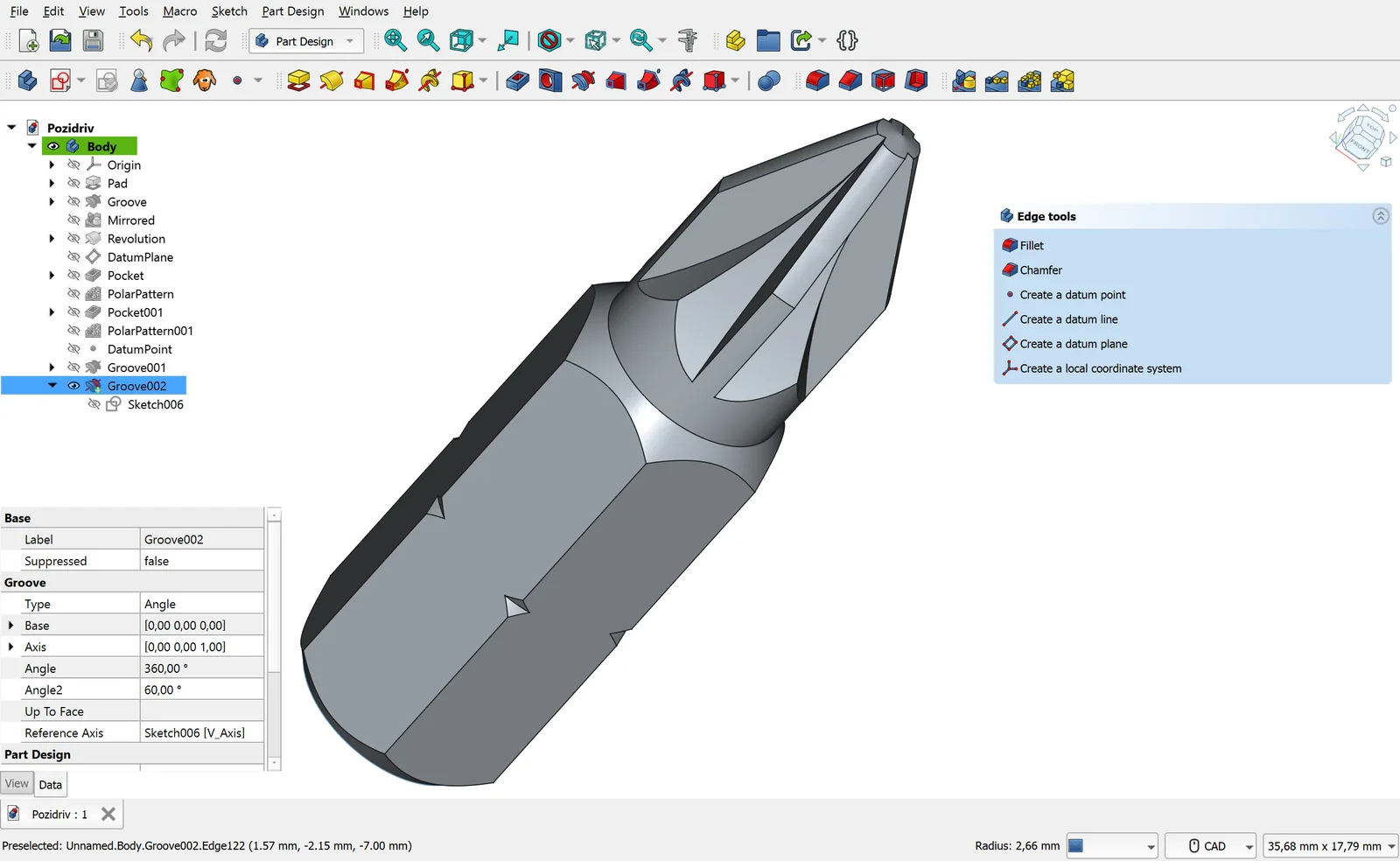





1973, Cambridge. In the university’s CAD Group, doctoral student Ian Braid, under the supervision of Charles Lang, authored a program called BUILD: How can a computer comprehend not merely the wireframe of an object, but its interior volume, mass properties, and solid boundaries with mathematical certainty? One year later, on January 1, 1974, Lang, Braid, Alan Grayer, and Peter Veenman turned that inquiry into a commercial enterprise: Shape Data Limited. In 1978, Romulus was launched as the world’s first commercial solid modeling kernel; written in Fortran, it was engineered specifically to be embedded within CAD applications. Today, whether you launch SOLIDWORKS, Onshape, Autodesk Inventor, or FreeCAD, none of these programs compute core geometry themselves. Beneath the user interface and parametric history tree operates an independent “geometric kernel”—the direct heir to that Cambridge question. Grasping which mathematical foundation each kernel employs is one of the most critical decisions in CAD system architecture.[5][1][2]
⚡ At a Glance: Primary Geometric Modeling Kernels
B-Rep vs CSG vs Mesh: The Three Dialects of Geometry
How a 3D model is structured in system memory dictates every downstream capability of a modeling application. Three distinct geometrical representations dominate modern engineering and computer graphics:
- 1. B-Rep (Boundary Representation): The standard dialect of mechanical CAD. It divides solid bodies into two coupled layers: Topology (the relational hierarchy of vertices, edges, loops, and faces) and Geometry (the underlying analytical planes, cylinders, or freeform NURBS equations). A solid is defined when these oriented surfaces enclose a watertight, manifold volume.
- 2. CSG (Constructive Solid Geometry): Defines solids as boolean combinations (union, intersection, difference) of analytical primitives such as spheres, cylinders, and cuboids. Code-driven systems like OpenSCAD reflect this paradigm in its purest form. It maintains pristine feature intent but struggles with complex filleting and organic surface transitions.
- 3. Polygon Mesh: The foundational language of Blender, Maya, and 3ds Max. Rather than computing true mathematical volumes, bodies are represented merely as interconnected planar triangle or quad facets. While universal for 3D printing via STL, polygon meshes lack parametric analytic intelligence and cannot be cleanly modified with standard mechanical tooling.
First Turn: Kernel Dependency and the Dassault-Siemens Paradox
The industrial CAD sector features one of the most remarkable technical paradoxes in computing: SOLIDWORKS, the most widely deployed mechanical desktop design platform globally, is owned by French conglomerate Dassault Systèmes. Yet the geometric engine powering SOLIDWORKS is Parasolid, owned by Siemens—Dassault’s primary global rival.[1][6]
When Dassault acquired SOLIDWORKS in 1997 for $310 million in stock, the software was already rooted in Parasolid. The founding team had evaluated ACIS during prototyping but pivoted to Parasolid prior to commercial shipment in 1995. Dassault possessed its own proprietary kernel, CGM (Convergence Geometric Modeler), and later acquired ACIS via Spatial in 2000. Replacing Parasolid was an openly discussed engineering initiative: around 2010, Dassault unveiled “SolidWorks V6” built upon the CATIA V6 platform and CGM. However, this version never replaced desktop SOLIDWORKS. Instead, CGM emerged in cloud applications like xDesign and 3DEXPERIENCE WORKS. Geometry translation between the two engines remains tethered to non-parametric “dumb solid” transfer. Schnitger Corporation’s 2020 white paper highlighted the prohibitive cost: guaranteeing that identical fillet algorithms and tolerance evaluations yield byte-for-byte identical solids across millions of historical production files is mathematically impossible. Consequently, desktop SOLIDWORKS continues to run upon Parasolid.[6][1]
A similar engineering conclusion guided Jon Hirschtick, founder of SOLIDWORKS. After leaving Dassault Systèmes, he co-founded Belmont Technology (later renamed Onshape) with John McEleney in November 2012. Rather than building a kernel from scratch, Onshape deployed Parasolid on AWS cloud instances. Emerging into public beta in March 2015 as the first native cloud 3D CAD system, Onshape was acquired by PTC in 2019 for $470 million.[8]
Second Turn: The Topological Naming Problem (TNP)
For decades, professional engineers regarded open-source CAD software with skepticism, largely due to a core mathematical dilemma in parametric design: the Topological Naming Problem (TNP). Imagine modeling a mechanical bracket and drilling a hole into its top surface (identified internally as Face4). If you step back in the history tree and modify an earlier sketch dimension, the modeling kernel recomputes the entire boundary representation.[3][9]
If the kernel cannot maintain persistent unique identifiers for generated faces, the original Face4 may suddenly re-index as Face6. The downstream hole feature searches for the old Face4, fails to find its attachment reference, and the entire feature tree explodes with dependency errors. Official FreeCAD documentation emphasizes that this challenge is not unique to open-source code: no commercial engine has “solved” TNP entirely; rather, commercial systems rely on complex heuristic tracking algorithms refined over decades across millions of production customer files.[9]
In the open-source Open CASCADE (OCCT) kernel, an integrated topological tracking layer was historically absent. The resulting model breakages in FreeCAD stemmed directly from this architectural gap rather than UI bugs. Resolution was a multi-year community effort: developer “realthunder” pioneered a TNP mitigation algorithm within his LinkStage3 branch. A community task force later modularized and merged these patches into mainline code, supported by commercial funding from Ondsel. With the milestone release of FreeCAD 1.0 on November 19, 2024, persistent topological naming algorithms were officially integrated into Sketcher and PartDesign, significantly elevating model parametric stability across real-world workflows.[3][9]
Third Turn: CGAL and the Power of Exact Number Types
Mainstream B-Rep engines execute calculations using standard IEEE 754 64-bit double-precision floating-point mathematics. While rapid, floating-point numbers inherently accumulate epsilon drift past the 15th decimal place. When two surfaces are nearly tangent or intersect along microscopic angles, B-Rep engines encounter numerical ambiguity—unable to determine whether a point lies strictly inside, outside, or on the boundary—often resulting in crashed boolean operations.
This challenge is where CGAL (Computational Geometry Algorithms Library) excels. Conceived in 1996 across prominent European research institutions (INRIA, Max Planck Institute for Informatics, ETH Zurich, Tel Aviv University), CGAL operates on the paradigm of Exact Geometric Computation (EGC). Predicates are evaluated using exact rational arithmetic, guaranteeing that boundary decisions are completely immune to floating-point drift. Boolean operations, 3D Delaunay triangulations, and Voronoi diagrams achieve mathematical certainty. OpenSCAD adopted CGAL as its core CSG backend for the stable 2021.01 release, accepting high CPU and memory overhead as the cost of precision. In response to performance demands, OpenSCAD introduced the Manifold backend in build 2024.09.28 as a selectable option alongside CGAL. While Manifold yields immense multi-threaded speedups, CGAL remains the absolute benchmark for provable geometric accuracy.[4][10]
Comprehensive Comparison Matrix Across Major Kernels
| Feature & Metric | Siemens Parasolid | Spatial ACIS | Open CASCADE (OCCT) | CGAL (FOSS) |
|---|---|---|---|---|
| Geometric Representation | Manifold & cellular non-manifold B-Rep, NURBS, Convergent Modeling (mesh + B-Rep) | Manifold & Non-Manifold B-Rep | Industrial B-Rep & STEP Engine | Exact CSG, Polyhedron, Nef Polyhedra |
| Numerical Precision | 64-bit IEEE Double + Toleranced | 64-bit IEEE Double + Toleranced | 64-bit IEEE Double + toleranced sewing & ShapeFix healing | Provably Exact (Exact Number Types) |
| Licensing Model | Commercial proprietary (Siemens OEM) | Commercial proprietary (Spatial / Dassault) | LGPL-2.1 with Open CASCADE exception | GPL v3+ or commercial (GeometryFactory); select LGPL v3+ |
| Native Format | .x_t, .x_b |
.sat, .sab |
.brep, STEP AP203/214/242 |
.off, .poly, STL |
| Direct Modeling | Industry-leading; Synchronous Technology built upon Parasolid + D-Cubed solver | Robust; SpaceClaim was ACIS-based through 2024 R2 before migrating to Parasolid in 2025 | Advancing via FreeCAD PartDesign | Not Applicable (Pure algorithmic) |
| Reference Applications | SOLIDWORKS, NX, Onshape | BricsCAD, KeyCreator, IronCAD (AutoCAD/Inventor: ShapeManager fork) | FreeCAD, CAD Exchanger, SALOME | OpenSCAD 2021.01, SFCGAL/PostGIS, MeshLab (optional remeshing plugin) |
Decision Support Matrix: Matching Kernels to Engineering Goals
Selecting or architecting CAD software requires aligning engineering requirements directly with kernel capabilities:
- Massive Assemblies and Automotive/Aerospace: For intricate freeform blending and assemblies containing tens of thousands of parts, Siemens Parasolid represents the most mature standard. Generating
.x_tdata ensures seamless exchange across NX, SOLIDWORKS, and Solid Edge.[1] - Open Source, Independence, and Data Sovereignty: If you must deploy automated manufacturing pipelines and custom CAM/CAE tooling without per-seat licensing fees, Open CASCADE (OCCT) paired with FreeCAD 1.0 is the sole enterprise-ready open-source B-Rep platform.[3]
- Algorithmic and Parametric Generative Design: For lattice structures, procedural modeling, or web configurators, OpenSCAD provides an ideal environment—leveraging CGAL when provable precision is non-negotiable, or Manifold when interactive speed is paramount.[10]
- Direct Concept Modeling and Legacy Repair: For pushing and pulling non-parametric STEP files without a history tree, direct modeling tools (BricsCAD on ACIS, Ansys SpaceClaim 2025 on Parasolid, Shapr3D on Parasolid) excel through dedicated direct editing layers.[2]
Conclusion & Practical Takeaway
When selecting CAD software or migrating to an open-source workflow, you are not merely selecting a user interface; you are choosing the underlying mathematical engine of your intellectual property. The question posed in Cambridge in 1973 remains unchanged: How can a computer truly know a solid? Parasolid and ACIS represent commercial answers authored by pioneers of that research group; OCCT and CGAL represent the vibrant open-source responses. The primary takeaway for practicing engineers: if you cannot guarantee which engine will open your designs a decade from now, archive your geometry not solely in proprietary native files, but also in standardized STEP AP242. If Dassault ever shifts SOLIDWORKS completely to CGM, what happens to decades of Parasolid files? And do performance-optimized engines like Manifold justify stepping away from CGAL’s guarantee of exact computation?
📚 Verified Primary Sources & Technical Documentation
- Siemens Digital Industries Software • Parasolid product specifications (“350+ applications”) and Tech Soft 3D distribution portal • Siemens Parasolid • Tech Soft 3D Parasolid
- Spatial Corporation (Dassault Systèmes) • 3D ACIS Modeler product portal; Ansys Discovery 2025 release notes detailing SpaceClaim ACIS to Parasolid transition • Spatial ACIS • Ansys 2025 R1 Release Notes
- Open CASCADE SAS • OCCT technical overview and official 7.9.0 / 8.0 release milestones • OCCT Overview • OCCT Announcement
- The CGAL Project • License specification (GPL/LGPL & GeometryFactory commercial options) • cgal.org • CGAL License
- Wikipedia / Solid Modeling Association • Shape Data Limited (1974), Romulus (1978), and 2008 Pierre Bézier Award (Braid, Grayer, Lang) • Shape Data • Romulus • Bézier Award
- upFront.eZine / Design Engineering / Schnitger Corp. • ShapeManager fork (2001), SolidWorks V6 and xDesign history, and the hidden cost of kernel transitions • ShapeManager • xDesign analysis • Schnitger 2020 (PDF)
- C3D Labs • nanoCAD enterprise customer case and 2016 license announcement • C3D Labs nanoCAD • C3D Toolkit
- Engineering.com / Wikipedia • Jon Hirschtick interview on cloud CAD architecture (Parasolid + AWS) and Onshape history • Hirschtick Interview • Onshape
- FreeCAD Project / Ondsel • Topological Naming Problem documentation, FreeCAD 1.0 milestone announcement (Nov 19, 2024), and Ondsel analysis • FreeCAD TNP Wiki • FreeCAD 1.0 • Ondsel Analysis
- OpenSCAD Project • Manifold backend integration announcement and OpenSCAD development roadmap • OpenSCAD Mailing List • OpenSCAD
Compare professional design platforms and their underlying engines in our guide to popular 3D modeling software.