



📊 Data at a Glance: Deluxe Paint (DPaint)
Released in 1985 for the Commodore Amiga, Deluxe Paint became the de facto standard for digital pixel art, video game graphics, and 16-bit multimedia production. The fundamental concepts of contemporary graphics software were forged within the code of this floppy disk.[1][5]
| Initial Release | November 1985 (Deluxe Paint I) — 1995 (Deluxe Paint V) |
|---|---|
| Lead Architect | Dan Silva (Software engineer formerly of Xerox PARC and Lucasfilm) |
| Publisher | Electronic Arts (EA) |
| Primary Platform | Commodore Amiga (Later ported to MS-DOS, Apple IIGS, Atari ST) |
| Key Innovations | Custom Brush mechanics, Color Cycling (palette animation), IFF/ILBM file format, AnimBrush |
| Historical Impact | Foundation of LucasArts adventure games (Monkey Island, Loom) and modern pixel artistry |
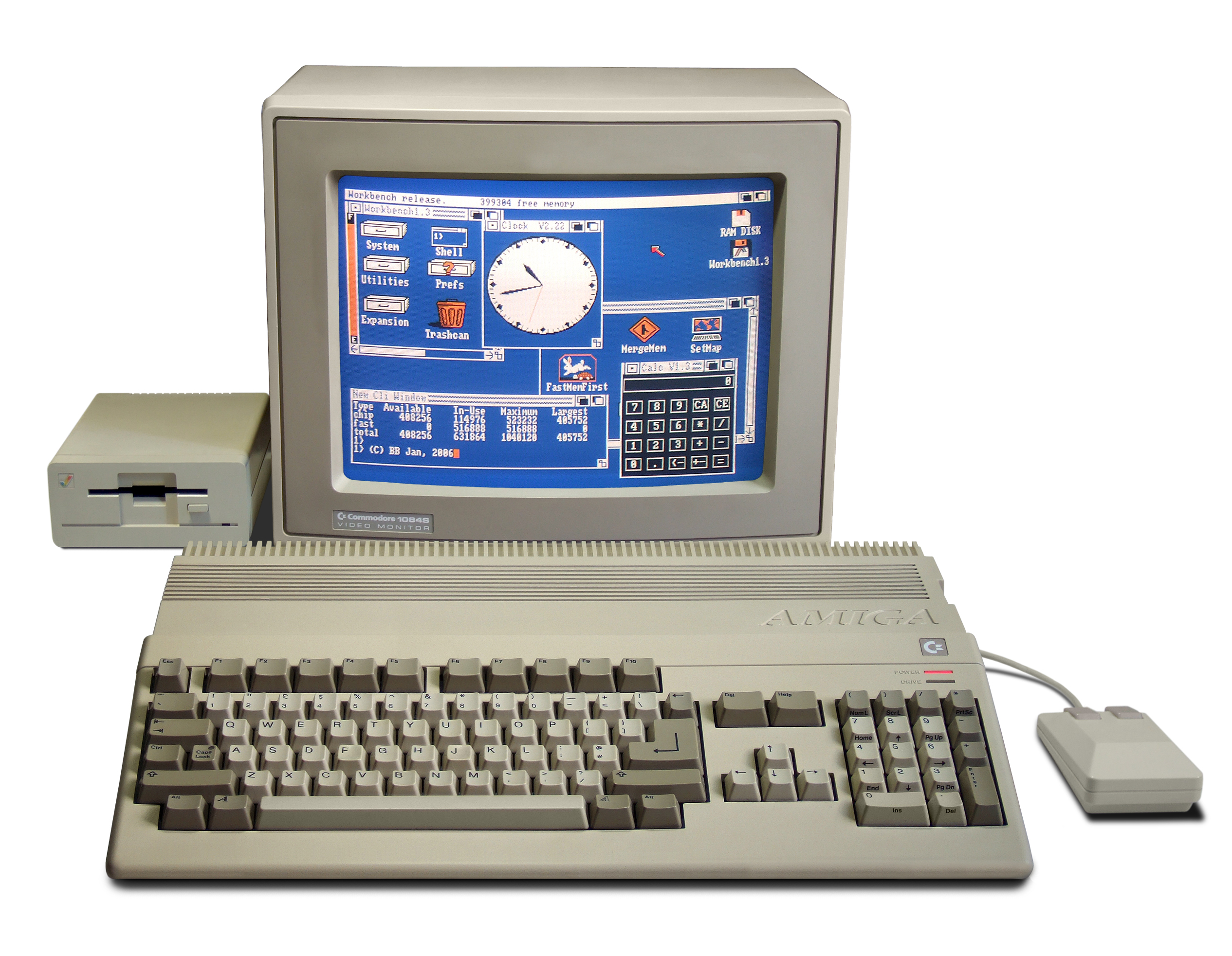
On the evening of July 23, 1985, an electric tension gripped the Vivian Beaumont Theater at Lincoln Center in New York City. Before an audience of tuxedo-clad technology and art elites stood pop art legend Andy Warhol and rock icon Debbie Harry. In Warhol’s hand was a computer mouse, and before him rested a machine unlike anything seen in homes before: the Commodore Amiga 1000.[4]
Warhol captured a monochrome video frame of Debbie Harry and began painting over it with shocking yellows, electric blues, and vivid pinks. The Amiga’s custom hardware architecture effortlessly showcased 4,096 colors simultaneously. The audience was mesmerized. Yet, backstage engineers knew a sobering truth: the software Warhol utilized on stage (GraphiCraft / ProPaint) was rudimentary, falling vastly short of unleashing this hardware monster’s true potential.[4]
The Amiga’s custom chips (Denise, Agnus, Paula) possessed the raw horsepower to manipulate millions of pixels per second, yet no digital brush existed that could translate that power to artists’ fingertips. That was until a few months later, when an unexpected program surfaced from behind closed doors.

The First Turning Point: A Program Never Intended for Sale
What comes to mind today when you hear the name Electronic Arts (EA)? Most likely annual sports blockbusters, microtransactions, and a massive corporate apparatus. But when Trip Hawkins founded EA in 1982, the company championed a singular artistic manifesto: “Can a computer make you cry?” EA treated software developers and digital artists like rock musicians, packaging their software in stylish LP-style record sleeves.[1]
Within this progressive hotbed, Dan Silva—a brilliant engineer with roots at Xerox PARC and George Lucas’s Lucasfilm Computer Graphics Division—sat down to code. EA was eager to produce games for the upcoming Amiga, but hit a comic roadblock: there was not a single professional graphics application on the market capable of designing production-grade game art.[1][3]
⚡ Surprise Plot Twist #1: The “Prism” Accident
Dan Silva set to work on an internal tool codenamed “Prism”. Crucially, this software was never planned as a commercial product; it was merely a fast-and-dirty in-house utility so EA’s staff artists could draw sprite assets for upcoming launch games.
However, once internal artists laid hands on Prism, an unexpected revolt occurred: they categorically refused to touch any other software. The ability to grab any section of the screen and instantly wield it as a paint brush was so intoxicating that EA leadership discarded their original roadmap: “We cannot keep this hidden inside; this must become a standalone product!” Prism was refined, boxed, and shipped in November 1985: Deluxe Paint (DPaint) was born.[1][3]
Why Was It a Revolution? The Moment Pixels Became Brushes
Prior to Deluxe Paint, computer painting felt like technical drafting with a ruler. Apple’s MacPaint existed, but was confined to black-and-white pixels and rigid monochrome tools. Dan Silva reimagined digital artistry from an entirely fresh perspective, establishing three core milestones:
1. Custom Brush Mechanics
In DPaint, any section of the canvas—whether a dragon’s wing or a spaceship hull—could be lassoed with a single right-click and transformed into an active brush. Artists could shear, rotate, resize, and stamp that piece across the canvas in real time. While standard in modern applications like Photoshop or Aseprite, in 1985 this functionality bordered on digital sorcery.[1]
2. The IFF / ILBM Universal File Standard
To enable different applications to communicate, EA engineer Jerry Morrison and Dan Silva collaborated with Commodore to establish the Interchange File Format (IFF) standard. The Amiga’s bitplane-oriented ILBM format became the foundational blueprint for modern TIFF and PNG image standards.[1][5]

The Second Turning Point: Tricking the CPU — The Magic of Color Cycling
In the late 1980s and early 1990s, 16-bit home systems faced strict floppy disk and RAM ceilings. Attempting to render a cascading waterfall, a roaring fire, or swirling ocean tides frame-by-frame would rapidly choke memory buffers.
To overcome this limitation, Dan Silva integrated an elegant mathematical illusion into DPaint: Color Cycling (Palette Animation).[2][3]
LucasArts’ legendary background artist Mark Ferrari transformed this technique into a sublime art form. In masterpieces like The Secret of Monkey Island and Loom, Ferrari built atmospheric vistas using Deluxe Paint where clouds drifted, tides surged, and torches flickered on a single static 256-color image. Not a single traditional frame of animation was drawn; the living movement was driven entirely by rotating palette registers.[2][3]
The Final and Grandest Plot Twist: Where Did Dan Silva Go?
By the mid-1990s, Commodore’s corporate mismanagement pushed the Amiga toward insolvency. The PC architecture surged forward, and polygonal 3D rendering eclipsed 2D bitmap art. With Deluxe Paint V, the series quietly exited the spotlight.
Did Dan Silva—the man who authored the lexicon of 2D pixel art and placed digital brushes into the hands of a generation—retire into quiet obscurity?
⚡ Grand Finale Twist: The Surprise Name in the 3D Studio Core Team
The answer is a remarkable turn of events: far from walking away, Dan Silva stepped into the engine room of the next graphics revolution.
After parting ways with Electronic Arts, Silva joined The Yost Group, an elite independent development collective led by visionary Gary Yost alongside software pioneers Tom Hudson and Jack Powell.[1][6]
This compact team was developing a groundbreaking 3D animation suite for MS-DOS, soon migrating under Autodesk to Windows NT. While Gary Yost spearheaded product vision and Tom Hudson constructed the core modeling framework, Dan Silva authored indispensable structural pillars: the rendering pipeline, the Material Editor, and most critically, the architectural concept that defines contemporary 3D modeling—the “Modifier Stack”.[6][7]
What was that software called? 3D Studio (known today as 3ds Max)!
The same mind that forged the paradigms of 16-bit 2D pixel art in the 1980s was an instrumental architect of the premier 3D platform that powered 1990s Hollywood visual effects (such as Babylon 5) and early 3D console blockbusters.[1][6]
The Living Legacy: 1985’s Brush Still Touching Today’s Canvases
Whenever you launch modern pixel art darlings like Stardew Valley, Celeste, Sea of Stars, or Blasphemous, you are experiencing an aesthetic tradition anchored in Dan Silva’s keyboard shortcuts.
Modern sprite tools such as Aseprite and Pro Motion NG maintain the exact brush-capture concepts, palette navigation, and workflow mechanics pioneered on that gray Amiga desktop back in 1985.[1][3]
Deluxe Paint proved that digital innovation is not merely a contest of clock speeds and transistor counts. When paired with a thoughtfully engineered brush, even a modest floppy disk can leave an indelible imprint across four decades of digital visual culture.
References and Verification
- Wikipedia — Deluxe Paint: Version History, IFF Standard, and Dan Silva
- Effect Games — Old School Color Cycling with HTML5 & Mark Ferrari Visual Archive
- Datagubbe — Deluxe Paint, Mark Ferrari, and 16-Bit Graphical Architecture Analysis
- Wikipedia — Amiga 1000: Lincoln Center Launch, Andy Warhol, and Debbie Harry Showcase
- Hall of Light (HOL) — Amiga Software Database and Deluxe Paint Archives
- Wikipedia — Autodesk 3ds Max: Gary Yost, Dan Silva, and The Yost Group History
- CGPress — The Origins of 3D Studio & The Modifier Stack Architecture