 EN
 TR
 DE
 FR
 ES
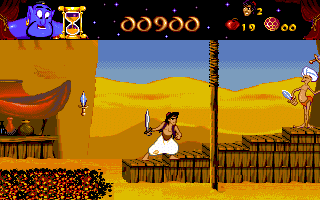
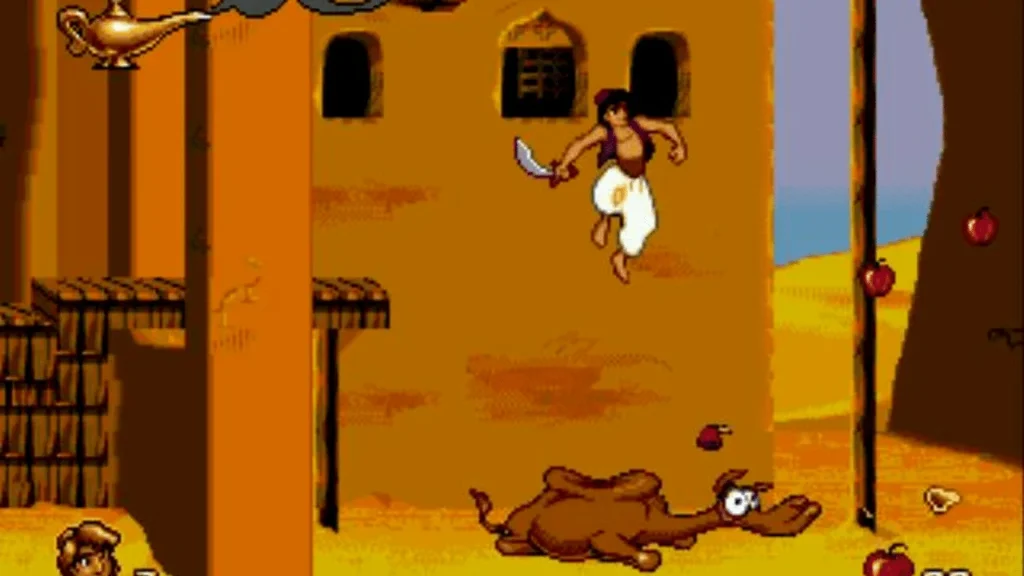
🕹️ DigiLiner Preservation Dossier: This review is part of our multi-platform Amiga and MS-DOS comparative archive in the Retro Games Index.
October 19, 1993. A cartridge arrives on North American store shelves.
Inside its ROM chips reside 1,400 hand-drawn animation frames, the sun-drenched rooftops of Agrabah, treasure-strewn caverns, and two youths escaping atop a flying carpet. The game is Disney's Aladdin. Yet the true story began months prior: Disney had grown wary of licensed video game adaptations, an initial development team walked away, and Virgin Games had just six months to prove that a cartridge could rival feature film animation.
⚡ Disney's Aladdin (1993/1995) Verified Archival Dossier
First Twist: The Abandoned Prototype & The Lamp in Jurassic Park
Following uninspired licensed projects such as Fantasia (1991), Disney wanted complete creative oversight. While Capcom secured Nintendo rights, Sega and Virgin took the Genesis lead. Originally, developer BlueSky Software began production, but their focus was split with Jurassic Park. Progress stalled, and Disney canceled BlueSky's unfinished build.
BlueSky's artists left a subtle memorial to their aborted project: deep within the mountainous jungle map of Jurassic Park for Sega Genesis, players can find a hidden Genie lamp easter egg nestled among the ridgelines. Disney subsequently partnered with David Perry at Virgin Games after witnessing their proprietary "Digicel" compression demo.
Digicel: Squeezing 1,400 Hand-Drawn Frames Into Silicon
Virgin assembled a nine-person strike team in Irvine, California. Working alongside Disney Feature Animation animators in Florida, Mike Dietz produced over 1,400 hand-drawn animation cels. Under the Digicel workflow, each drawing was digitized, palette-optimized, and compressed using frame-holding and symmetrical tile-flipping algorithms.
David Perry engineered the underlying scrolling engine to handle diagonal slopes, rope swings, and multi-tier pathways. The result was so fluid that Nintendo executives took immediate notice: the visual benchmark set by Aladdin became a primary catalyst for Nintendo partnering with Rare to commission Donkey Kong Country.
Amiga & MS-DOS Architecture: 16-Bit Swan Song
When porting the title to home microcomputers in 1994–1995, Virgin assigned legendary programmer John Twiddy (famed for The Last Ninja) to oversee the Amiga conversion:
- Commodore Amiga (January 1995): Programmed for the AGA chipset (Amiga 1200/4000), utilizing a 256-color palette across 3 floppy disks. Because both Genesis and Amiga shared the Motorola 68000 family, Twiddy ported core gameplay logic with near-perfect fidelity, garnering a 90% score from Amiga Format, which famously declared it "quite possibly the best-looking Amiga game ever."
- MS-DOS VGA (1995): Requiring a total rewrite for x86 Intel architectures, the PC release operated in standard Mode 13h (320×200, 256 colors) with enhanced Sound Blaster / AdLib FM audio. It delivered the identical cinematic flow to desktop PC users.
Second Twist: Luscious Visuals vs. Forgiving Difficulty
Contemporary critics universally praised the game's visuals while noting its breezy difficulty. Unlike the punishing platformers of the era, Aladdin prioritized momentum and spectacle over brutal difficulty spikes: health was represented by a plume of smoke unfurling from the Genie's lamp, checkpoints were generous, and extra wishes allowed swift stage recovery.
Third Twist: Archival Honesty: Why There Is No C64 Edition
Historical rigor demands clarity: Disney's Aladdin was never officially published on the Commodore 64. A database search across GameBase64's 32,000 entries yields only 1985's unrelated Aladdin's Cave. By 1993–1995, squeezing 1,400 cel animation frames into a 64-kilobyte 8-bit machine was neither commercially viable nor technically practical. DigiLiner deliberately excludes nonexistent platform entries to uphold strict archival integrity.
Verdict & Legacy
Disney's Aladdin proved that licensed games could transcend mere promotional merchandise to redefine industry animation standards. David Perry, Mike Dietz, and John Twiddy transformed Disney's silver-screen magic into an enduring computer masterpiece that remains as breathtaking today as it was when the first floppy spun up in 1995.
[1] Perry, David & Dietz, Mike. "The Making of Disney's Aladdin", Retro Gamer Magazine, Issue 82, 2010.
[2] Amiga Format Magazine, Issue 68, January 1995, Review: 90/100.
[3] CU Amiga Magazine, Issue 59, January 1995, Technical Review: 90/100.
[4] Hall of Light (HOL) Amiga Database Identifier: 3381 (Disney's Aladdin AGA).
[5] MobyGames: Disney's Aladdin (Amiga/DOS/Genesis) Production Credits & Technical Archive.
[6] Internet Archive: MS-DOS Historical Software Vault —
msdos_Disneys_Aladdin_1994.