




December 24, 2017. A three-word headline appears on the Knights of Bytes development blog: “Sam Is Out!” [4] The game released that Christmas Eve for the Commodore 64 was the culmination of an ambitious journey that began on February 19, 2015, with a modest announcement: “New game for C64 in development” [8]. The original brief was stark and focused: target a vanilla PAL C64 with a 1541 disk drive, with VICE emulator support for modern enthusiasts lacking vintage hardware. At that early stage, the team possessed little more than a concept teaser image and a determined ambition.
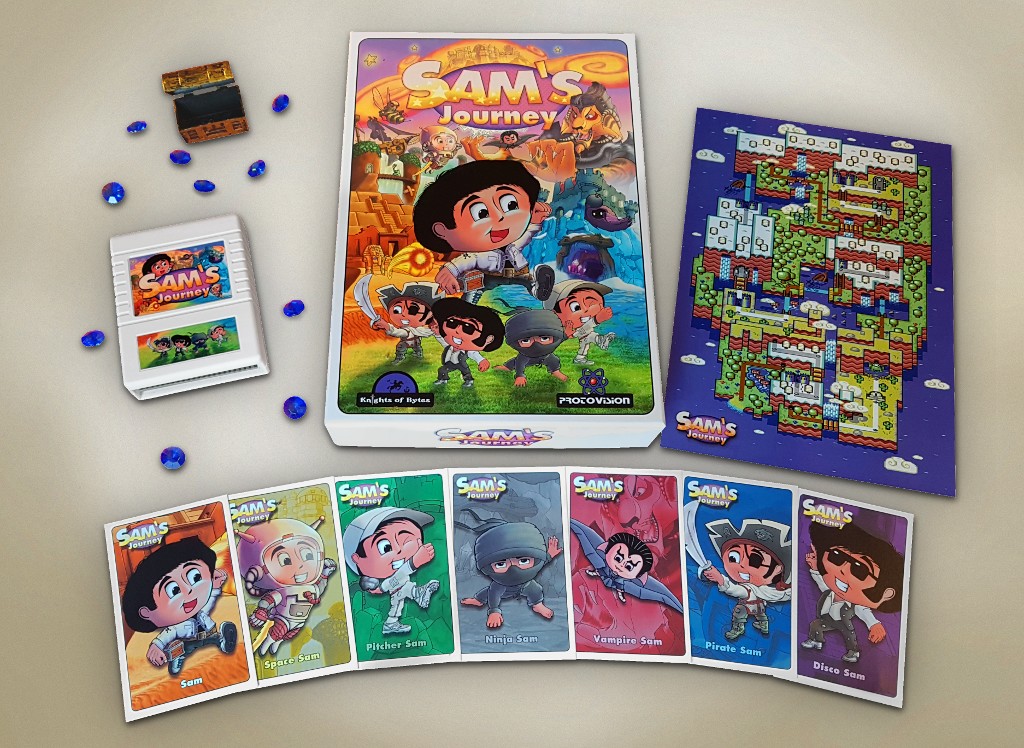
Nearly three years later, the final product exceeded all expectations: 2,000 individual screens, 27 expansive stages, three seamless overworld maps, 19 original chiptune tracks, and six unique costume transformations [1]. This was far more than an affectionate retro homage. Packaged in a lavish physical carton containing a custom PCB cartridge, printed world map, full-color manual, and artisan packaging, Sam’s Journey arrived as a commercial retail release [3]. It demonstrated that an expansive, contemporary platforming adventure could be engineered from the silicon up within the strict boundaries of an 8-bit architecture.
Data at a Glance: Sam’s Journey (C64, 2017)
| Parameter | Verified Dossier |
|---|---|
| Developer | Knights of Bytes — Chester Kollschen (code, lead design, auxiliary graphics, sound effects), Stefan Gutsch (pixel art, level architecture, cover art), Alex Ney (soundtrack) [1], [11] |
| Publisher / Distributor | Protovision [1], [2] |
| Release Date | December 24, 2017 [4], [10] |
| Platform | Commodore 64 (PAL vanilla primary); NTSC supported via diskette with Commodore REU [1], [2] |
| Media Formats | Two double-sided 5.25-inch floppy disks (PAL or NTSC) or GMod2 flash cartridge (PAL exclusive) [1], [3], [12] |
| Genre | Free-directional scrolling action platformer [1] |
| Player Count | Single-player [10] |
| In-Game Languages | English and Spanish (including manual and packaging variants) [3], [10] |
| Content Scale | 3 open-world maps, 27 stages, 2,000 screens, 14 graphic themes, 19 audio tracks, 6 hero costumes [1] |
| Save Architecture | Mid-level checkpoints and persistent manual save states; supported on both cartridge EEPROM and disk [2], [11] |
| Current Catalog Status | Physical boxed edition listed around €50 in the 2026 Protovision catalog [3] |
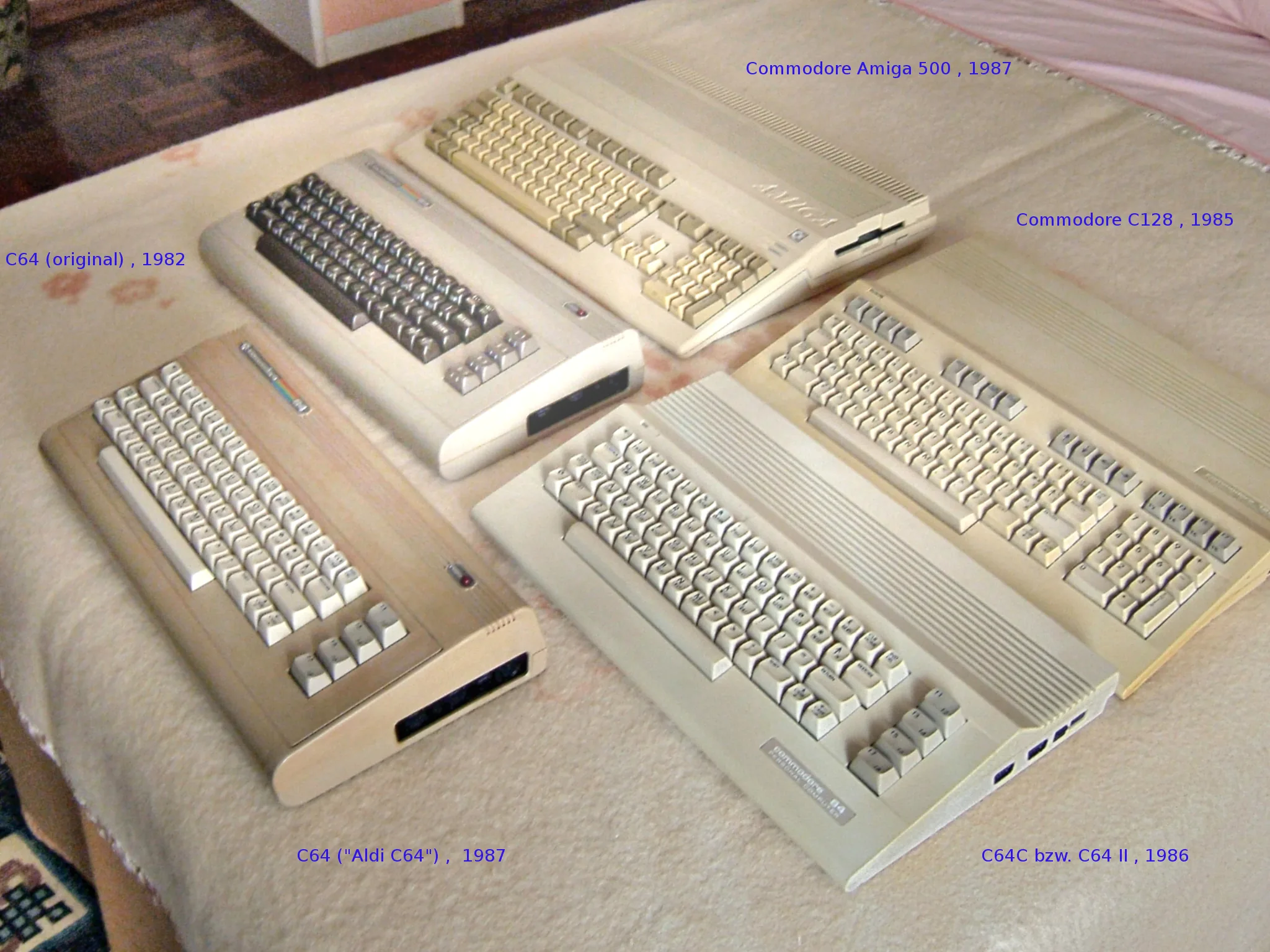
Beyond this impressive spec sheet lies the fundamental engineering riddle: How was an expansive platformer of this magnitude funded, programmed, and commercially manufactured for 1982 home computer silicon in the year 2017? The explanation unfolds across three distinct turning points. First, however, one must examine the raw technical constraints of the host hardware—because Sam’s 2,000 screens exist precisely within the margins dictated by MOS Technology silicon.
Hardware Architecture: Fitting 2,000 Screens into 64 KiB
The Commodore 64 debuted in 1982 equipped with 64 KiB of main RAM [16]. The PAL cartridge release of Sam’s Journey utilizes the GMod2 hardware standard engineered by Individual Computers. GMod2 integrates 512 KiB of flash ROM and 2 KiB of serial EEPROM for game saves, toggling memory banks via a single control register at memory address $DE00 [12]. On cartridge, the game’s expansive asset library streams seamlessly into memory from this high-speed external flash storage. In contrast, the floppy disk edition distributes the same virtual adventure across four individual D64 disk sides [3].
| Subsystem / Constraint | Commodore 64 Specification | Sam’s Journey Architectural Solution |
|---|---|---|
| CPU (MOS 6510) | 0.985 MHz (PAL) / 1.023 MHz (NTSC) [16] | Tracking an agile, high-velocity protagonist requires continuous screen-scrolling calculations and collision sweeps each frame, placing rigorous demands on cycle budgets. |
| RAM Capacity | 64 KiB (65,536 bytes) total [16] | A 2,000-screen world cannot reside in RAM simultaneously; assets must stream dynamically. Cartridges leverage 512 KiB flash ROM banking [12]. |
| VIC-II (Video Controller) | 320×200 resolution, 40×25 text matrix, 16 fixed colors, 8 hardware sprites per scanline (24×21 px) [13] | Smooth multi-directional scrolling uses custom character tile modes paired with sophisticated raster interrupt multiplexing to exceed the 8-sprite scanline bottleneck [13]. |
| Color RAM | Single color attribute per character cell; 16-color fixed system palette [13] | Establishing visual diversity across 14 distinct tile sets within 16 colors requires precise raster-line palette manipulation during the beam flyback [1], [13]. |
| SID (Audio Synthesizer) | MOS 6581/8580 with 3 independent audio voices [14] | 19 musical scores and real-time sound effects dynamically share 3 hardware voices through careful channel prioritization [1], [2]. |
| Bus / Storage Transfer | Stock 1541 serial bus (slow); instantaneous bus-speed cartridge access | Floppy versions require optimized fastloaders; SD2IEC hardware compatibility requires firmware dated January 21, 2018 or newer [2]. |
| REU (Expansion) | 128 KB (1700), 256 KB (1764), 512 KB (1750) DMA expansion [15] | NTSC release requires disk media plus an REU to offset tighter NTSC scanline timing via hardware DMA memory blits [2], [10]. |
| PAL vs. NTSC Timing | PAL: 50 Hz (312 lines, 63 cycles/line); NTSC: 60 Hz (263 lines, 65 cycles/line) [13], [16] | Running the PAL cartridge on NTSC hardware causes audio acceleration, dropped frames, and visual glitches due to tighter raster deadlines [18]. |
The most revealing entry in this comparison is the PAL versus NTSC timing disparity. These broadcast standards represent two fundamentally different CPU execution budgets per frame. The technical choice to design Sam’s Journey natively around PAL timing—while relegating NTSC users to floppy disks and REU memory expansions—illustrates how deeply retro software must bend to silicon clock pulses [2], [10].
First Turning Point: The Artisan Economics of 2017 Cartridge Production
The initial 2015 announcement made no secret of its commercial intent: the project aimed to deliver a finished commercial software product running on genuine vintage hardware, supported by VICE emulation for broader accessibility [8]. When the boxed edition arrived in late 2017, it rejected the throwaway nature of digital downloads. Inside the packaging was a comprehensive physical manual, a folded three-part cloth-styled world map, miniature treasure chest, seven collectible character cards, and a tamper-evident holographic seal [3].
The defining detail of this release is found in Protovision’s production ledger: each box was assembled and finished by hand, rendering every single retail copy unique [3]. This represents an inverted economic model compared to 1980s mass manufacturing. Instead of high-volume industrial molding, Protovision and Knights of Bytes built a boutique, artisanal publishing operation based on direct-to-consumer distribution. The GMod2 cartridge design reflected this same pragmatic philosophy: engineered not as an expensive multi-purpose flash cart, but as a lean OEM mass-reproduction vehicle featuring minimal banking logic managed by a single control register [12].
Sales milestones validate the viability of this boutique ecosystem. From launch in December 2017 to late March 2018, the game achieved 1,250 units sold [5]. By December 2018, sales crossed 2,000 copies [7]; by April 2020, 2,500 units [2]; and in October 2021, Protovision reported passing the 3,000-copy milestone [2]. As Protovision observed during the 3,000-unit announcement: “Selling 3,000 copies of a new C64 game in these days is unprecedented” [2]. In the context of modern homebrew computing, 3,000 physical copies represents a monumental community triumph.
💡 The Core Turning Point
Sam’s Journey demonstrated that an 8-bit computer game in 2017 could thrive as a genuine commercial release. However, achieving this required abandoning industrial scale in favor of hand-folded cartons, small PCB manufacturing batches, and intimate distributor relationships [3], [12]. This production reality echoed directly into game design: asset footprint was strictly calibrated to ROM banks, soundscapes were tailored to three SID voices, and scrolling velocity was bounded by the raster line clock.
Second Turning Point: Bargaining with the VIC-II Raster Clock
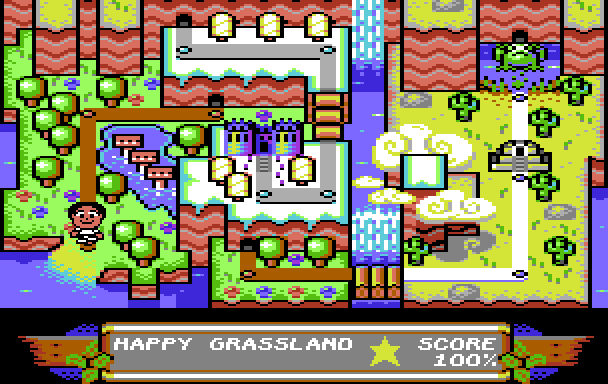
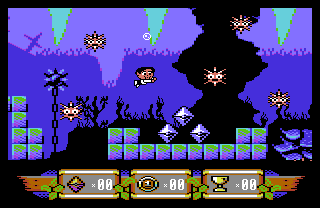
At first glance, Sam’s Journey seems to mirror the expansive scope of a 16-bit console title: three vast overworlds, 27 varied levels, and 2,000 scrolling screens [1]. Yet the chip driving this digital illusion is a video processor engineered in the late 1970s. The MOS VIC-II renders a native resolution of 320×200 pixels across a 40×25 character grid using a strict 16-color palette, constrained to a hardware maximum of eight 24×21-pixel sprites per scanline [13]. Sustaining a fast-moving, omnidirectional camera across this rigid substrate demands an intricate balancing act every single video frame.
Two critical architectural realities govern this achievement. First, the scanline budget: the VIC-II provides 63 clock cycles per line on PAL versus 65 on NTSC [13], yet NTSC must refresh the display 60 times per second rather than 50. As C64-Wiki documents, stock NTSC hardware lacks sufficient raster execution time during vertical blanking to handle software-driven directional scrolling; consequently, the NTSC disk edition utilizes the Commodore REU blitter to transfer tile blocks [10]. Second, color attributes: because each character cell possesses restricted color definitions, evoking 14 visually distinct environments across a 16-color palette requires mid-frame raster color splits [1], [13].
The sprite subsystem faced equal pressure. The 8-sprite-per-line barrier quickly becomes congested when Sam, wandering adversaries, airborne projectiles, and interactive collectibles share the same horizontal horizon. Employing dynamic raster interrupts, the engine multiplexes hardware sprites down the screen, repurposing the eight physical sprite registers across multiple vertical zones [13]. However, every additional multiplexing interrupt steals valuable CPU cycles away from physics logic and collision checks.
Audio duties fall entirely upon the MOS SID chip’s three analog voices [14]. The soundtrack’s 19 compositions and dozens of dynamic sound effects must share these three channels in real time [1], [2]. Alex Ney’s musical arrangements craft distinct tonal landscapes for every biome—ranging from whimsical grassland melodies to somber subterranean themes [2]. Maintaining seamless melodic progression while interweaving projectile bursts and jump chimes requires precision audio engine scheduling.
From a design philosophy standpoint, Sam’s Journey consciously broke away from punishing 1980s coin-op conventions. As lead designer Chester Kollschen explained, the game discards artificial life counters and sudden “Game Over” screens, adopting friendly mid-level checkpoints and comprehensive save-anywhere mechanics [11]. This modern accessibility encourages playful exploration over rote memorization. The six collectible costume suits further reinforce this design: altering Sam’s visual aesthetic while augmenting his traversal abilities [1], [9].
Third Turning Point: Establishing a Modern Homebrew Standard
Technical execution alone does not explain why Sam’s Journey evolved into a historic milestone; its standing was cemented by widespread critical and community acclaim. In October 2018, Knights of Bytes announced that legacy gaming journal Zzap! 64 awarded the game its coveted Gold Medal with a staggering 98% review score [6]. The publication subsequently featured Sam on the cover of the Zzap! 64 Annual 2019, illustrated by iconic artist Oliver Frey [19]. Retro Gamer UK bestowed its prestigious “SIZZLER” award, while Indie Retro News crowned it 2017 Game of the Year [1]. On community portal itch.io, the title maintains a stellar 4.9/5 rating across verified reviews [18].
The vitality of this modern homebrew ecosystem was demonstrated through ongoing hardware adaptation. Sam’s Journey runs flawlessly on modernized replica systems including THEC64 Mini and Maxi [2], [18]. In January 2020, Protovision announced verified native operation on the next-generation MEGA65 open-hardware platform [2]. Later that year, Protovision’s crowdfunding campaign for the Protopad multi-button gamepad incorporated dedicated multi-button control mapping for Sam’s Journey [2]. In December 2021, celebrating the game’s fourth anniversary, the team published the free “Season Special”—an ultra-challenging standalone level requiring mastery of every advanced maneuver [2].
The most remarkable chapter arrived with the announcement of an official Nintendo Entertainment System (NES) port in February 2019 [20]. Following pre-orders in July 2023 [21], physical NES cartridges began shipping in 2024 through publisher poly.play, surpassing 500 copies sold by July 2024 [22]. Bringing an expansive C64 platformer to Nintendo’s rival 8-bit architecture stands as a rare testament to the maturity of modern retro engineering [17].
This enduring legacy must be appraised with objective clarity. Sam’s Journey did not invent free-scrolling platforming, costume-based abilities, or overworld progression; these conventions were pioneered during the 16-bit console era [11]. As some retrospective critiques on C64-Wiki fairly observe, the title prioritizes polished refinement over radical thematic novelty [10]. Yet other reviews highlight how the experience surpasses revered genre ancestors like 1993’s Mayhem in Monsterland in fluidity and fairness [10]. Both perspectives capture the truth: Sam’s Journey represents the apex of evolutionary refinement, translating modern design maturity into vintage silicon.
Gameplay Mechanics and Practical Evaluation
Stage design adheres to an exploratory cadence. Each level is populated with hidden passages, bonus alcoves, and collectible trinkets; the status HUD constantly tracks whether an area has been fully uncovered [9]. Consequently, 2,000 screens provide depth rather than hollow expanse: revisiting previously cleared corridors with a newfound costume unlocks alternative pathways and secret chambers [1], [9].
The kinetic feel of the game can be summarized in three words: nimble, legible, generous. Despite Sam’s compact sprite footprint, his momentum builds rapidly and jumps are responsive; the virtual camera tracks him fluidly across dynamic ascents [2]. Surface climbing, underwater swimming, and free diving elevate navigation beyond horizontal corridors [1]. Picking up and hurling enemy projectiles pairs with costume buffs—such as the pirate’s cutlass, the ninja suit’s wall-clinging grip, and the disco dancer’s pirouette—to solve diverse environmental obstacles [1], [9].
The save architecture remains the engine’s most progressive triumph. Dispensing with arcade-style lives ensures players never lose hours of progression to unexpected pitfalls; checkpoint bells and persistent save files encourage experimental traversal [2], [11]. While purists accustomed to harsh 1980s quarter-eater difficulty might find the baseline curve forgiving, mastering hidden items and completing the grueling 2021 Season Special demands pinpoint mechanical mastery [2].
Operating vintage hardware carries practical considerations. While the PAL cartridge will initialize on NTSC systems, the soundtrack plays at an accelerated tempo and visual tearing occurs; Knights of Bytes explicitly advises against this mismatched configuration [18]. For genuine NTSC hardware, the dedicated floppy release paired with a Commodore REU remains essential [2]. When using modern SD2IEC disk emulators, firmware dated January 21, 2018 or later is required [2]. Cartridge ROM dumps cannot run on legacy EasyFlash units, though 1541 Ultimate devices support GMod2 emulation [3], [18].
Who Is It For, and Who Should Pass?
| User Profile | Verdict | Technical Rationale |
|---|---|---|
| 8-Bit Platforming Connoisseur | Essential | Precise physics, brilliant level design, and a massive 2,000-screen world to explore [1], [2]. |
| C64 Hardware Collector | Highly Recommended | Artisanal physical packaging, custom GMod2 cartridge, printed map, and collectible cards [3]. |
| Hardcore Arcade Score Chaser | Conditional | Focuses on narrative exploration and puzzles rather than lives and score pressure [11]. |
| North American NTSC C64 Owner | Conditional | Cartridge is PAL-tailored; native NTSC play requires the disk release and an REU module [2], [18]. |
| First-Time Retro Emulation Enthusiast | Highly Recommended | Runs seamlessly on VICE 3.1+; official free rolling demo available for evaluation [2]. |
For those seeking broader historic context, comparing Sam’s design against The Great Giana Sisters reveals the evolutionary arc of 8-bit platforming, while investigating Turrican II: The Final Fight illustrates the action-oriented extreme of European microcomputer game craft. For wider exploration, our comprehensive retro games hub and C64 catalog provide definitive guidance.
Frequently Asked Questions
When was Sam’s Journey originally released?
The game launched on December 24, 2017, for the Commodore 64 [4], [10].
Which Commodore 64 models are supported?
Standard PAL Commodore 64 units are supported via cartridge or floppy disk. NTSC systems require the floppy edition paired with an official Commodore REU. The C64 mode of the Commodore 128 is fully supported [2].
How extensive is the game world?
The title features three distinct overworld maps, 27 individual stages, and roughly 2,000 interactive screens, accompanied by 14 visual themes and 19 chiptune tracks [1].
Can the PAL cartridge run on North American NTSC hardware?
It boots, but audio plays abnormally fast and severe frame stuttering occurs. Knights of Bytes recommends PAL hardware or an NTSC disk/REU setup [18].
Does the game feature a save function?
Yes. Progress is saved at checkpoints and manual save stations, stored on cartridge EEPROM or disk media without requiring passwords [2], [11].
Is the NES edition identical to the C64 original?
The NES release represents an authentic conversion preserving the full 27 stages and 2,000 screens, published physically by poly.play [20], [21], [22].

The true triumph of Sam’s Journey is not merely that it packed 2,000 screens into 64 KiB of memory; it is that in 2017, it made every single one of those screens worth buying, unboxing, and remembering.
Two questions to ponder today:
- Does retro gaming truly require vintage hardware pedigree, or is it defined by the thoughtful design disciplines that make classic silicon sing?
- Is a 3,000-copy physical release enough to keep a historic computing culture alive, or has retro software become an exclusive bastion for dedicated collectors?
Verified Citations and Archival Documents
[1] Knights of Bytes — Sam’s Journey (C64) Official Portal: Feature specifications (27 stages, 2,000 screens, 14 graphic environments, 19 tracks, 6 costumes), credits, awards, and media archive. knightsofbytes.games/samsjourney/c64
[2] Protovision — Sam’s Journey Game Profile and News Archive: Hardware requirements, NTSC/REU documentation, SD2IEC firmware updates, sales bulletins (2,500 and 3,000 copies), MEGA65 and Protopad integration, Season Special. protovision.games — Sam’s Journey
[3] Protovision Shop — Sam’s Journey Commercial Listing: Box contents, disk/cartridge bundles, GMod2 technical notes, hand-crafted packaging, and retail catalog pricing. Protovision Shop #199
[4] Knights of Bytes — “Sam Is Out!” (December 24, 2017): Official launch announcement and release date record. KoB News #18
[5] Knights of Bytes — “Sam’s Journey: 1,250 Units Sold!” (March 28, 2018): Initial quarterly commercial milestone report. KoB News #19
[6] Knights of Bytes — Zzap! Gold Medal Announcement (October 22, 2018): Documentation of 98% rating and Gold Medal citation. KoB News #22
[7] Knights of Bytes — “2,000 Sales Reported!” (December 6, 2018): Second-year commercial volume verification. KoB News #23
[8] Knights of Bytes — “New Game For C64 In Development” (February 19, 2015): Original project inception post, PAL 1541 baseline target, and initial teaser release. KoB News #1
[9] Knights of Bytes — 2015 Development Logs (Sneak Peek #1–#6): Architectural documentation of costume mechanics, climbing physics, and overworld navigation. KoB News Archive
[10] C64-Wiki (German) — Sam’s Journey: Technical breakdown, stage counts, 19 chiptune tracks, NTSC/REU blitter implementation, 3,000 sales data, C64 Mini compatibility, and 8.65/10 review consensus. c64-wiki.de
[11] Commodore Plus — Interview with Chester Kollschen: Development team division, Assembly toolchains, omission of lives/Game Over, and persistent cartridge save mechanics. commodoreplus.org
[12] Individual Computers Wiki — GMod2 Hardware Standard: 512 KiB flash ROM architecture, 2 KiB serial EEPROM, $DE00 banking register, and 8K Game operation. wiki.icomp.de/wiki/GMod2
[13] Wikipedia — MOS Technology VIC-II: Technical analysis of 320×200 resolution, 40×25 matrix, 16 fixed colors, 8 hardware sprites per scanline, raster multiplexing, and PAL/NTSC color clocking. Wikipedia — VIC-II
[14] Wikipedia — MOS Technology 6581 (SID): Sound interface device architecture, 3 independent oscillators, analog filter, and voice scheduling. Wikipedia — SID
[15] Wikipedia — Commodore REU: RAM Expansion Unit models (1700, 1764, 1750), 128 to 512 KiB capacity, and DMA memory transfers. Wikipedia — REU
[16] Wikipedia — Commodore 64: 64 KiB memory architecture, MOS 6510 clock rates, and global hardware specifications. Wikipedia — Commodore 64
[17] Knights of Bytes — Sam’s Journey (NES) Official Portal: World scope preservation, poly.play distribution partnership, Famicom/NES editions, and conversion honors. knightsofbytes.games/samsjourney/nes
[18] itch.io — Protovision: Sam’s Journey (C64): 4.9/5 player review aggregate, GMod2 emulation requirements, and PAL cartridge behavior under NTSC clocking. protovision.itch.io/sams-journey
[19] Knights of Bytes — “Sam On The Zzap! 64 Annual 2019” (October 17, 2018): Annual cover feature and Oliver Frey cover illustration. KoB News #21
[20] Knights of Bytes — “Sam Started His Journey To The NES!” (February 21, 2019): Inception of the Nintendo console conversion. KoB News #24
[21] Knights of Bytes — “Sam’s Journey Ready For Pre-Order!” (July 1, 2023): Opening of physical NES pre-orders. KoB News #46
[22] Knights of Bytes — “Sam’s Journey On The NES Hits 500 Sales!” (July 25, 2024): Milestone verification of 500 units distributed for the NES platform. KoB News #81