 EN
 TR
 DE
 FR
 ES

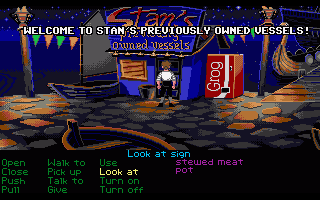
🕹️ DigiLiner Preservation Registry: This editorial retrospective belongs to our Retro Games Index and multi-platform Amiga / MS-DOS preservation dossier.
October 1990. Marin County, California. Skywalker Ranch.
Inside the Lucasfilm Games offices, 26-year-old Ron Gilbert slammed a stack of Sierra On-Line floppy disks onto his desk [1]. In those years, playing King's Quest or Space Quest felt akin to navigating a minefield blindfolded: miss an obscure brass key three hours earlier in a library, and you found yourself permanently soft-locked at the climax with days of effort wasted. Step into the wrong corridor, and an instant death screen wiped your progress without warning.
Gilbert despised this punitive design philosophy. In his radical 1989 manifesto published in the Journal of Computer Game Design, "Why Adventure Games Suck", he laid down an uncompromising golden rule: The player must never die arbitrarily, never get trapped in unwinnable dead ends, and never be penalized for curious experimentation [1][2].
On the misty, gaslit docks of Mêlée Island, this manifesto transformed pirate fiction into an enduring monument of sharp narrative wit.
⚡ The Secret of Monkey Island (1990) Verified Archival Dossier
msdos_Secret_of_Monkey_Island_The_1990 / monkey_adf) [7]First Twist: Sword Duels Were Won Through Literature, Not Reflexes
A pirate setting naturally demanded blade combat. Yet in 1990, computer sword fighting meant frantic button mashing or wearing down joystick microswitches. Ron Gilbert flatly rejected that convention: this was not an arcade brawler, but a game of narrative wit and intellect.
Drawing inspiration from classic Errol Flynn cinema where duelists constantly traded theatrical taunts to unbalance their rivals, Gilbert envisioned a rock-paper-scissors mechanic fueled by verbal insults. However, the early insults penned by the team lacked genuine literary flair.
The breakthrough came with an unexpected guest at Skywalker Ranch: celebrated author Orson Scott Card (Ender's Game) [3]. Card sat down with the team and authored some of the most memorable combat lines in video game history:
— "You fight like a dairy farmer!"
— "How appropriate. You fight like a cow!" [3]
To defeat the legendary Sword Master Carla, players had to roam Mêlée Island, dueling local pirates to collect verbal insults and their devastating ripostes. The cutlass was merely an excuse for dialogue.
Second Twist: A Hero Born From an Amiga File Extension: "guy.brush"
Guybrush Threepwood, gaming's most lovable and hapless buccaneer, did not get his name from maritime folklore or classical mythology. It was the accidental byproduct of an Amiga file format.
Lead artist Steve Purcell was designing the protagonist's pixel sprites using Electronic Arts' Deluxe Paint on Commodore Amiga [2]. At that stage, the character had no official name in the script; the team simply referred to him as "the guy". Purcell saved the walking cycles and idle poses as an Amiga brush file.
On the filesystem, the file appeared simply as: guy.brush [2].
Soon, team members were asking around Skywalker Ranch: "Where is the guy.brush file?" and "Have you imported Guybrush into SCUMM?" The name became indelible. Ron Gilbert then added the surname "Threepwood"—inspired by P.G. Wodehouse's comedic English nobles—and an iconic character was born: Guybrush Threepwood, an aspiring pirate ready to conquer the Caribbean.
Third Twist: The Single Exception to the "No Death" Rule
Gilbert remained fiercely loyal to his design manifesto: throughout Monkey Island, toss Guybrush into cannon blasts or pirate brawls and he always survives with comic nonchalance.
Yet the Lucasfilm team hid one brilliant exception to tease Sierra's paranoid fanbase: Sheriff Fester Shinetop (Ghost Pirate LeChuck in disguise) pushes Guybrush off the dock into deep ocean water, padlocked to a heavy idol [2]. Trapped underwater, Guybrush is surrounded by sharp tools, saws, and knives, but the taut rope prevents him from reaching any of them.
Earlier on Mêlée Island, Guybrush proudly bragged: "I can hold my breath for ten whole minutes!" [2].
If the player simply sits back without solving the puzzle, Guybrush genuinely stays alive underwater for ten entire minutes. Exactly when the timer runs out, his face turns sickly purple, his eyes roll back, and his standard SCUMM verb menu (Look, Pick up, Talk to) transforms into "Bloat" and "Rot". A mock Sierra tombstone appears. It remains one of the sharpest parodies in interactive storytelling.
Hardware Wars: Amiga 4-Floppy Juggling vs. PC VGA 256 Colors
The Secret of Monkey Island served as a landmark showcase for the hardware transition of the early 1990s:
- MS-DOS EGA (October 1990): The debut release delivered striking visuals within a 16-color limit. Artist Mark Ferrari employed master-level dithering patterns to craft atmospheric Caribbean nights.
- MS-DOS VGA (December 1990): Shipped two months later, the 256-color VGA edition revolutionized PC graphical benchmarks. The rich woodwork of the SCUMM Bar and lush island sunsets were breathtaking. Roland MT-32 MIDI support rendered Michael Land's reggae-pirate soundtrack with studio fidelity.
- Commodore Amiga (1991): Adapted to 32 colors across 4 floppy disks [5]. For Amiga 500 owners without a hard drive, the title turned into an infamous disk-swapping endurance test ("Please insert Disk 4"). Yet Amiga's 4-channel Paula DMA audio hardware rendered Michael Land's marimbas and bass grooves with such organic warmth that the Amiga release became an instant cult treasure.
Legacy & Closing
The Secret of Monkey Island demonstrated that deep respect for player agency, sparkling literary humor, and masterful hardware engineering could turn interactive entertainment into timeless art. Breaking away from the punitive pitfalls of the 1980s, Ron Gilbert's team showed that adventure gaming flourishes not by tallying player deaths, but through genuine laughter—and by elevating an accidental file extension (guy.brush) into an unforgettable heroic legacy.
[1] Gilbert, Ron. "Why Adventure Games Suck", The Journal of Computer Game Design, Vol. 3, 1989.
[2] Retro Gamer Magazine: "The Making of The Secret of Monkey Island", Issue 34, Imagine Publishing, 2007.
[3] Card, Orson Scott. "Insult Sword Fighting: Writing for LucasArts", GDC Archival Notes & Interviews, 1991.
[4] Sanglard, Fabien. "SCUMM Engine Architecture and Graphics Pipeline Analysis", 2019.
[5] Hall of Light & Lemon Amiga: The Secret of Monkey Island Entry #1856, Amiga Preservation Database.
[6] MobyGames: The Secret of Monkey Island (1990) Credits, Releases and Technical Specifications.
[7] Internet Archive: Software Library: MS-DOS Classic Showcase (msdos_Secret_of_Monkey_Island_The_1990) & Amiga TOSEC (monkey_adf).