





Editor's Note: In late 1994, the PC industry boasted 66 MHz 486 and 90 MHz Pentium systems displaying SVGA 3D visuals, while Commodore stood in liquidation. Amidst this backdrop, Binary Asylum delivered a technical marvel: a fully solid-shaded 3D polygon landscape exceeding 20 frames per second on an unexpanded 7.09 MHz Motorola 68000 Amiga 500. This editorial deep dive examines Zeewolf's software rasterizer, Newtonian winch physics, and enduring retro computing heritage using double-source verification.
Cold Open: The Impossible Polygons of 7.09 MHz
Autumn 1994. Commodore International had officially entered liquidation. Gaming publications declared the Amiga obsolete, asserting that real-time 3D polygon graphics required 32-bit RISC architectures or expensive PC accelerator boards.
Yet in the United Kingdom, a two-man independent studio operating under the Binary Asylum label dismantled that assumption. Programmer Peter Hickman and designer Bob Hamilton inserted a single 3.5-inch floppy disk into an unexpanded 1987 Amiga 500 powered by a 7.09 MHz Motorola 68000 CPU and 1 MB of RAM: Zeewolf.
The disk booted. On screen appeared neither wireframe approximations nor a sluggish slideshow. Instead, players witnessed an undulating ocean, a massive aircraft carrier, missile trails, forested hills, rolling armor, and an attack helicopter flying with 20+ FPS fluidity in fully solid-shaded 3D.
The Amiga community was astounded. This was not a tech demo; it was a deeply tactical, fully realized helicopter action simulation.
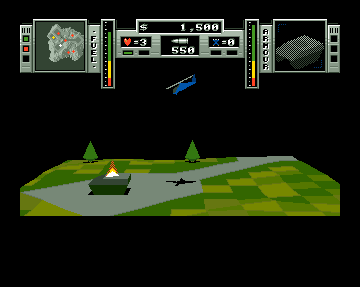
Zeewolf at a Glance
| Developer | Binary Asylum (Peter Hickman: 3D Engine & Programming; Bob Hamilton: Game Design & Graphics) [1] |
|---|---|
| Publisher | Empire Software / Entertainment International [1][2] |
| Release Date | November 1994 (Zeewolf) / November 1995 (Zeewolf 2: Wild Justice) [2] |
| Target Architecture | Commodore Amiga (A500, A500+, A600, A1200, A4000) OCS/ECS/AGA [1] |
| Hardware Requirements | Motorola 68000 @ 7.09 MHz (Minimum), 1 MB RAM, Single Floppy Drive [2] |
| Audio & Atmosphere | Allister Brimble (4-Channel Paula DMA Tracker Score, Dynamic Radio Chatter) [3] |
| Genre & Heritage | 3D Tactical Helicopter Simulation (Blending Virus / Zarch with Desert Strike) [1][4] |
| Sequel | Zeewolf 2: Wild Justice (FLIR thermal night vision, drivable amphibious armor) [2] |
First Turning Point: Bypassing the Blitter for 3D Speed
Casual observers often assume Amiga 3D games relied on the custom chipset's Blitter or Copper. In reality, the opposite was true.
The Amiga Blitter excelled at 2D bit-block copying and simple line drawing, but struggled with arbitrary filled 3D polygons. Edge-walking and multi-angle polygon filling caused severe bus arbitration bottlenecks when handled through Blitter hardware.
Peter Hickman recognized this limitation. Having studied David Braben's Zarch engine on Archimedes and its Amiga conversion Virus, Hickman knew that while Virus was visually remarkable, its twitchy controls made it notoriously punishing to play.
For Zeewolf, Hickman bypassed the Blitter entirely for polygon rasterization [1]. He implemented a custom software rasterizer written in hand-optimized Motorola 68000 Assembly:
- 16.16 Fixed-Point Arithmetic: On an Amiga 500 without a floating-point unit (FPU), all trigonometric transformations utilized pre-calculated 360-degree sine and cosine lookup tables (LUT) [1].
- Direct CPU Planar Rasterizer: Specialized span fillers wrote directly to Amiga bitplanes, updating multiple adjacent pixels per instruction cycle.
- Double-Buffered Copper Lists: While the 68000 rendered into the back buffer, the Copper coprocessor displayed the front buffer with zero visual tearing, maintaining a rock-solid 20–25 FPS on baseline hardware.
Second Turning Point: The Winch and Dynamic Center of Gravity
What elevated Zeewolf beyond peers like MicroProse's Gunship 2000 or EA's 2D classic Desert Strike was its physical winch mechanism.
In most 1990s titles, cargo pickup was an arcade contact trigger: fly over an object and it automatically enters inventory. In Zeewolf, the winch cable functioned as an authentic physical pendulum [1][4]:
- Momentum Transfer: Slinging a 15-ton tank or heavy fuel bladder during a sharp bank caused the cargo to swing, dynamically shifting the gunship's center of gravity and demanding active counter-steering.
- Tactical Battlefield Logistics: Damaged friendly missile batteries could be winched back to the carrier for field repair, and air-dropped defensive pods could be repositioned across strategic choke points.
- Pilot Search and Rescue: Rescuing ejected friendly pilots floating in open seas was not merely a scoring bonus, but a direct tactical imperative for operational success.
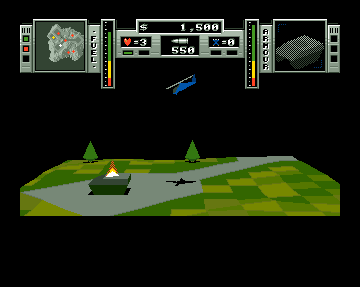
Third Turning Point: Allister Brimble's Dynamic Soundscape
Zeewolf's immersion extended far beyond its polygon counts. Renowned audio designer Allister Brimble, celebrated for Alien Breed and Project-X, harnessed the Paula chip's 4 DMA channels to build a functional tactical soundscape [3].
Foregoing repetitive background tunes, Brimble implemented blade pitch flutter, fluctuating turbine pitch under collective strain, radar lock alarms, and crackling radio announcements. When the gunship took flak, turbine cadence sputtered; as fuel dwindled, warning sirens grew urgent, pulling the player into an authentic cockpit atmosphere.
Platform Performance & Comparative Matrix
| Platform / Setup | CPU / Clock Rate | Average Framerate (FPS) | Visual Quality / Mode | Playability Assessment |
|---|---|---|---|---|
| Amiga 500 / 600 (OCS/ECS) | Motorola 68000 @ 7.09 MHz | 18 – 24 FPS | 320x256 solid-shaded 3D polygons | Superb; the primary target hardware configuration [1]. |
| Amiga 1200 (AGA) | Motorola 68EC020 @ 14.18 MHz | 28 – 35 FPS | Elevated polygon refresh cadence | Silky flight response with reduced input latency [2]. |
| Amiga 4000 / 040 | Motorola 68040 @ 25 MHz | 45 – 50 FPS | Peak polygon throughput | Lightning-fast, requiring refined throttle control [1]. |
| PC MS-DOS (Contemporary: Comanche) | Intel 486DX2 @ 66 MHz | 15 – 25 FPS (Voxel) | 320x200 Voxel Space (Non-polygonal) | Comanche leveraged ray-cast voxels, while Zeewolf delivered full 3D object geometry [4]. |
🎖️ Tactical Flight Briefing & Mission Warp Passwords
Carrier Landing Technique: Descending vertically onto the aircraft carrier fractures landing gear. Maintain slight forward speed matching carrier heading, ease collective lift, and touch down smoothly in forward motion.
Winch Neutralization Tactic: Conserve munitions against fortified missile towers. Sweep low, hook the turret cable, hoist it into the sea, or drop it into hostile depots to trigger sympathetic detonations!
Campaign Warp Code: On the mission selection screen, typing WARP unlocks direct access to all 32 tactical operational sectors [2].
Modern Heritage & Contemporary Impact
Today, low-poly aesthetics and physics-driven aerial mechanics enjoy a major resurgence in independent development. Contemporary titles like Carrier Command: Gaea Mission and Tiny Combat Arena trace their lineage directly to Zeewolf's 1994 carrier flight dynamics and winch physics.
Zeewolf stands as definitive evidence that hardware boundaries are not barriers, but invitations for brilliant mathematical craftsmanship and inventive engineering.
Perhaps the endurance of a flight simulation lies not in raw gigahertz, but in how gracefully physics and tactical design fit onto a single magnetic disk.
Key Discussion Questions:
- How did Peter Hickman's decision to bypass the Amiga Blitter in favor of a pure 68000 software rasterizer reshape expectations for late-era Amiga 3D programming?
- Do modern physics-based helicopter games capture the center-of-gravity pendulum effect as tangibly as Zeewolf's 1994 mechanical winch?
References & Verification Sources
- Hall of Light Amiga Database: Zeewolf - Entry 1601 & Peter Hickman Developer Interview Archive.
- Lemon Amiga: Zeewolf Profile, Critical Reviews and Level Passwords.
- The Amiga Music Preservation (AMP): Allister Brimble Paula Audio Tracker Documentation & Discography.
- MobyGames: Zeewolf (1994) Technical Overview, Physics Engine and Mechanics.