






September 17, 1994. London. Amid the crowded aisles of the European Computer Trade Show (ECTS), young Amiga programmer Andy Davidson wandered between publisher booths clutching a handful of 3.5-inch floppies. Weeks earlier, his passion project—titled 'Total Wormage'—had been rejected in an Amiga Format magazine coding contest. But the moment Martyn Brown inserted the disk into an Amiga at the Team17 booth, history pivoted. On the monitor, animated pink worms fired bazookas across procedural destructible landscapes, deployed kamikaze dives, and squeaked in high-pitched voices: 'Bye bye!' Brown stared at the screen for barely five minutes before looking up: 'We have to sign this game right now.'
Data at a Glance / Technical Specifications
| Original Release Date | November 17, 1995 (Europe), 1996 (North America) |
|---|---|
| Developer / Publisher | Andy Davidson, Team17 / Ocean Software |
| Design & Original Architecture | Andy Davidson (Developed in Blitz BASIC) |
| Audio & Sound Engineering | Bjørn Lynne (Amiga MOD Tracker & CD-DA) |
| Target Platforms & Chipsets | Commodore Amiga (OCS/ECS/AGA), MS-DOS, PlayStation, Saturn |
| Graphics Standard | PAL 320x256 16/32 Colors (AGA & DOS enhanced to 256 Colors) |
| Engine Architecture | Destructible Procedural 2D Bitmap Terrain Engine |
| Original Arsenal Count | Over 25 Weapons (Bazooka, Grenade, Sheep Bomb, Banana Bomb) |
| Expansions & Director's Editions | Worms Reinforcements (1996), Worms: The Director's Cut (1997) |
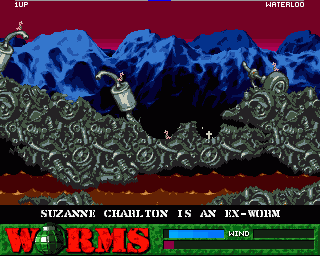
First Turning Point: Transforming Stiff Artillery Tanks Into Expressive Cartoon Annelids
The foundational mechanics of Worms traced their roots back to the late 1970s mainframe classic 'Artillery' and the MS-DOS classic 'Scorched Earth'—turn-based ballistic duels where players dialed in angle, elevation, and velocity. However, Andy Davidson replaced utilitarian tank barrels with living, breathing, emotionally reactive cartoon worms.
Each invertebrate grimaced when taking shrapnel, put on a safety helmet when digging blowtorch shafts, drowned with bubbling distress when submerged, and forced players to read shifting wind gauges before firing a bazooka. Accompanied by pitched voice samples shouting 'Incoming!', 'You'll regret that!', and 'Stupid!', clinical ballistic trajectory math was transformed into an uproarious living-room multiplayer phenomenon.
Second Turning Point: Blitz BASIC and Pixel-Level Destructible Bitmap Physics
The foremost technical triumph behind Worms was its origin in Blitz BASIC on the Commodore Amiga. At a time when commercial developers insisted high-performance games demanded pure Motorola 68000 assembly or optimised C, Davidson single-handedly constructed a fully destructible procedural physics engine in Blitz.
At the start of each match, the engine synthesized an entirely random fractal island in memory. Every detonated dynamite stick, proximity mine, or cluster grenade cleanly erased a circular radius of pixels from the bitmap mask. The ground literally evaporated beneath players' feet, sending unsuspecting worms tumbling into the instant-death brine below. This fully dynamic terrain meant no two rounds were ever identical, elevating the environment from passive scenery into a primary weapon.
Third Turning Point: Bjørn Lynne and Amiga Tracker Atmosphere
The acoustic personality of Worms was forged by Bjørn Lynne (known in the Amiga demoscene as Dr. Awesome). Lynne pushed the Paula sound processor's 4-channel DMA architecture, and later Red Book CD-DA audio tracks, into crafting an understated yet deeply atmospheric backdrop.
Ambient themes built around subtle bass grooves and rhythmic percussion heightened match tension without distracting from the countdown timer. Coupled with visceral, punchy sound design for shotgun blasts, ricochets, and water splashes, Worms set a milestone for tactical sound engineering. This audio framework would soon expand to include legendary gags such as the 'Holy Hand Grenade' choir in subsequent expansions.
Decision Matrix: Worms vs. Scorched Earth vs. Lemmings
| Feature / Game | Worms (1995) | Scorched Earth (1991) | Lemmings (1991) |
|---|---|---|---|
| Gameplay Archetype | Turn-Based Tactical Artillery Warfare | Turn-Based Ballistic Tank Simulation | Real-Time Puzzle & Pathfinding Strategy |
| Terrain Deformation | Fully Destructible Procedural Bitmap | 2D Mountain/Valley Erosion (Falling Dirt) | Diggable / Constructible Static Stages |
| Character Identity | Custom Team Names, Voice Packs, Health Pools | Static Mechanical Tanks & Shield Buffs | Uniform, Disposable Lemming Swarms |
| Multiplayer Dynamic | Hotseat Support for up to 4 Teams on One Rig | Sequential Hotseat for up to 10 Players | Split-Screen Two-Player Mode Only |
| Core Engine Architecture | Amiga Blitz BASIC (Andy Davidson) | Borland C++ (Wendell Hicken) | Amiga 68000 Assembly (DMA Design) |
Modern Resonance and Enduring Cultural Legacy
What originated as an independent Amiga hobby project in 1994 propelled Team17 into a globally recognized publishing powerhouse. The franchise reached competitive maturity with 1999's Worms Armageddon, which continues to host international online tournaments to this day.
Modern successors like Worms W.M.D deliberately adhere to Davidson's original 2D physics and hand-drawn spirit. In the autumn of 1995, as the industry rushed headlong into early 3D polygons, Worms proved that flawless emergent physics, sharp British satire, and pure couch-multiplayer camaraderie possess a timeless appeal that outlasts any hardware generation.