 EN
 TR
 DE
 FR
 ES
WOLFENSTEIN 3D (1992)
John Carmack's DDA Raycasting Breakthrough, Sound Blaster Roars, and the Dawn of the First-Person Shooter
| Development Team | id Software (John Carmack, John Romero, Adrian Carmack, Kevin Cloud, Tom Hall) |
|---|---|
| Publisher & Distribution | Apogee Software (Scott Miller) / Shareware & Retail |
| Audio & Sound Effects | Bobby Prince (Sound Blaster FM Synthesis & 8-bit Digital Samples) |
| Initial Release Date | May 5, 1992 (MS-DOS) |
| Target Architecture & Mode | Intel 80286 / 80386 (Mode 13h: 320x200, 256 Colors VGA @ 60 FPS) |
| Source Code License | 1995 GNU General Public License (GPL) |
The night of May 5, 1992. A modest apartment in the quiet Dallas suburb of Mesquite, Texas. Under the cool amber glow of a CRT monitor sat 21-year-old mathematical prodigy John Carmack. Around him, amidst scattered pizza cartons and cans of soda, stood John Romero, Adrian Carmack, Kevin Cloud, and Tom Hall, holding their breath. Carmack tapped the Enter key. In an instant, the 16-bit MS-DOS screen dissolved into stone corridors, banners, and iron doors, rotating smoothly at a blisteringly responsive 60 frames per second.
Until that moment, personal computers were widely considered utilitarian workhorses suited for spreadsheets, text adventures, chess simulations, or sluggish side-scrollers. Smooth three-dimensional graphics belonged exclusively to military simulators or Silicon Graphics supercomputers costing tens of thousands of dollars. With his pioneering DDA (Digital Differential Analysis) raycasting algorithm, Carmack turned a commodity Intel 286/386 PC into a relentless labyrinth of visceral adrenaline, sparking the explosive dawn of the First-Person Shooter (FPS) genre.
Turning Point 1: DDA Raycasting and the Mode 13h Revolution
In 1992, computing arbitrary 3D polygons in real time on an Intel 80286 or 80386 CPU was practically out of reach; floating-point co-processors were rare luxuries, and integer ALUs choked on complex matrix transformations. Carmack discarded polygons entirely, reimagining spatial rendering through planar geometry.
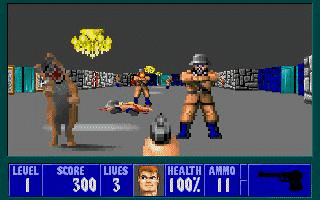
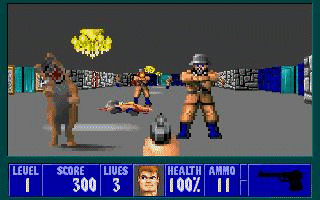
The entire game world was mapped to a uniform 64x64 two-dimensional grid. Walls stood strictly perpendicular at 90-degree angles, while floors and ceilings were rendered as solid, untextured planes. Carmack's engine cast a single mathematical ray for each of the 320 horizontal screen columns. Using the Digital Differential Analysis (DDA) algorithm, the ray stepped through grid boundaries using simple additions and bit shifts, calculating wall intersection distances without expensive trigonometric division.
By bypassing 90% of the mathematical overhead, the engine rendered textured vertical wall slices at blazing speeds. Operating directly inside VGA's Mode 13h (320x200, 256 colors) linear frame buffer, Wolfenstein 3D sustained 30 to 60 frames per second even on a modest 12 MHz 286. It was a software engineering milestone that rewrote the playbook of real-time computer graphics.
Turning Point 2: Bobby Prince and the Sound Blaster Roar
The impact of Wolfenstein 3D went far beyond its visual fluidity; it completely redefined the auditory presence of personal computers. Prior to this era, most PC games relied on the tinny, monotonic squeaks of the internal motherboard speaker.
Composer and sound engineer Bobby Prince utilized the emerging Sound Blaster 2.0 / Pro audio boards to their absolute limits. Digitized German voice samples echoed through stone corridors ("Achtung!", "Schutzstaffel!", "Mein Leben!"), heavy iron doors slid shut with metallic thuds, and the devastating rat-tat-tat of the motorized chaingun made desks vibrate.
Combined with driving FM-synth militaristic scores, the audio introduced positional environmental awareness to PC gaming for the very first time. Players learned to stop in their tracks, listening intently for approaching boots or distant guttural growls around blind corners.
Wolfenstein 3D did not debut on retail store shelves. Following the visionary business counsel of Apogee founder Scott Miller, the game was structured into six distinct episodes. The first ten levels, packaged as Episode 1: Escape from Castle Wolfenstein, were uploaded completely free of charge to BBS networks, dial-up bulletin boards, and university FTP servers.
The climactic confrontation in Episode 3—a dual-chaingun mechanized suit battle against Adolf Hitler—became an indelible pop-culture icon of raw gaming audacity.
Turning Point 3: B.J. Blazkowicz's Legacy — The Runway to DOOM
Upon its debut, computer gaming journals hailed Wolfenstein 3D as a seismic shift, earning Action Game of the Year honors across the globe. Yet for id Software, it was essentially a proof of concept.
Carmack remained unsatisfied with orthogonal 90-degree walls, completely flat floors, and uniform ambient brightness. The immense financial windfall from Wolfenstein gave id absolute independence. Carmack invested in high-end NeXTstation workstations and set to work on a true revolution featuring non-orthogonal geometry, variable ceiling heights, and dynamic sector lighting—DOOM.
Without Wolfenstein 3D, the foundation for DOOM, Quake, Half-Life, and contemporary competitive multiplayer gaming would never have crystallized. B.J. Blazkowicz's escape laid down the structural genome for the entire genre.
Hardware Architecture & Platform Comparison
| Technical Characteristic | MS-DOS (Original Release 1992) | Super Nintendo (SNES Port 1994) | Macintosh / 3DO (Enhanced Ports) |
|---|---|---|---|
| Graphics Engine & Mode | DDA Raycasting (Mode 13h, 320x200, 256 Colors) | Custom Software Raycaster (256x224 Mode) | High-Resolution Engine (640x480 Pixels) |
| Frame Rate (FPS) | Locked 60 FPS on 386 Hardware | 15–25 FPS (Fluctuating at hardware limit) | Stable 30 FPS at High Resolution |
| Audio Architecture | Sound Blaster / AdLib FM + 8-bit PCM Shouts | Sony SPC700 8-Channel ADPCM Wavetable | 16-bit Digital CD-Quality Audio Tracks |
| Censorship & Presentation | Completely Uncut: Swastikas, blood, portraits | Heavy Censorship: Green sweat, mutant rats | Uncut, redrawn high-resolution textures |
| Commercial Model | Apogee Shareware (Episode 1 Free + Direct Mail) | Retail ROM Cartridge ($30–$40) | Retail CD-ROM Boxed Release |
Decision Support Matrix: Experiencing Wolfenstein 3D Today
| Platform / Flavor | Target Audience | Key Advantages | Constraints & Caveats |
|---|---|---|---|
| ECWolf Source Port (PC / Mac / Linux) | Modern players seeking widescreen display, mouselook, and flawless controls | Modern OS support, smooth high frame rates, automap, active modding | Smooth scaling diminishes the raw, chunky CRT aesthetic |
| DOSBox Staging / GOG Edition | Purists seeking authentic 320x200 VGA pixels and true Sound Blaster FM tones | 100% faithful emulation, original pacing, authentic audio timings | Keyboard-centric control scheme requires initial acclimation |
| Macintosh / 3DO Editions | Retro enthusiasts curious about enhanced 640x480 sprites and extra weapons | Crisp redrawn textures, atmospheric audio redesign | Requires dedicated Mac or 3DO emulation software |
In strict adherence to DigiLiner's preservation charter, commercial game binaries are not hosted on our servers. John Carmack released the full Wolfenstein 3D source code under the GPL in 1995. You may inspect verified historical repositories via:
Wolfenstein 3D stands as an enduring testament to what a small group of determined visionaries armed with pure mathematics and raw ambition can achieve, permanently rewriting the trajectory of interactive entertainment.
One parting question: when a guttural "Achtung!" reverberates through the cold stone corridors, will you conserve your ammunition and retreat into the shadows, or spin up the chaingun and charge headlong into the fray?