 EN
 TR
 DE
 FR
 ES
SPEEDBALL 2: BRUTAL DELUXE
The Cyberpunk Sports Sanctuary Born in East London, Chrome Pixel Mastery, and the "Ice Cream!" Legacy
| Lead Developers & Design | The Bitmap Brothers (Mike Montgomery, Eric Matthews, Steve Kelly) |
|---|---|
| Art Director & Graphics | Dan Malone (Chrome, Steel, and Polished Metallic Pixel Architecture) |
| Audio & Sound Design | Richard Joseph (In Collaboration with Nation 12 / John Foxx) |
| Initial Release Date | November 1990 (Amiga OCS/ECS), 1991 (MS-DOS, Atari ST, C64) |
| Target Architectures | Commodore Amiga (MC68000 @ 7.14 MHz), MS-DOS (VGA 16/256 Colors) |
| Archive Preservation IDs | Amiga TOSEC: speedball_2_brutal_deluxe.adf | DOS: speedball2.zip |
Autumn 1990. The historic docklands of Wapping, East London. Inside the studio of The Bitmap Brothers—the leather-jacketed, sunglass-wearing developers celebrated by the gaming press as the industry's first true rock stars—the conventional rules of sports games were about to be dismantled. Mike Montgomery and Eric Matthews sat before glowing cathode screens, plotting a dystopian vision of the year 2095 around a single provocative inquiry: "What if street violence wasn't outlawed, but transformed into a sanctioned corporate gladiator spectacle?"
Artistic visionary Dan Malone transformed the Amiga’s 32-color OCS palette into gleaming sheets of polished steel, rivets, and reflective chrome. Legendary composer Richard Joseph entered the recording booth alongside electronic music pioneer John Foxx (Nation 12), encoding crunching bone impacts, metallic ricochets, and the eerie tannoy announcement "Ice Cream! Ice Cream!" into Paula’s four hardware audio channels. The result was far more than an athletic contest; it was a cybernetic masterpiece where every match revolved around ruthless 10-point tactical decisions.
Turning Point 1: Targeting Bodies Over the Net (The Mathematization of Violence)
In traditional athletic simulations, the objective is elementary: deliver the ball into the net to take the lead. In Speedball 2, a goal still awards 10 points. Yet the radical conceptual leap introduced by the Bitmaps was turning the opponent's physical body into an equally lucrative scoring asset.
There are no referees, no whistles, and no yellow cards. Hurling yourself into a flying tackle against a ball carrier, driving an opponent headfirst into the perimeter wall, and whittling their vitality bar until they collapse onto the steel floor earns precisely 10 points! Crucially, there are no substitutes on the bench; a stretcher case forces the opposing squad to play out the half down a man.
This dynamic upended standard sports logic. Faced with an agile, high-scoring opponent, the optimal strategy wasn't to chase goals, but to hunt down their primary striker, shatter their armor, and turn a close contest into a 150-to-20 rout while playing against a severely depleted squad.
Turning Point 2: Not a Pitch, but a Vertical Pinball Table
The arena in Speedball 2 is neither a soccer pitch nor a handball court; it is a gigantic, vertical pinball table. The side boundaries are not passive out-of-bounds lines, but kinetic surfaces designed to generate velocity and points:
- Star Lights: Five star nodes line each flank. Banking the heavy ball against them activates each light for 2 points, with a 20-point bonus awarded for illuminating all five.
- Score Multiplier Domes: Routing the ball through the curved side-wall ramps increases your team’s subsequent scoring by 50% or 100%, doubling a 10-point goal into a devastating 20-point strike.
- Electro-Bumpers and Coin Pickups: Flashing tokens scattered across the arena floor swell your club’s bank account for subsequent locker-room investment.
A veteran Speedball player could easily surpass 200 points without registering a single traditional goal—simply by cycling the ball through multiplier chutes, illuminating constellations of wall stars, and brutalizing the opposing roster.
To convey believable metallic reflection within the Amiga's 32-color ceiling, Dan Malone utilized extreme contrast: placing stark single-pixel white highlights immediately adjacent to dark navy and black shadows to evoke mirror-like reflection. For the stretcher announcement, Richard Joseph sampled a genuine stadium vendor loudspeaker. The cheerful chant of "Ice Cream! Ice Cream!" blaring while an incapacitated cyborg was dragged away remains one of the sharpest satirical touches in gaming history.
Turning Point 3: The Resurrection of Brutal Deluxe (Deep RPG Management)
Speedball 2 was fundamentally more than an arcade contest. At its core lay an addictive RPG progression loop where players took command of Brutal Deluxe, a bankrupt, demoralized outfit languishing at the rock bottom of the Second Division.
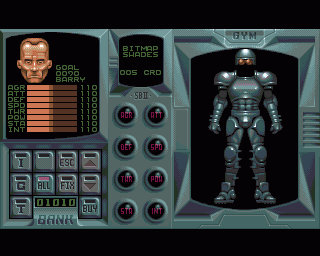
Your opening squad consisted of slow, fragile rookies who collapsed under the slightest collision (Noddy, Eddie, Glen). Reinvesting match purses into gym upgrades allowed you to systematically bolster Eight Vital Attributes—Speed, Power, Armor, Stamina, Aggression, Passing, Throwing, and Intelligence.
When training reached its ceiling, you entered the transfer market to recruit armored cyborg mercenaries, such as the unstoppable forward Barros. Guiding Brutal Deluxe from 16th place in Division Two to the pinnacle of Division One and hoisting the Champions Cup stands as one of 16-bit gaming's most gratifying long-term journeys.
Hardware & Architectural Comparison
| Technical Characteristic | Commodore Amiga (OCS/ECS) | MS-DOS (VGA / AdLib) |
|---|---|---|
| Display Timing & Scroll | 50 Hz Locked Hardware Blitter Vertical Raster Scroll | 60 Hz VGA Software Rendering (Occasional Judder) |
| Palette & Chrome Art | Custom High-Contrast 32-Color OCS Palette | 256-Color VGA Palette (Vivid, but less textured shading) |
| Audio Engine & Synthesis | Paula 8364 (4-Channel 8-bit PCM Stereo DMA) | Yamaha YM3812 (AdLib OPL2) / Early Sound Blaster |
| Soundtrack & Voice Work | Sampled Metal Impacts, Screams, and "Ice Cream!" Voice | FM Synthesized Effects or 8-bit Sound Blaster Samples |
| Control Architecture | 1-Button 9-Pin Digital Joystick (Leap & Power Throw) | Keyboard or 2-Button PC Gameport Joystick |
| Career Framework | 2-Tier Division Structure, 16 Teams, Attribute Training | Identical League & Roster Framework |
Decision Support Matrix: Experiencing Speedball 2 Today
| Platform / Flavor | Target Audience | Key Advantages | Constraints & Caveats |
|---|---|---|---|
| Original Amiga (WinUAE / FS-UAE) | Purists seeking Dan Malone's true chrome pixels, Paula audio, and 50 Hz glide | Authentic Blitter collision physics, bone-crunching audio, zero input delay | Demands a precise microswitched digital joystick |
| MS-DOS Port (DOSBox-Staging) | Retro PC gamers comfortable with keyboard or gamepad mapping | Rapid loading, clean VGA lines, broad emulator support | Lacks the liquid 50 Hz vertical raster glide of the Amiga original |
| Speedball 2 HD (Steam / Modern Port) | Casual players wanting modern widescreen resolutions and gamepads | Plug-and-play modern gamepads, clean interface, high resolution | Alters the dark, grit-heavy atmosphere of the original 1990 pixel art |
In strict adherence to DigiLiner's preservation charter, no commercial ROMs or disk images are hosted on our servers. Verified historical records may be accessed via these trusted public institutions:
Speedball 2: Brutal Deluxe proved that the greatest sports simulations need not imitate television broadcasts; by forging a ruthless universe out of chrome pixels, steel balls, and human resolve, it built an indelible monument of 16-bit interactive art.
One parting question: with scores tied late in the second half and the steel ball ricocheting off the side bumper directly toward your path, will you slip a tidy goal past the keeper, or launch a flying tackle into the advancing forward to summon that chilling cry of "Ice Cream!"?