





December 1993. As id Software's DOOM detonated across computer publications worldwide, the Commodore Amiga community stood in absolute shock. Since 1985, with its rich planar graphics, DMA hardware blitter, and Paula 4-channel sound chip, the Amiga had reigned supreme as the unchallenged king of home computing. Suddenly, in the face of PC 486 processors and linear VGA framebuffers, the platform appeared technically outmatched. The limitation was not raw processing deficit, but the beloved planar bitplane architecture designed a decade earlier by Jay Miner. While 3D raycasters and texture mappers calculated pixels on a linear byte-per-pixel ("chunky") basis, displaying them on the Amiga's Denise or Lisa chip required scattering bits across multiple distinct bitplanes. This "Chunky-to-Planar" (C2P) conversion devoured the Motorola 68020's CPU cycles within milliseconds. As critics declared that the Amiga could never run a fast first-person shooter, a solitary software author in New Zealand stepped forward: Mark Sibly.
Data at a Glance: Gloom & Gloom Deluxe (1995 / 1996)
| Parameter | Detail & Technical Standard |
|---|---|
| Lead Programmer & Engine Architect | Mark Sibly (Black Magic Software) [1] |
| Graphic Artists & Visuals | The Real Alan (Alan Thorn), James Sibly [1] |
| Audio & Sound Engineering | Kev Stannard (Paula Tracker Sound Modules) [2] |
| Publisher & Distribution | Guildhall Leisure Services Ltd. (UK) [1] |
| Target Architecture | Commodore Amiga AGA (A1200 / A4000 / CD32) & ECS (1 MB Chip + Fast RAM) [3] |
| Engine Framework | Custom Sector Raycaster + Hand-Tuned Assembly C2P Converter |
| Multiplayer Modes | Split-Screen & Null-Modem Serial Link (2 Players Simultaneous) [3] |
| Archival Registries | Hall of Light (#2739, #2740), Lemon Amiga (#1668), MobyGames (#6583) |

First Turning Point: The Assembly Revolution Overcoming the C2P Bottleneck
Commodore made a fateful engineering omission when designing the AGA (Advanced Graphics Architecture) chipset in 1992: it neglected to include a dedicated hardware Chunky-to-Planar converter. While a PC processor wrote pixel colors directly to a flat video buffer (`0xA0000`), an Amiga had to unpack every byte into eight discrete memory planes, consuming tens of thousands of shifting and masking operations per frame.
Mark Sibly rejected defeat. He wrote highly optimized Motorola 68020 assembly routines that choreographed processor registers with clock-cycle precision. By rendering the display at 2x1 and 4x1 horizontal pixel blocks, he slashed the data conversion burden to a fraction. The outcome sent shockwaves through the industry: running on a completely unexpanded Amiga 1200 or CD32 console, Gloom delivered full-screen texture-mapped 3D corridors and animated adversaries at a responsive 20 to 25 frames per second [1], [3]. Amiga owners could finally meet PC enthusiasts on equal ground.

Second Turning Point: Over-the-Top Gore, "Meaty" Mode, and Cult Black Comedy
Rather than merely mimicking the solemn industrial horror of DOOM, Gloom forged its own identity through visceral, satirical British black comedy. When zombie marines, mutant guards, and underworld demons took plasma fire, geysers of gore erupted, gibs plastered stone walls, and severed heads tumbled through the air, propelling the title into immediate cult status.
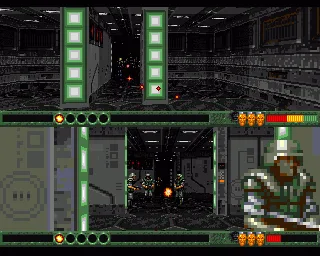
The violence toggle in the options menu ("Messy" versus "Meaty") stood as an open rebellion against the sanitization guidelines enforced by major console makers of the era [1]. Yet this blood-soaked aesthetic served a profound engineering purpose: instantly vaporizing vanquished foes eliminated the memory footprint of lingering corpse animations from the Amiga's precious 2 MB Chip RAM pool. Furthermore, Gloom made history as the first fast Amiga shooter offering simultaneous two-player deathmatch—either via horizontal split-screen on a single machine or over a null-modem serial cable connecting two Amigas [3].
Third Turning Point: From Amiga's Swan Song to Modern Indie Engines — The Blitz BASIC Legacy
In 1996, Gloom Deluxe advanced the engine further: unlocking an uncompromised 1x1 full-pixel mode for systems equipped with Motorola 68030 and 68040 accelerator boards, achieving visual parity with PC VGA setups [3]. But the title's deepest historical impact took place long after the commercial retail era concluded.
Mark Sibly evolved the software foundations forged during Gloom into a global software movement. Sibly authored the Blitz BASIC compiler, followed by the acclaimed BlitzMax and Monkey development languages, which became the launchpad for hundreds of thousands of independent developers producing their first 2D and 3D titles throughout the 2000s. Sibly's decision to release the full Gloom source code into the Public Domain enabled the emergence of modern cross-platform engines such as ZGloom, preserving the game natively on modern operating systems [1]. Gloom was not merely a technical triumph that restored the Amiga's pride; it was a foundational seed that nurtured modern independent game development culture.
Platform & Hardware Performance Matrix
| Hardware Tier | Processor & Clock | Display Mode & C2P Ratio | Framerate (FPS) | Gameplay & Multiplayer Status |
|---|---|---|---|---|
| Amiga 500 / 600 (ECS) | Motorola 68000 @ 7.09 MHz + 1 MB Chip + Fast RAM | 4x1 Chunky Block Pixels | 12 - 16 FPS (Borderline) | Single-Player Only, Reduced Viewport |
| Amiga 1200 / CD32 (Stock AGA) | Motorola 68020 @ 14.18 MHz (2 MB Chip RAM) [1] | 2x1 Texture Mapping (Full Screen) | 20 - 25 FPS (Smooth & Stable) | Full-Screen Campaign & Fluid Split-Screen [3] |
| Amiga 1200 + Accelerator (030/040) | Motorola 68030 / 68040 @ 40-50 MHz + Fast RAM | 1x1 Crisp Resolution (Gloom Deluxe) [3] | 30 - 40+ FPS (High-Speed) | Maximum Visual Detail, 256 AGA Colors, Serial LAN |
| Modern PC / Open Source Port (ZGloom) | x86_64 / ARM (WebAssembly / SDL2) | 1080p / 4K Native Aspect Ratio | Solid 60 FPS (Zero Stutter) | Modern Gamepad Support, High-Fidelity Audio Mode |
Contemporary Significance: Pure Engineering Born from Constraint
In an era where modern gaming relies on gigabytes of memory and towering GPUs, developers can draw immense inspiration from what Gloom achieved within 2 megabytes of shared Amiga RAM. Rather than lamenting hardware limitations, Mark Sibly adapted algorithms directly to silicon realities, transforming the impossible into working code.
Perhaps Gloom's greatest triumph lies not in the viscera it hurled across Amiga monitors, but in how a solitary software engineer outwitted an architectural omission to turn the impossible into reality.
Two questions to consider today:
- With near-limitless modern computing power, have we lost the raw craftsmanship of low-level assembly optimization that defined early computing?
- What does a game that overcame an entire platform's hardware limitation through pure software ingenuity say to an industry increasingly dependent on off-the-shelf game engines?
Verified Archival Sources:
[1] Wikipedia & Black Magic Software Historical Records: Mark Sibly development biography, Blitz BASIC engine history and Gloom public domain release data. Wikipedia Gloom Article
[2] Exotica & Amiga Music Preservation: Kev Stannard Gloom and Gloom Deluxe sound module records and tracker audio engineering. Exotica Gloom Audio Archive
[3] Hall of Light (HOL): Gloom (#2739) & Gloom Deluxe (#2740) technical specifications, ECS/AGA requirements and multi-player serial connection notes. Hall of Light Record #2739