 EN
 TR
 DE
 FR
 ES
🕹️ DigiLiner Retro Dossier: This review is part of our central MS-DOS preservation archive in the Retro Games Catalog.
December 10, 1993. Midnight. Dallas, Texas.
Inside id Software’s offices, Jay Wilbur and John Romero were desperately attempting to connect to an FTP server at the University of Wisconsin-Parkside (ftp.uwp.edu) [1]. On that freezing winter night, during the infancy of the public internet, thousands of university students and system administrators sat hunched before glowing monitors, hammering the F5 key. Network congestion surged so intensely that the sysadmin had to forcefully drop connected users just to keep the server from collapsing under the weight of incoming traffic.
The moment the clock struck 00:00, a compressed 2.39-megabyte archive dropped onto the network wire: 1doom1_0.zip [1][2]. Within minutes, Wisconsin’s external bandwidth vanished entirely. The university network ground to an absolute halt.
What was released that night was far more than another computer video game. The dull, beige office desktop—customarily relegated to the corner of the room for processing invoices and editing spreadsheets—was hurled violently into the center of the living room, transformed into an unrelenting arcade demon.
⚡ DOOM (1993) Archive Dossier & Verified Specifications
First Twist: It Wasn't 3D; It Was a 13-Year-Old Mathematical Illusion
In early 1994, anyone laying eyes on DOOM for the first time was gripped by the same visceral deception: they believed they were gazing into a genuine three-dimensional universe. The player ran, ducked into subterranean tunnels, ascended staircases, and rounded sharp corners.
Yet what flickered across the phosphor screen was not a 3D coordinate space. In rigorous technical terms, DOOM was an uncompromising 2.5D sectoral illusion [2].
Under the hood of the engine, you could never build one room directly atop another ("room-over-room" was strictly impossible). The entire level geometry was drawn on a flat, two-dimensional floor plan. Every sector was assigned a floor height, a ceiling height, and an ambient light level. There was no real Z-axis calculation; a 2D line drawing was merely extruded vertically upward and downward [2][5].
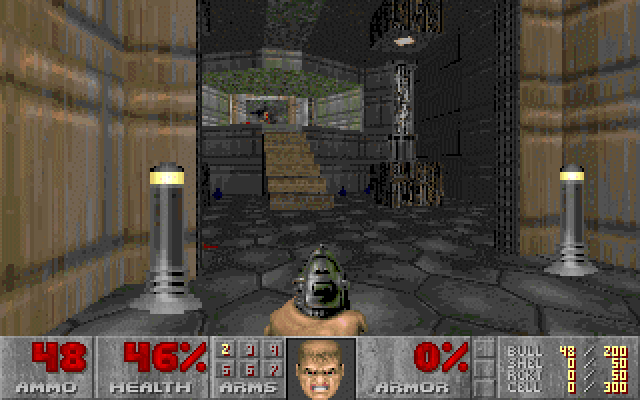
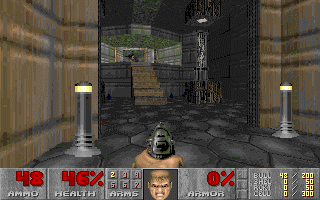
How, then, did a contemporary 33 MHz 486 processor render this intricate scene at a consistent 35 frames per second?
At the time, commodity personal computers lacked dedicated hardware to compute pixel depth (no Z-buffer existed). Memory bus bandwidth was so constricted that rendering the same screen pixel twice (overdraw) choked the CPU immediately [2]. Rather than fighting consumer hardware limitations with brute force, John Carmack turned to academic mathematics.
He discovered his breakthrough inside a 1980 academic paper by Bruce Naylor: BSP (Binary Space Partitioning) [5].
Carmack devised a binary tree structure that partitioned the map into halves, quarters, and eighths during pre-compilation. When the player moved down a corridor, the engine did not paint surfaces from back to front; it traversed the tree front to back. The instant a foreground wall column was rendered to the frame buffer, its vertical pixel columns were locked; any room, corridor, or monster lurking behind it was completely omitted from CPU calculations [2].
Computational complexity plummeted to (O(N)). Developed by Carmack in Objective-C on a high-end NeXTstation workstation, this algorithm allowed a modest 4-megabyte DOS machine to operate as though it were an advanced graphics mainframe.

Second Twist: Tearing up the "Doom Bible" and the Clash of the Two Johns
The production of DOOM witnessed an intense ideological reckoning within the id Software team.
Co-founder Tom Hall had authored an exhaustive 120-page design document for the title: "The Doom Bible" [1]. Hall envisioned four distinct playable military operatives named Teague, Dimitri, Lorelei, and Thi, complete with intricate narrative dialogue, radio check-ins with research staff, and trapped scientists awaiting rescue.
John Carmack casually discarded the binder onto the table, delivering one of the most famous and blunt aphorisms in computer gaming lore:
"Story in a game is like a story in a porn movie; it's expected to be there, but it's not that important." [1]
John Romero stood firmly alongside Carmack. Romero had no interest in mission logs or scripted narrative halts; he wanted James Cameron's Aliens colliding with Sam Raimi's Evil Dead II, propelled forward by blistering heavy metal guitar riffs [1][3].
Tom Hall's deliberate, narrative-heavy world was shelved overnight. Disheartened, Hall resigned from id Software and transitioned to Apogee.
With merely 10 weeks remaining before the scheduled launch date, half of the existing level assets were scrapped. In that high-pressure vacuum, Sandy Petersen—celebrated author of the tabletop role-playing classic Call of Cthulhu—joined the studio [1]. Over those final 10 weeks, Petersen built 19 legendary maps from the ground up, while Romero crafted the opening masterpiece: E1M1: Hangar [3].

The visual weight of the game emerged from an equally physical, tactile process. Rather than hand-pixeling enemy sprites on monitors, Adrian Carmack and Kevin Cloud sculpted miniature maquettes out of latex, clay, and steel wire (Spider Mastermind, Cyberdemon, Baron of Hell) [1].
Mounted on a turntable, these models were captured via video camera across 8 rotations. Kevin Cloud digitized his own hairy forearms and workshop cuts for the Doom Marine’s first-person punching animation; the iconic pump-action shotgun in hand was a scanned photograph of a cheap plastic TootsieToy purchased at a local department store [1][3].
Third Twist: 2.39 MB Paralyzing Corporate Networks and Port 666
The explosive velocity of DOOM's distribution defied all conventional marketing logic. id Software embraced Apogee's shareware publishing model: the initial 9-level episode (Knee-Deep in the Dead) was distributed completely free of charge [1]. Players were explicitly urged: "Copy this game, give it to friends, upload it to BBSs."
Yet the true cultural catalyst was the adversarial mode christened by John Romero himself: "Deathmatch" [1][3].
DOOM allowed up to 4 players over a local area network (LAN), or 2 players via serial modem, to hunt each other inside shared labyrinths. Prior to this, PC gaming was largely an isolated encounter between a solitary human and scripted machine logic. DOOM inverted the premise: your adversary was no longer deterministic AI, but your college roommate across the table or your colleague down the hall.

The corporate toll of this multiplayer fever was severe. The network stack in early DOOM broadcast raw IPX packets indiscriminately across the entire local subnet [2]. When four users engaged in a match, the flood of packet broadcasts saturated corporate Ethernet lines, bringing enterprise operations to an abrupt halt.
Corporations including Intel, Lotus Development, Texas A&M, and Carnegie Mellon instituted blanket bans on running DOOM during business hours [1]. University network engineers authored custom daemon scripts known as "Doom-busters" that monitored network traffic, killed active processes, and severed offending network connections on sight.
The phenomenon grew so vast that in May 1994, John Carmack petitioned the Internet Assigned Numbers Authority (IANA). Jon Postel, legendary pioneer of internet protocol standards, reviewed the application and officially assigned DOOM its own permanent port number: Port 666 [4].
Open a terminal on any contemporary Linux, macOS, or FreeBSD server today and examine /etc/services; you will still find those two historic entries enshrined in the operating system [4]:
doom            666/tcp    # DOOM Id Software
doom            666/udp    # DOOM Id Software
Hardware Architecture Matrix (1993 vs. 1994 Benchmarks)
| Hardware Component | Minimum System (1993) | Recommended Ideal Experience | Technical Role & Architectural Impact |
|---|---|---|---|
| Processor (CPU) | Intel 80386SX (25/33 MHz) | Intel 80486DX (33/66 MHz) | 32-bit arithmetic and BSP traversal required the 386 protected mode environment [2]. |
| System Memory (RAM) | 4 MB | 8 MB | DOS/4GW 32-bit extender shattered the 640 KB barrier to buffer active WAD assets [2]. |
| Graphics Adapter | VGA 320x200 (Mode 13h) | VGA 320x200 (Mode 13h) | Linear 64,000-byte video memory addressing delivered smooth 35 FPS playback [2][5]. |
| Audio Hardware | PC Speaker / AdLib FM | Sound Blaster 16 / Roland SC-55 | Bobby Prince's General MIDI compositions attained studio-grade synthesis on Roland hardware [1][3]. |
| Disk Storage | 15 MB Free HDD Space | 30 MB Free HDD Space | Consolidated archive package architecture (DOOM.WAD) [2][6]. |
WAD Architecture and the Modern Legacy
Perhaps John Carmack's most visionary engineering decision was bifurcating the game's internal anatomy: DOOM.EXE (the compiled core engine logic) and DOOM.WAD ("Where's All the Data?" — levels, textures, audio, and monster sprites) [2][6].
Carmack intentionally encouraged players to construct their own bespoke maps and asset packs. This open architecture sparked the first massive gaming modification ecosystem in history. Within months, university networks traded community-authored Star Wars, Aliens, and Simpsons WAD files hand-to-hand.
In December 1997, id Software published the engine source code under the GNU General Public License (GPL), cementing DOOM's digital immortality [6]. Today, DOOM runs on virtually anything endowed with an electric microchip—from smart refrigerators and digital cameras to scientific graphing calculators and monochrome medical displays ("Can it run Doom?").
For retro enthusiasts wishing to experience this milestone today in its unadulterated form, two primary avenues exist:
- The Pure MS-DOS Experience: Running the original
DOOM.EXE v1.9underDOSBox-Staging. Complete with native 320x200 pixel rendering, CRT scanline emulation, and OPL3 Sound Blaster FM synthesis. - Modern Source Ports: Leveraging the original WAD game data with modern 60+ FPS rendering, widescreen aspect ratios, and precise mouse-look via
Chocolate Doom(for exact historical fidelity) orGZDoom(for advanced rendering and extensive mod support).
Perhaps the true genius of an engine architecture lies not in overtaxing hardware for what it cannot do, but in discovering the singular mathematical illusion that makes what it can do look like pure sorcery to the world.
Did you experience your first DOOM campaign using keyboard arrow keys, or during that clumsy transition era when you first configured mouse look? And as the opening riffs of E1M1 kick in, does that claustrophobic chill of Mars still linger beneath today's multi-million-dollar graphics?
📚 Verified Sources & Archival References
- David Kushner, Masters of Doom, Random House, 2003. (ISBN: 0-375-50524-5) — Formative days of id Software, Wisconsin FTP midnight release, and Tom Hall's departure.
- Fabien Sanglard, Game Engine Black Book: DOOM, 2018. (ISBN: 978-1099882319) — 2.5D architecture, Mode 13h VGA analysis, and BSP tree rendering algorithms.
- John Romero, Doom Guy: Life in First Person, Abrams Press, 2023. — Coining the term Deathmatch, E1M1 architectural design, and Bobby Prince's audio composition.
- IANA (Internet Assigned Numbers Authority), Service Name and Transport Protocol Port Number Registry — Official assignment of Port 666 (TCP/UDP).
- Bruce Naylor, A Hash-based Method for Generating Multiresolution Spline Representations / BSP Trees, ACM SIGGRAPH. — Binary space partitioning algorithm adapted by Carmack.
- id Software, DOOM Source Code Release (GNU General Public License v2), 1997 / 1999. — WAD package structure and original C engine source code.
- MobyGames, DOOM (1993) Technical Specifications, Credits & Release History. — Verified historical credits and publishing documentation.
- The Doom Wiki & id Software Archive, The Doom Bible (Tom Hall Original Design Document, 1992). — Original character concepts and canceled story treatments.