






Autumn 1986. Tokyo, Taito Research & Development Division. Leaning over design sheets on his desk, Fukio Mitsuji (known to the industry as MTJ) felt deeply uneasy about the state of Japanese arcade centers. Arcades had turned into smoke-filled, intimidating dungeons echoing with the screech of dogfights and competitive martial arts, patronized almost entirely by lone young men. Mitsuji asked a simple question that would reshape arcade design: "Why aren't women and couples coming to play?" His answer was neither lasers nor violence, but two pastel-colored bubble dragons—Bubblun and Bobblun. Behind that disarming charm, however, lay one of the most calculated, intricate platforming architectures in computer history.
Data at a Glance: Bubble Bobble (1986 / 1987)
| Parameter | Detail & Technical Standard |
|---|---|
| Original Lead Designer & Director | Fukio Mitsuji (MTJ / Taito Corporation) [1] |
| Original Music Composer | Tadashi Kimijima (Zuntata / Taito) [2] |
| Home Computer Conversions | Software Creations (Manchester, UK) / Firebird [3] |
| C64 Code & SID Music | Stephen Ruddy (Code) / Peter Clarke (SID 6581 Sound Arrangement) [4] |
| Amiga Conversion & Audio | Mike Follin (Code), Ste Follin (Graphics) / David Whittaker (Paula Driver) [3] |
| Windows & PC CD-ROM Port | Probe Entertainment / Acclaim Entertainment (1996) [5] |
| Level Count | 100 Single-Screen Labyrinth Stages + Cryptic Secret Rooms |
| Simultaneous Co-Op Mode | Yes (2-Player Simultaneous Cooperative Campaign) |
| Archival Registries | Hall of Light (#224), Lemon Amiga (#166), Lemon64 (#371), MobyGames (#1211) |
First Turning Point: The Cuteness Disguise and the Hidden Arithmetic
Anyone walking past an arcade cabinet or a Commodore 64 monitor in 1987 might have dismissed Bubble Bobble as a lighthearted diversion for children. In reality, Fukio Mitsuji had engineered a demanding, mathematical engine beneath the pastel veneer.
Every piece of fruit, candy, and diamond appearing across the 100 vertical labyrinths adhered to strict mathematical logic rather than random chance. The trailing digits of your score, the exact count of bubbles popped, the number of jumps taken, and the order in which monsters were trapped directly determined bonus spawns. Reaching the exit on specific stages (such as floors 20, 30, and 40) without losing a single life unlocked an entrance into a "Secret Room". Inside, nestled among sparkling gems, were cryptic messages inscribed in an ancient runic alphabet [1], [4]. Mitsuji deliberately designed this puzzle layer to turn arcade visitors into an active community, exchanging hints and deciphering codes through word of mouth long before the public internet existed.
Second Turning Point: The Rejection of Solitary Triumph
The greatest narrative twist awaited players on Floor 100. Overcoming ninety-nine grueling stages and beating the colossal boss Super Dron (Grumple Grommit) alone did not yield a glorious victory fanfare. Instead, the screen dimmed, delivering an unexpected verdict:
"This is not the true ending! True happiness cannot be won alone. Come back with a friend!" [1]
For the first time in arcade history, a major video game explicitly refused to crown a solitary champion. To break the curse, restore Bub and Bob to their human identities, and rescue their loved ones Betty and Patty, the entire journey had to be experienced side by side in two-player cooperation. Even then, reaching stage 100 together was merely the entry fee.

100 Levels Are Not Enough: The Mandatory Full Replay for the True Ending
The ending architecture of Bubble Bobble is one of the most daring and multi-layered narrative designs in arcade history. Many players mistakenly believe defeating Stage 100 concludes the journey; in truth, the canonical resolution requires passing through three deliberate gates:
- Single-Player False Resolution (Bad Ending): If you conquer all 100 stages alone and defeat the boss Super Dron, neither Betty nor Patty is truly saved. The screen dims with an uncompromising rebuke: "This is not a true end! True happiness cannot be won alone. Come back with a friend!" Bub and Bob remain permanently trapped as dragons.
- Two-Player Partial Ending & Secret Code (Normal Co-Op Ending): When two partners defeat the boss together on Stage 100, their girlfriends are rescued, but the underlying family curse remains active. The game displays an encrypted command (in the arcade release: Left, Jump, Left, 1P Start, Left, Fire, Left, 1P Start). This code unlocks "Super Bubble Bobble" from the title screen.
- The Canonical True Ending (Another 100 Levels in Super Mode): The only path to the authentic canonical conclusion requires players to replay the entire game from Stage 1 all the way to Stage 100 a second time in Super Mode with two players. In this mode, enemy placements are scrambled: high-tier adversaries (Mighta, Monsta, Drunk) spawn on Stage 1 with heightened velocity and aggressive AI. When two players overcome these 100 brutal stages and defeat Hyper Drunk on Stage 100, the ultimate secret is unveiled: a colossal bubble descends, restoring Bub and Bob's transformed parents (Mama and Papa) to human form! The family unites, Bub and Bob shed their dragon forms to become human boys (Bubby and Bobby), and the true "Happy End" credits roll.
In essence: truly finishing Bubble Bobble demands mastering 200 consecutive labyrinth floors side by side with a trusted partner.
Third Turning Point: Hardware Duels — C64 SID Defies 16-Bit Amiga
When publisher Firebird acquired the home computer conversion rights, development was assigned to Manchester-based Software Creations. The natural industry assumption was clear: the Commodore Amiga, equipped with a 16/32-bit Motorola 68000 CPU, 32-color OCS graphics, and a 4-channel DMA Paula sound chip, would unquestionably surpass the aging 8-bit Commodore 64.
Yet microcomputer history delivered an unexpected outcome:
- The Commodore 64 Triumph: Programmer Stephen Ruddy pushed the MOS 6510 processor to its absolute clock cycles, employing flawless hardware sprite multiplexing to manage dozens of moving bubbles and enemies at a solid 50 Hz PAL refresh rate. But the defining achievement belonged to composer Peter Clarke. Clarke spent three dedicated months in the studio translating Tadashi Kimijima's infectious melody to the MOS 6581 SID chip [4]. Weaving arpeggios through analog resonant filters across three voices, Clarke crafted one of the top ten chiptune soundtracks in microcomputer history.
- The Commodore Amiga Conversion: Programmed by Mike Follin with art by Ste Follin, the Amiga release mirrored the arcade coin-op visually with vibrant 32-color palettes and faithful sprite outlines [3]. David Whittaker's Paula sound driver delivered punchy sound effects. Yet the organic warmth and relentless bass drive of Clarke's SID composition gave the 8-bit version an energetic soul that many retro critics found even more memorable than its 16-bit counterpart.
Fourth Turning Point: From Desktop to Browser — Windows 95, Web, and the Emulation Era
Bubble Bobble's evolutionary journey did not conclude with 8-bit and 16-bit microcomputers; as personal computing transitioned toward graphical operating systems and the global internet in the late 1990s, the game pioneered new waves of accessibility:
- Windows 95 and the CD-ROM Era (1996): Developed by Probe Entertainment and published by Acclaim, "Bubble Bobble also featuring Rainbow Islands" brought the arcade classic into the 32-bit Windows 95 PC ecosystem [5]. Featuring orchestrated Red-Book CD-Audio tracks and utilizing early WinG/DirectX APIs, this edition offered high-fidelity music. However, variations in PC CPU clock speeds and reprogrammed collision routines introduced subtle physics discrepancies that dedicated arcade purists quickly identified.
- The Early Internet and Web/Flash Wave (2000s): During the early 2000s explosion of browser portals (such as Miniclip, Newgrounds, and Shockwave), Bubble Bobble emerged as an online fixture. Alongside licensed Java applet conversions, independent programmers built lightweight Macromedia Flash versions, introducing millions of school and office players to the cooperative dynamic without requiring any installation.
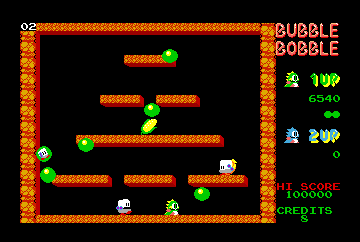
- Modern Web & HTML5 / WebAssembly Architecture: With the release of Taito Legends (Windows PC) in 2005, Taito accurately emulated the authentic 1986 arcade ROM on modern desktops. Today, powered by WebAssembly and Emscripten frameworks on Archive.org and modern HTML5 engines, Bubble Bobble runs natively inside Chrome, Firefox, and Safari at full 60 Hz responsiveness with seamless two-player local keyboard inputs.
Platform Comparison Matrix
| Technical Standard | Arcade (Taito Original 1986) | Commodore 64 (Software Creations 1987) | Commodore Amiga (Firebird 1988) | Windows 95 (Probe/Acclaim 1996) | Modern Web (HTML5 / WebAssembly) |
|---|---|---|---|---|---|
| Processor & Architecture | 2x Zilog Z80 @ 6 MHz [1] | MOS Technology 6510 @ 0.985 MHz [4] | Motorola 68000 @ 7.09 MHz [3] | Intel Pentium / Win95 (DirectX/WinG) [5] | WebAssembly VM / Browser Thread |
| Resolution & Palette | 256x224 (Broad Palette) | 160x200 Multicolor (16 Colors) | 320x200 OCS (32 Colors) | 640x480 Scaled SVGA (256 Colors) | Original Aspect Ratio / WebGL Canvas |
| Framerate & Sync | 60 Hz Seamless Sync | 50 Hz PAL Hardware Multiplexing | 50 Hz Smooth Double Buffering | Variable Windows Timer (~60 Hz) | requestAnimationFrame (Solid 60 Hz) |
| Sound Architecture | Yamaha YM2203 + Oki MSM5205 | MOS 6581 SID (Peter Clarke) [4] | MOS 8364 Paula (4-Channel DMA Stereo) [3] | Red-Book CD-Audio / MIDI / DirectSound | Web Audio API (Lossless Chiptune / PCM) |
| Gameplay & Co-Op | Reference Standard (2 Players) | Exceptional Joystick Responsiveness | Fluid Two-Player Keyboard/Joystick | DirectInput Keyboard / Gamepad | Simultaneous Two-Player Keymap |
Contemporary Significance: Lessons from a 100-Room Legacy
In hundreds of single-screen platformers produced by modern independent game developers—such as Super Meat Boy, TowerFall, and Celeste—the core design formula established by Fukio Mitsuji in 1986 remains evident: simple movement mechanics, strict physics, and deep layers of hidden mastery.
Bubble Bobble demonstrated that video games need not serve merely as competitive endurance tests, but can function as shared spaces built on human connection.
Perhaps the reason Bubble Bobble remains timeless after four decades lies not in its colorful bubbles, but in that uncompromising 100th room—a sanctuary that refuses to open its doors to any victor standing alone.
Two questions to consider today:
- As modern gaming shifts toward remote online lobbies, have we lost the irreplaceable intimacy of sitting shoulder to shoulder on a shared couch?
- What does a game that openly refuses solitary triumph say to an industry increasingly obsessed with individual achievements and solo rankings?
Verified Archival Sources:
[1] Arcade-History & Taito Design Documents: Fukio Mitsuji (MTJ) Bubble Bobble design philosophy, secret rooms, and dual player ending analysis. Arcade-History Entry #340
[2] VGMdb & Zuntata Official Archives: Tadashi Kimijima original arcade soundtrack credits and audio engineering records. VGMdb Zuntata History
[3] Hall of Light (HOL): Bubble Bobble Commodore Amiga technical specification, Software Creations development credits. Hall of Light Record #224
[4] Lemon64 & C64.com Archives: Stephen Ruddy programming notes and Peter Clarke MOS 6581 SID adaptation history. Lemon64 Entry #371
[5] MobyGames Archive: Bubble Bobble also featuring Rainbow Islands (Windows 95, Probe Entertainment / Acclaim, 1996) technical release data. MobyGames ID #4346