 EN
 TR
 DE
 FR
 ES


| Title | Turrican II: The Final Fight |
|---|---|
| Original Developer | Rainbow Arts / Factor 5 (Lead Designer: Manfred Trenz) |
| Publisher | Rainbow Arts |
| Release Year | 1991 |
| Legendary Composer | Chris Hülsbeck (MOS 6581 SID & Paula 8364 Sound Architecture) |
| Verified Platforms | Commodore 64, Amiga 500, Atari ST, MS-DOS, CDTV, ZX Spectrum |
| Genre | Action / Run & Gun Platformer |
In the spring of 1991, video gaming stood at a generational crossroads. While 16-bit consoles like the Sega Genesis and Super Nintendo dominated storefront windows, home computer engineers were locked in an intense battle: pushing the 64-kilobyte ceiling of the Commodore 64 on one side, and wrestling with the custom coprocessor architecture (Blitter and Copper) of the Amiga 500 on the other.[1]
During this pivotal transition, an independent German development house named Factor 5, together with visionary designer Manfred Trenz, crafted a title that claimed the undisputed crown of action platforming across both 8-bit and 16-bit computing: Turrican II: The Final Fight.[1][2]
🖼️ Platform Face-Off: Visual & Architectural Showcase
How did the exact same game manifest across two divergent hardware generations? Below is the side-by-side architectural comparison based on authentic archive captures:
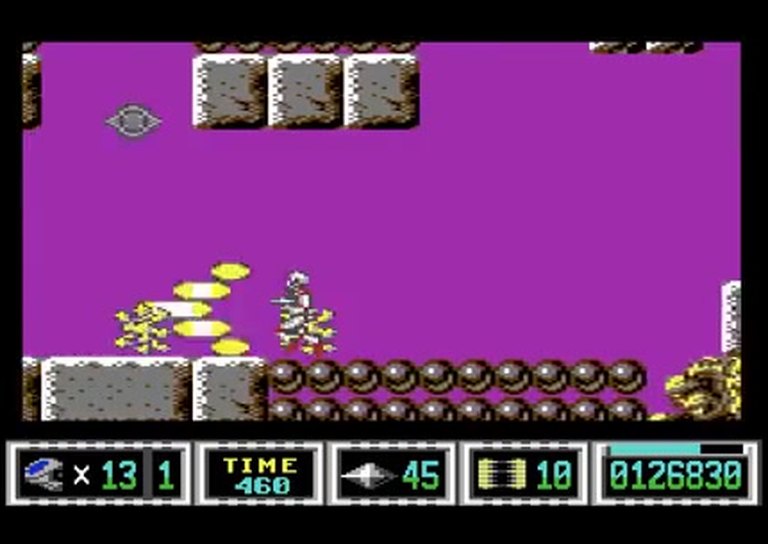
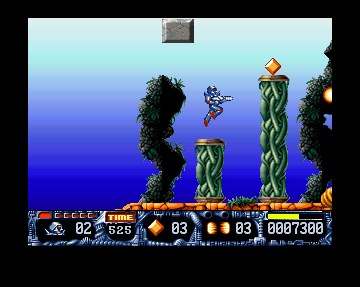
📊 Hardware Architecture & Audio Chip Comparison Matrix
Comparative hardware metrics across verified platforms for Turrican II:
| Platform | Resolution & Colors | Audio Architecture | Media Format | Key Engineering Highlight |
|---|---|---|---|---|
| Commodore 64 | 160×200 (Multicolor 16 Colors) | MOS 6581 SID (3-Channel Analog Filter Synth) | 1× 170 KB Floppy (.D64) | Software border removal and full multidirectional parallax scrolling. |
| Amiga 500 | 320×256 (32 Colors OCS / 4096 Palette) | Paula 8364 (4-Channel 8-bit DMA Stereo) | 2× 880 KB Floppies | Locked 50 FPS refresh, multi-screen mechanical bosses, and 21-track symphonic score. |
| Atari ST | 320×200 (16 Colors / 512 Palette) | Yamaha YM2149 (3-Channel PSG) | 2× 720 KB Floppies | Visual assets ported from Amiga; software-driven scrolling compensation. |
| MS-DOS | 320×200 (256-Color VGA) | AdLib / Sound Blaster 16 | 1× 1.44 MB Floppy | Vibrant 256-color VGA palette with AdLib FM synthesis and digitized FX. |
📖 Narrative Architecture & Legendary Gameplay Mechanics
When the deep-space exploratory vessel Avalon 1 is ambushed by galactic bio-mechanical tyrant "The Machine", the entire crew is obliterated. Sole survivor Bren McGuire discovers the prototype Turrican II assault suit inside the wreckage, deploying directly onto the warlord's fortress planet.[1]
Master composer Chris Hülsbeck delivered benchmark soundscapes across both Commodore platforms. Using his custom **TFMX (The Final Musicsystem eXtended)** engine on Amiga, Hülsbeck multiplexed Paula's 4 DMA channels into a virtual 7-channel mixer, allowing sound effects to fire simultaneously without cutting off musical melodies—a technical breakthrough at the time.[1][4]
Following Turrican II's European critical acclaim, American publisher Accolade acquired the video game adaptation rights to Jean-Claude Van Damme's 1992 action blockbuster Universal Soldier.
> SOURCE_CORE: TURRICAN II ENGINE (FACTOR 5)
> MODIFICATION: BREN MCGUIRE → PIXEL VAN DAMME // BIO-MECH ENEMIES → MILITARY TERRORISTS
Rather than developing a movie tie-in from scratch, Accolade purchased the console publishing rights to Turrican II. Manfred Trenz and Factor 5's original Bren McGuire sprite was stripped away and replaced with a digitized likeness of Jean-Claude Van Damme, while robotic enemies were redrawn as mercenaries and tanks.
The altered title shipped to Sega Genesis and Game Boy retail shelves branded as "Universal Soldier", standing today as one of the most curious stealth rebrandings in retro gaming history.[1]
Because Turrican II is a copyrighted commercial classic, DigiLiner does not host direct .adf or .d64 image downloads. Explore our verified platform databases and academic preservation records below: