 EN
 TR
 DE
 FR
 ES
MONKEY ISLAND 2: LECHUCK'S REVENGE
The Summit of Skywalker Ranch, the Invention of iMUSE, and an 11-Disk Caribbean Odyssey
| Director & Lead Author | Ron Gilbert (Lucasfilm Games / LucasArts) |
|---|---|
| Designers & Dialogue | Tim Schafer, Dave Grossman (SCUMM Engine v5) |
| Art Direction & Backgrounds | Peter Chan, Steve Purcell (Hand-Painted & Scanned 256-Color VGA) |
| iMUSE Audio Architecture | Michael Land, Peter McConnell, Clint Bajakian (Roland MT-32 & AdLib) |
| Initial Release Date | December 1991 (MS-DOS VGA 256 Colors), 1992 (Amiga 500 / Mac OS) |
| Archive Preservation IDs | DOSBox: monkey2 | Amiga TOSEC: Monkey_Island_2.zip (11 Floppy Disks) |
Autumn 1991. The sun-drenched hills of Marin County, California, home to George Lucas’s Skywalker Ranch. Inside the LucasArts adventure division, three brilliant young authors—Ron Gilbert, Tim Schafer, and Dave Grossman—gathered around dry-erase boards to shape the boldest sequel in interactive fiction. The naive, clean-shaven youth from the first chapter was gone. In his stead stood a Guybrush Threepwood sporting stubble, a dashing blue trenchcoat, a pouch brimming with plundered gold, and a surplus of swagger as he set foot on the gloomy shores of Scabb Island.
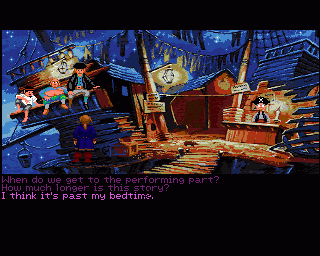
The tale opens in media res: Guybrush dangles by a fraying rope over a bottomless void, recounting his misadventures to Elaine Marley: "It all began with the search for the treasure of Big Whoop..." This time, LucasArts held nothing back. Artists Peter Chan and Steve Purcell composed lush watercolor and gouache landscapes on physical canvas, digitized through 256-color scanners. Sound wizards Michael Land and Peter McConnell patented iMUSE, revolutionizing non-linear musical scoring. And for Amiga owners, an epic saga spanning a monumental 11 floppy disks was born.
Turning Point 1: The Interactive Scoring Leap (The Invention of iMUSE)
Until 1991, video game music functioned like a rigid jukebox. Entering a new room prompted an abrupt track cut, a brief silence, and a jarring restart. This disjointed architecture stood as a major barrier against cinematic pacing.
LucasArts composers Michael Land and Peter McConnell solved this challenge by engineering iMUSE (Interactive MUsic Streaming Engine). Strolling through the pirate haven of Woodtick showcased its brilliance: Guybrush’s breezy acoustic theme played outside on the docks, but as he stepped into the carpenter’s workshop, the music never restarted. Instead, on the exact musical beat, sawing percussion and banjo licks seamlessly folded into the melody. Approaching the bar where Largo LaGrande lurked gently modulated the harmony into an ominous accordion minor key.
iMUSE translated the player's spatial movement into a responsive orchestral score. For gamers equipped with a Roland MT-32 multi-timbral MIDI sound module, Monkey Island 2 delivered the most luxuriant auditory landscape ever heard on a home computer.
Turning Point 2: Scanned Canvases and Caribbean Baroque
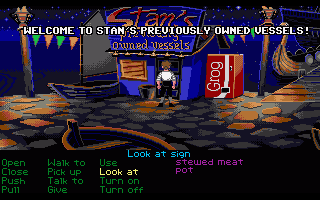
The rigid grid-based environments of earlier graphic adventures gave way to physical painterly craft. Rather than assembling scenes pixel-by-pixel, Peter Chan and Steve Purcell painted sprawling backgrounds using traditional watercolors and gouache. Crooked pirate shacks, moss-draped roofs, the driftwood harbor of Woodtick, and the imposing governor's mansion on Phatt Island felt tangible.
These physical artworks were digitized with cutting-edge color scanners and mapped into SCUMM’s walkable perspective matrices. The Caribbean ceased being a digital abstraction; it felt like stepping into an illuminated storybook.
The puzzles mirrored this narrative confidence: adjusting for wind direction with colored drinks in a spitting competition, employing a literal monkey as a wrench to shut off an island’s water pump, and reassembling four map fragments from dusty crypts. It was an inspired blend of lateral logic and sharp comedic theater.
The game reaches its climax in a subterranean chase where zombie LeChuck stalks Guybrush through pitch-black service tunnels. Striking down LeChuck with brute force is futile; the only escape requires consulting the Voodoo Lady's recipe to gather four intimate ingredients (something of the thread, something of the head, something of the bone, and something of the body) to sew a voodoo effigy. The rising musical tempo and claustrophobic pacing represent one of adventure gaming's greatest dramatic triumphs.
Turning Point 3: The Surreal Theme Park Finale That Shook the Industry
In all of video game history, few endings have ignited as much passionate debate as the climax of Monkey Island 2. After impaling LeChuck’s voodoo doll in the service tunnels, the dreaded zombie collapses and implores Guybrush to remove his mask. Underneath lies his brother Chuckie!
Suddenly, the shadowy catacombs morph into the back-alleys of an amusement park (the Big Whoop Theme Park). Two ordinary young boys in modern clothing emerge into the daylight as their parents approach: "Where have you two been? Come on, let's ride the Mad Hurricane." Guybrush glances toward the camera, Chuckie’s eyes glow with demonic red embers, and the screen fades to black.
Was the entire Caribbean saga merely the runaway fantasy of two children in a suburban theme park, or had LeChuck cast a sinister hex over Guybrush’s psyche to trap him in a surreal illusion? Ron Gilbert's metaphysical cliffhanger elevated video game storytelling into genuine modern art.
Hardware & Architectural Comparison
| Technical Characteristic | MS-DOS (VGA 256 Colors / Roland MT-32) | Commodore Amiga 500 (OCS / ECS) |
|---|---|---|
| Display Resolution & Palette | 320x200 (256-Color MCGA / VGA Palette) | 320x200 (32-Color with Extra Half-Brite Shading) |
| Background Asset Pipeline | Scanned Watercolor / Gouache Paintings | Dithered 32-Color Scaled Paintings |
| Audio Architecture & Engine | iMUSE Driven Roland MT-32 / AdLib Synthesizer | iMUSE Driven Paula 8364 (4-Channel 8-bit PCM) |
| Storage Footprint & Media | Hard Drive Installation (~12 MB Footprint) | 11 Standard 880 KB Floppy Disks |
| Interaction Model | Mouse Point-and-Click (SCUMM v5 Interface) | Mouse Point-and-Click (SCUMM v5 Interface) |
| Difficulty Setting | Lite Mode (Streamlined) & Regular Mode (Full Puzzles) | Lite Mode (Streamlined) & Regular Mode (Full Puzzles) |
Decision Support Matrix: Experiencing MI2 Today
| Platform / Flavor | Target Audience | Key Advantages | Constraints & Caveats |
|---|---|---|---|
| ScummVM + Roland MT-32 Emulation (PC/Mac) | Purists seeking the definitive 1991 aesthetic and authentic iMUSE score | Flawless iMUSE dynamic transitions, pristine 256-color VGA art, rich MT-32 synth | Requires ScummVM setup and MT-32 ROM configuration |
| Special Edition (Steam / GOG / Modern Consoles) | Gamers desiring voice acting (Dominic Armato), modern hints, and accessibility | Full voice acting, modernized artwork, instant toggle to classic mode | Updated art smooths over the tactile, painterly texture of the 1991 originals |
| Original Amiga (WHDLoad) | Retro enthusiasts wanting to experience Paula sound and EHB visuals | Unique Amiga color dithering warmth, authentic Paula audio | Playing via floppies is grueling; a hard drive WHDLoad setup is essential |
In strict observance of DigiLiner's preservation charter, no commercial game binaries are hosted on our servers. Verified historical records may be accessed via these trusted public institutions:
Monkey Island 2: LeChuck's Revenge is far more than a witty pirate yarn; through its scanned gouache landscapes, pioneering iMUSE architecture, and daring surreal finale, it stands as an enduring high point of adventure storytelling.
One lingering question: as zombie LeChuck closes in through the pitch-black tunnels while you assemble the final voodoo charm, are you a swashbuckling pirate conquering destiny, or just a lost boy wandering behind an amusement park?