




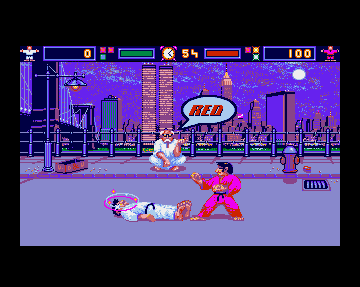
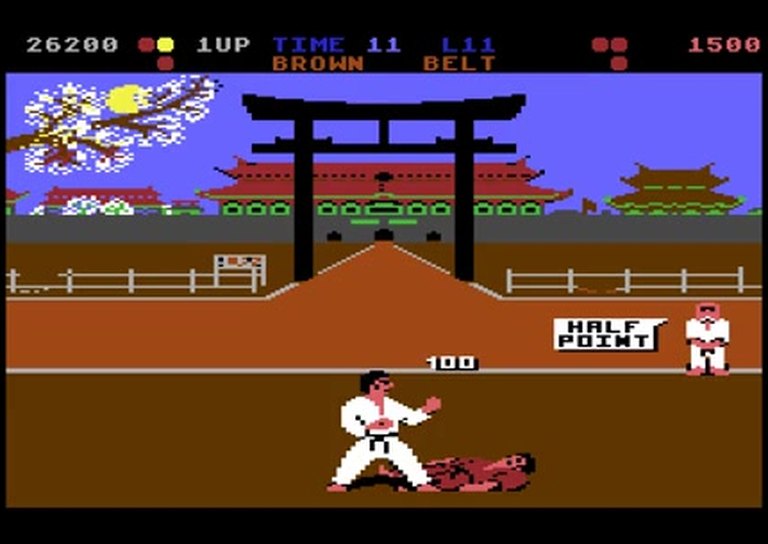
// SYSTEM DOSSIER: INTERNATIONAL KARATE + (IK+) (1987)
| Developer / Publisher | Archer Maclean / System 3 Software Ltd. |
|---|---|
| Lead Design, Code & Animation | Archer Maclean (Solo 6502 Assembly Visionary) |
| Original Music (SID) | Rob Hubbard (Historic Sydney Sunset Masterpiece) |
| Target Platforms | Commodore 64 (Original), Amiga, Atari ST, ZX Spectrum, Amstrad CPC |
| Genre & Player Capacity | Martial Arts / 3 Simultaneous Fighters (2 Human + 1 CPU or 1 Human + 2 CPU) |
| Accolades & Legacy | Zzap!64 Gold Medal (97%); The Gold Standard of 8-Bit Martial Arts |
Summer 1987. Sunset over Sydney Harbour. Across the screen, the glowing orange-crimson rays of the setting sun danced over rippling water, illuminating the white sails of the Sydney Opera House. From the television speaker emerged Rob Hubbard's legendary MOS 6581 SID composition, interweaving Far Eastern modal scales with driving progressive synthesizer rhythms. In the foreground, three martial artists in white, red, and blue gi stood poised, awaiting the referee's decisive command: "HAJIME!"
Until that moment, fighting games adhered to a rigid convention: one player on the left, one player on the right, exchanging punches across a flat horizontal axis. British programmer and animator Archer Maclean challenged that status quo with a revolutionary proposition: "What happens if there are not two, but three fighters clashing simultaneously in the arena?" That singular breakthrough birthed the legend of International Karate + (IK+).
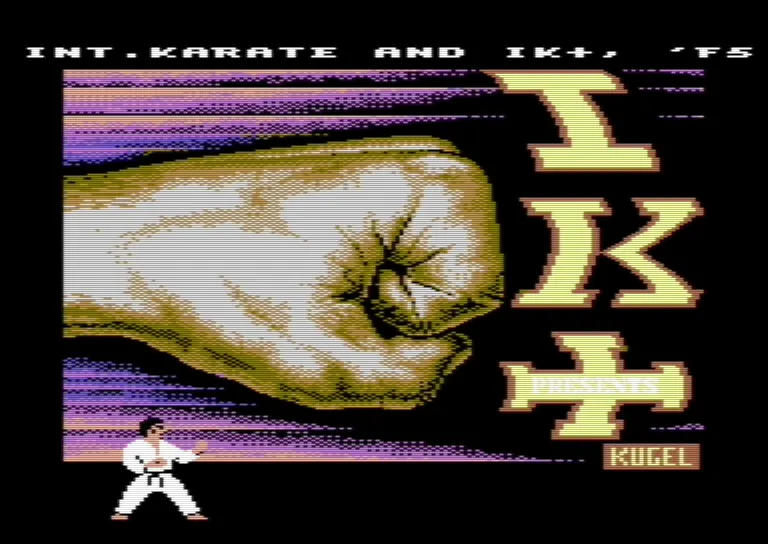
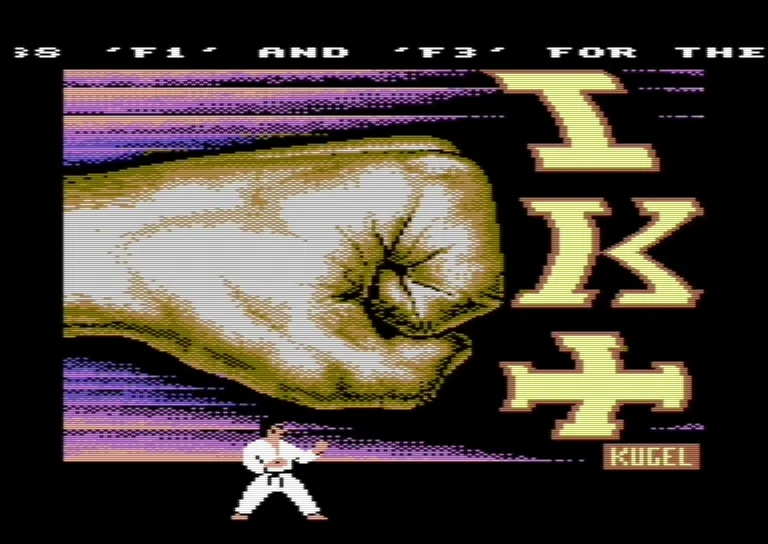
Turning Point One: The Daring Shift from Dual Duels to Three-Way Chaos
The first turning point. Canonical martial arts games like Karate Champ and The Way of the Exploding Fist relied on symmetric 1v1 tension. Archer Maclean dismantled this symmetry by adding a third fighter to the mat. In IK+, every bout featured three combatants: two human players seated side by side accompanied by a relentless CPU opponent, or a single player braving two artificial intelligences at once.
The scoring mechanism altered the psychology of digital combat: the first two fighters to accumulate 6 points advanced to the next round, while the lowest scorer was eliminated. This rule sparked rich strategic improvisation:
- Fragile Alliances: Two human players could flank the computer opponent, sandwiching the AI with coordinated high kicks.
- Sudden Betrayals: The instant the AI fell, a friend would pivot without hesitation to land a spinning reverse kick to your ribs, seizing the decisive point.
- 360-Degree Spatial Awareness: Striking forward while anticipating a sweep from the opponent behind you demanded complete spatial mastery and instinctive reflexes.
Turning Point Two: Archer Maclean's Physics and the Art of Deflecting Balls
The second turning point: the physical weight of pixels. Maclean studied martial arts footage frame by frame to design the animation routines. Despite the modest clock speed of the MOS 6510, he accurately modeled the center of gravity, rotational momentum, and the puff of dust rising as a fallen athlete struck the timber deck. Every technique—headbutts, roundhouse kicks, sweeps, backflips, and lunging punches—responded instantaneously with zero input latency.
Beyond fighting, IK+ included the legendary "Bouncing Ball" bonus stage, one of gaming's greatest tests of rhythmic reflex. Holding a small hand shield, the player deflected bouncing iron balls hurled simultaneously from left and right. The trajectory physics, bouncing angles, and visual clarity stood as a triumph of real-time 8-bit engineering.
To overcome hardware sprite limitations on the Commodore 64, Archer Maclean engineered a hybrid multiplexing routine that preserved background clarity while three full fighters battled:
$2000 - $3FFF: Fighter Sprite Frame Banks (3 Distinct Belt & Uniform Sets)
$4000 - $5FFF: Pixel-Accurate Hitbox Collision Tables & Stumble Detection
$8000 - $9FFF: Rob Hubbard SID Music Engine & Dynamic Bell Harmonics
$A000 - $BFFF: Threat Assessment AI Matrix & Flanking Movement Logic
Maclean peppered the software with delightful Easter eggs: pressing 'T' caused the fighters' trousers to drop, flies buzzed across the sky, fish leaped from the harbour, and tiny Pac-Man figures darted through the twilight backdrop, cementing the title's charismatic identity.
Turning Point Three: Rob Hubbard's Sydney Opera House Masterpiece
The third turning point: Rob Hubbard's soundtrack. Where contemporary brawlers relied on aggressive, fast-tempo loops, Hubbard composed an expansive, atmospheric overture. Opening with echoing temple gongs, the track utilized the MOS 6581 SID chip's three sound channels to weave Asian musical themes with contemporary 1980s synth-bass arpeggios.
The rhythmic bassline set the heartbeat of the tournament, while poignant lead melodies elevated the contest into a cinematic spectacle. Awarded a 97% Gold Medal by Zzap!64 magazine, IK+'s sonic identity solidified its immortal standing in computer history.
| Platform Port | Graphics & Color Palette | Audio Hardware & Arrangement | Physics Speed & Combat Responsiveness |
|---|---|---|---|
| Commodore 64 (1987) | 320x200 Multicolor Mode. Iconic Sydney sunset pixel art. | MOS 6581 SID. Rob Hubbard's historic analog synth masterpiece. | Locked 50 frames/sec (50 Hz). Flawless hit detection and zero lag. |
| Commodore Amiga (1988) | 32-Color OCS Palette. Drifting clouds, animated water, rich crowd. | MOS Paula (4-Channel PCM). Dave Lowe arrangement and punchy audio samples. | Fluid 16-bit performance; character collisions feel slightly softer than C64. |
| Atari ST (1988) | 16-Color High Contrast. Visually very close to the Amiga release. | Yamaha YM2149 Sound Chip. Lacks the analog resonance of the SID. | Crisp and responsive controls; delivers robust arcade immediacy. |
| ZX Spectrum (1987) | Monochrome sharpness avoiding distracting colour clash. | Beeper or AY-3-8912 (128K). Functional, clear combat audio cues. | Remarkably swift engine; effortlessly animates three fighters on screen. |
Hardware Decision Matrix: How Should You Experience It Today?
| User Profile | Recommended Platform | Architectural Justification |
|---|---|---|
| Pure SID Magic & Authentic Gameplay Timing | Commodore 64 (Original Silicon / TheC64 / VICE) | Rob Hubbard's unfiltered 6581 SID synthesis combined with Maclean's direct 6502 assembly input polling. |
| Rich Visual Detail & Stereo Ambiance | Commodore Amiga (Amiga 500 / FS-UAE) | 32-color pictorial richness, animated Sydney waterfront details, and digitized stereo effects. |
| Head-to-Head Multiplayer Tournament | C64 / Amiga Dual-Joystick Setup | The unmatched psychological thrill of two friends competing alongside an unpredictable AI wildcard. |
International Karate + proved that fighting games need not rely on memorizing labyrinthine button combinations. When grounded in impeccable timing, spatial intuition, and physical weight, simple mechanics achieve timeless elegance. Archer Maclean's pixel mathematics and Rob Hubbard's sunset melodies represent a pinnacle of 8-bit computer culture.
Revisiting IK+ today brings two central questions to mind:
- Did the unpredictable three-way chaos of IK+ deliver a more vibrant, spontaneous thrill than the sterilized competitive modes of modern fighting titles?
- Can any computer gamer truly claim to know the spirit of the 1980s without having fought before the Sydney Opera House while Rob Hubbard's melodies echoed across the screen?
Verified Sources & Archival References:
[1] Maclean, A. (1987). The Programming and Physics of International Karate +, Zzap!64 Magazine Issue 32, pp. 12-15. Archive: Archive.org Zzap!64 Issue 32.
[2] Hubbard, R. (1987). International Karate + Soundtrack Composition Diary, C64 Audio Archives. Source: Rob Hubbard Official SID Archives.
[3] Lemon64 Database (2024). International Karate + Comprehensive Community & Historical Archive. Source: Lemon64 IK+ Catalog.