 EN
 TR
 DE
 FR
 ES
🕹️ DigiLiner Retro Dossier: This review is part of our MS-DOS preservation archive in the Retro Games Catalog.
The year was 1999. Silicon Valley and the PC gaming industry were entranced by 3D hardware.
Retail shelves were lined with 3dfx Voodoo3 and Nvidia RIVA TNT2 accelerators. Glossy magazines hailed DirectX 7 and multi-gigabyte installs. MS-DOS had been declared dead—no longer recognized as a viable gaming platform, but merely a monochrome command prompt beneath Windows 98.
Yet that very year, a compact executable published under the PLBM Games banner lured thousands of gamers away from windowed desktops and straight into the adrenaline of raw DOS execution: Ack-Ack Attack.
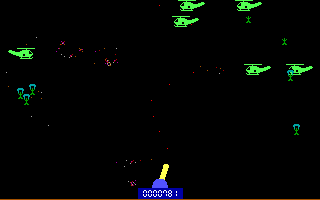
Developer Kurt W. Dekker needed no 3D accelerator cards. All he required was the classic 320×200 Mode 13h VGA canvas, a Sound Blaster card, and a merciless design rule that tested player reflexes to the brink: The 4-Paratrooper Rule.
⚡ Ack-Ack Attack (1999) Verified Archive Credentials
First Twist: The 1982 Sabotage Formula Reborn 17 Years Later
While younger players in 1999 viewed Ack-Ack Attack as a fresh arcade blast, its core DNA reached back to the origins of home computing: Mark Allen's 1982 Apple II classic Sabotage and its ubiquitous PC counterpart Paratrooper.
Positioned in the lower-center of the screen, you control a dual-cannon 40mm anti-aircraft emplacement aiming across a 180-degree sweep. Overhead, C-130 transport aircraft, stealth bombers, and assault choppers crisscross the sky dropping paratroopers at erratic altitudes. Dekker revitalized the concept with 256-color VGA vibrancy, tracer smoke trails, and deep Sound Blaster concussions.
Second Twist: The 4-Paratrooper Human Pyramid
Beginners instinctively fire at high-speed aircraft. Seasoned defenders know the real existential crisis lies on the ground.
A player could choose to target paratroopers directly or clip their canopies, sending them into free-fall. But if four paratroopers landed safely on either flank of the bunker, they enacted the iconic fail-state: stacking atop one another into a human ladder, climbing into the cockpit, and dropping a grenade into the turret. This created a razor-sharp risk-reward loop where players had to prioritize low-altitude threats over passing planes.
Third Twist: Twilight of the Shareware Distribution Model
Ack-Ack Attack stood as one of the final representatives of the 1990s Shareware tradition. PLBM Games distributed the core playable demo freely across BBS systems, CD-ROM compilations, and early web archives. Players ordered the registered version via mail-order checks to unlock night operations, advanced heavy bomber squadrons, and secondary weapon upgrades.
The Verdict: The Enduring Power of Focused Arcade Design
Modern air defense simulations boast millions of polygons and complex radar models. Yet Kurt W. Dekker's 1999 defense gem demonstrates the fundamental law of timeless game design: great arcade gameplay requires no convoluted menus—only a flawless core loop and an unyielding, fair rule of engagement.
The spirit of retro arcade gaming resides not in the complexity of its technology, but in that breathless split-second when you pivot your cannon just before the fourth paratrooper hits the dirt.
[1] PLBM Games Archive & Kurt W. Dekker Developer Documentation, 1999.
[2] DOSGames Archive: Ack-Ack Attack Verified Record Entry.
[3] MobyGames: Ack-Ack Attack (1999) Technical and Publishing Credits.
[4] Allen, Mark. "Sabotage (1982) Apple II Architecture", Software Preservation Archive.