 EN
 TR
 DE
 FR
 ES
When you purchase a 3D printer, you quickly discover that the machine cannot operate in isolation. Transforming a digital concept into a tangible physical object requires an integrated, four-stage software pipeline. Even when downloading ready-to-print 3D models from community repositories, converting those geometries into machine motor instructions (G-code) and correcting potential mesh anomalies remains essential.
In this comprehensive guide, we dissect every software layer involved in desktop fabrication, highlighting industry standards, powerful open-source alternatives, and the exact role each tool fulfills along the production pipeline.
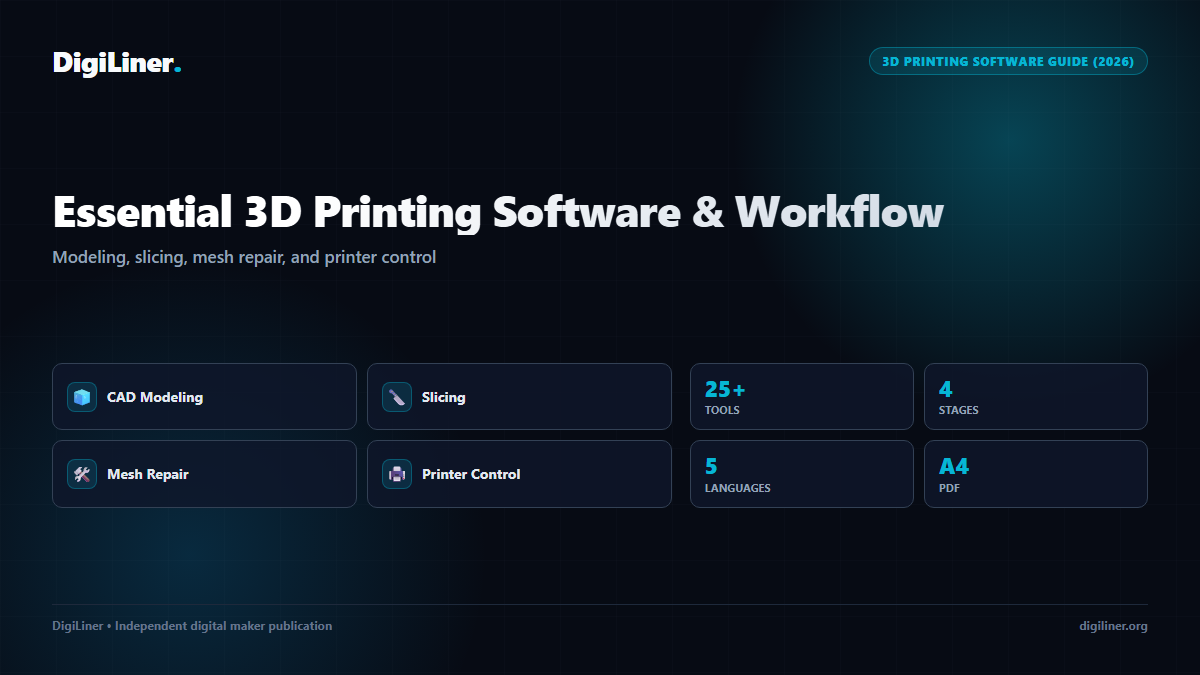
The 4 Core Stages of the 3D Printing Software Ecosystem
| Stage | Core Purpose | File Output | Leading Tools |
|---|---|---|---|
| 1. Design & CAD | Drafts and constructs the 3D geometry from scratch | .step, .stl, .3mf | FreeCAD, Autodesk Fusion, Tinkercad, Blender |
| 2. Mesh Repair | Fixes non-manifold edges, flipped normals, and holes | .stl, .3mf | Microsoft 3D Builder, Meshmixer, Prusa Repair |
| 3. Slicing (Slicer) | Divides the mesh into planar layers and machine motion paths | .gcode, .ufp | PrusaSlicer, OrcaSlicer, Bambu Studio, Cura |
| 4. Control & Host | Streams machine commands, monitors temperatures and video | Real-time Serial / TCP | OctoPrint, Klipper (Mainsail / Fluidd) |
Stage 1: 3D Design and CAD Software (Geometry Authoring)
Every fabrication workflow begins with a three-dimensional model. The optimal design environment depends directly on the functional requirements of your target print:
A. FreeCAD (Open-Source Parametric Engineering)
License: 100% Free & Open Source (LGPL-2.0+)
Core Function: Engineered for functional, dimensionally precise mechanical components. Because it is fully parametric, adjusting a single constraint or dimension cascades through the entire model tree automatically.
Ideal For: Replacement parts, gears, custom brackets, electronics enclosures.
Official Site: freecad.org
B. Autodesk Fusion (Cloud-Connected Professional CAD/CAM)
License: Proprietary (Free tier available for non-commercial personal use)
Core Function: Delivers professional parametric solid modeling, multi-component assembly verification, and integrated CAM toolpaths.
Ideal For: High-precision engineering mechanisms, complex assemblies.
Official Site: autodesk.com/fusion-360
C. Tinkercad (Browser-Based Entry-Level Modeler)
License: Free (Cloud-hosted web application)
Core Function: Uses intuitive constructive solid geometry (CSG) to combine geometric primitives and cutouts into solid models without local installation.
Ideal For: Educational environments, introductory design tasks, and rapid prototyping.
Official Site: tinkercad.com
Stage 2: Mesh Repair and STL Optimization Tools
Raw .stl files exported from polygonal tools frequently suffer from non-manifold geometry, self-intersecting facets, or inverted surface normals. Feeding defective meshes to a slicer results in missing layers, unextruded perimeters, or toolpaths floating in mid-air.
A. Microsoft 3D Builder
License: Free (Windows native application)
Core Function: Outstanding automated manifold repair. When opening a defective STL, a prompt appears to repair inverted normals and micro-holes with a single click via an exceptionally robust voxelization algorithm.
Official Site: apps.microsoft.com
B. Autodesk Meshmixer
License: Free desktop utility
Core Function: Essential for plane cuts, adding alignment pins to large models that exceed build plates, hollowing dense volumes, and placing drainage holes for resin printing.
Official Site: meshmixer.com
Stage 3: Slicing Software (Toolpath Generation)
The slicer is the computational brain of the additive manufacturing process. It converts continuous 3D surfaces into discrete horizontal layers, computes internal infill structures, calculates thermal profiles, and outputs the exact sequence of G-Code commands for step motors and extruders.
A. PrusaSlicer (Open-Source Benchmark)
License: Open Source (GNU GPLv3)
Key Strengths: Class-leading organic tree supports, paint-on support interfaces, adaptive layer height calculation, and extensive presets for both Prusa hardware and third-party desktop printers.
Official Site: prusa3d.com/prusaslicer
B. OrcaSlicer (Community-Driven Performance Powerhouse)
License: Open Source (GNU AGPLv3)
Key Strengths: Forked from Bambu Studio and PrusaSlicer, OrcaSlicer has emerged as the premier independent slicer. It integrates native calibration routines (flow rate, pressure advance, temperature towers), multi-bed build plates, and direct Klipper socket integration.
Official Site: orcaslicer.com
C. Bambu Studio
License: Open Source / Hybrid
Key Strengths: Multi-material color painting (AMS), project-based multi-plate management, and seamless cloud/LAN synchronization.
Official Site: bambulab.com/download/studio
D. Ultimaker Cura
License: Open Source (LGPLv3)
Key Strengths: The most established slicing ecosystem, offering over 400 granular printing settings and an extensive third-party plugin repository.
Official Site: ultimaker.com/software/ultimaker-cura
Stage 4: Hardware Control and Host Systems (Remote Management)
Rather than physically juggling SD cards, modern additive workflows rely on network-attached print servers and high-speed motion firmware:
A. OctoPrint (Web-Based Print Server)
License: Open Source (GNU AGPLv3)
Core Function: Typically deployed on a single-board computer like a Raspberry Pi. Delivers full browser-based print initiation, real-time thermal telemetry, live webcam monitoring, and AI failure detection plugins like Obico.
Official Site: octoprint.org
B. Klipper + Mainsail / Fluidd (High-Speed Motion Architecture)
License: Open Source (GPLv3)
Core Function: Offloads heavy trajectory kinematics from the printer’s 8-bit or 32-bit microcontroller to a dedicated Linux host. Features such as Input Shaping (resonance cancellation via ADXL345) and Pressure Advance deliver high-speed printing without ghosting.
Official Site: klipper3d.org
Decision Matrix: Which Tool Fits Your Needs?
| Operational Goal | Recommended Software | Primary Benefit |
|---|---|---|
| Parametric technical parts & enclosures | FreeCAD | Exact dimensioning, zero license fees, open format storage |
| Repairing damaged STL mesh geometry | Microsoft 3D Builder | One-click automated surface healing and manifold closure |
| Print preparation & organic supports | OrcaSlicer / PrusaSlicer | Clean support generation and built-in calibration prints |
| Remote web monitoring & camera streaming | OctoPrint | Deep plugin ecosystem and headless web interface |
| Maximum velocity with resonance damping | Klipper | Input Shaping eliminates vibration artifacts at high speeds |
🎁 3D Printing Quick Reference Card (Free PDF Download)
Get instant access to our single-page printable reference sheet covering optimal filament temperatures (PLA, PETG, ABS, TPU, Nylon), slicer speed rules, and the 5 most critical troubleshooting remedies:
✓ Instant direct PDF download. No waiting or verification required.
Want to receive our weekly open-source guides, 3D toolkits, and maker digests? Join our mailing list below:
Verified Citations & References
- FreeCAD Project Documentation: Parametric modeling workbenches & STEP/STL export pipelines, FreeCAD.org, 2026.
- IEEE Open Hardware Review: Open source CAD ecosystem for additive manufacturing, IEEE Spectrum, 2025.
- Prusa Research Knowledge Base: Slicing algorithms, organic supports, and G-code generation, Help.Prusa3d.com, 2026.
- RepRap Slicing Benchmark: Analysis of toolpath generation across modern open-source slicers, RepRap Project, 2025.
- OrcaSlicer Documentation: Pressure advance calibration & multi-plate toolpath workflows, GitHub/SoftFever, 2026.
- All3DP Slicer Comparison: Comprehensive technical breakdown of leading FDM and resin slicers, All3DP, 2026.
- OctoPrint Official Documentation: REST API and serial communication standards with Marlin/RepRap, Docs.OctoPrint.org, 2026.
- Raspberry Pi Hardware Compatibility Guides: Single-board computer deployment for 3D printer host servers, RaspberryPi.com, 2025.
- Klipper Official Documentation: Kinematics calculation, stepper execution, and resonance testing with ADXL345, Klipper3D.org, 2026.
- Hackaday Hardware Analysis: Moving motion planning from 8-bit/32-bit MCU to Linux hosts, Hackaday, 2025.